
women’s anthromorphic statue from Gonur Depe, 3rd/2nd millenium BC, in the museum in Mary
During my reading up on things Turkmenistan, ahead of our trip, I had come across a description of Gonur Depe, another archaeological site, even older than Merv. The site was discovered by a Russian-Greek archaeologist, Viktor Saraidini, in 1972, and he spent the rest of his life excavating here. (He died in 2013, well in his 80s). From his work we know that Gonur Depe was one of the Bronze Age settlements along the Murgab River, probably as early as 7000 years BC. The place grew to dominate its surroundings, and some – Viktor, perhaps – equate it to the big Mesopotamian and Egyptian cultures. True or not, it was certainly an impressive culture – of which we have seen artefacts already in the National Museum in Ashgabat. It may also have been the place where the first monotheistic religion in the world was born, Zoroastrianism, whose founder, Zoroaster, may have lived here part of his life

part of the Karakum Canal, irrigating vast parts of the desert

and this is the type of irrigation you get
My source claimed that the site was a bit far away from Mary, two hours’ drive – and two hours back. As it was not in the trip’s itinerary, I made the suggestion to try to include this in the program, not expecting this to be honoured, of course. But lo and behold, Nomadmania and our local travel agency, MS Travel, both being exceedingly flexible, my request was honoured, the program adjusted, and off we went, one early morning, to Gonur Depe.
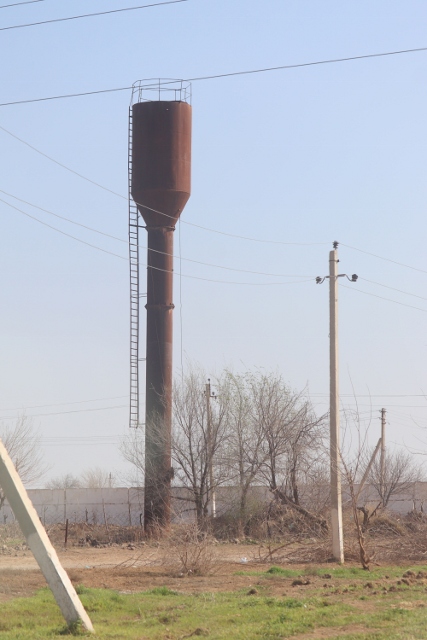
rusty water tower on the way to Gonur Depe

the desert, with little left in terms of irrigation
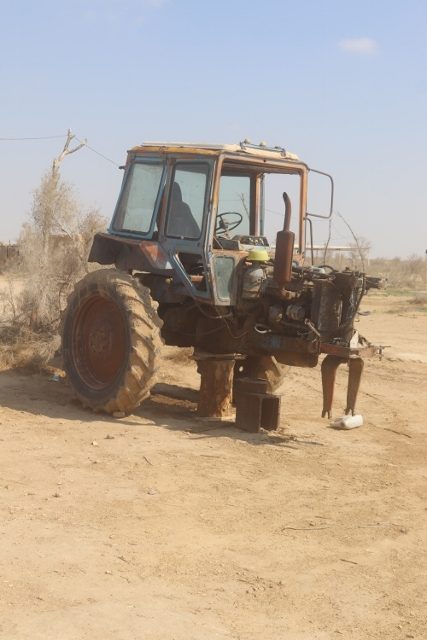
agricultural remnant in the desert
It turned out not two, but closer to four hours’ drive, mostly on unsurfaced roads, again not very good, through the desert. The desert is being cultivated, somewhat, with irrigation channels spreading from the Karakum Canal – an irrigation canal constructed in the 1950s to transport water from the Amur Darya river in Uzbekistan to promote cotton culture, and thereby draining the water meant to flow to the Aral Sea. However, as soon we move further away from the canal, into the desert, the more sand and the less green in became. And after a while the only diversion from the by now rather monotonous countryside was a herd of camels, driven through the desert by what we would have called a gaucho. Hmm. This Gonur Depe thing better be good, I thought, or I will be crucified by the rest of the group.

a Turkmen ‘gaucho’ managing the herd of camels

quite a few camels in fact

who move at an incredible speed
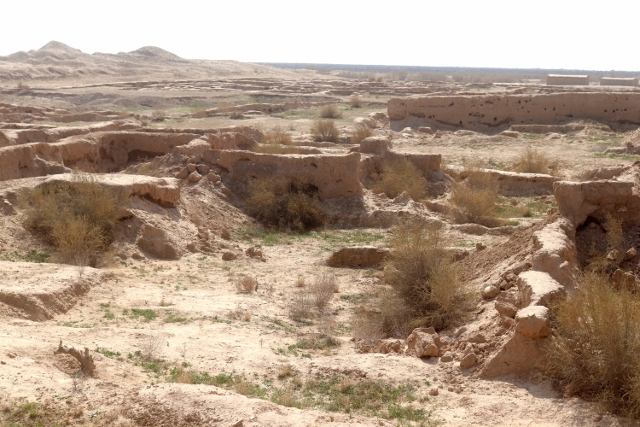
Gonur Depe site, with traces of dwellings and palaces, as far as the eye can see

a small part of the Gonur Depe site has been restored

and these are the original walls, still remarkably well preserved after such a long time

burried pot – imagine, burried 5000 years ago!
It exceeded all expectations! In the middle of nowhere, past some expansive dune fields, we come across a little shed, which is the site office and ticket booth. Our guide gets a set of keys, and off we go, walking, further into the desert, to some immaculately reproduced mud walls. Behind which lays an enormous complex of low walls, not restored. I imagine most of these representing dwellings, and some larger enclosures perhaps palaces, or temples. Being Zoroastrians, the Gonur Depe people would have worshipped the elements, including fire; indeed, we find several locations where traces of fire, in the form of red-coloured remnants of ovens, are visible. Shards of pottery have been left on some of the walls, and in a few places we encounter large pots, still buried in the earth. The excavations here are probably just scratching the surface, this apparently being one of the largest archaeological complexes found in the world.
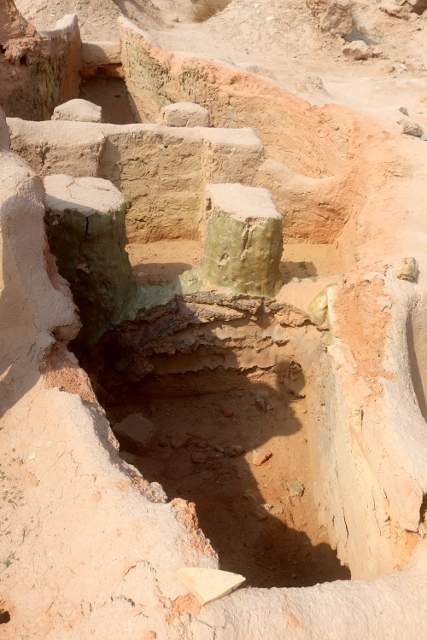
ancient worship structure

probably a Zoroastrian altar, coloured red from burning

same structure, quite large

animal burial, together with mostlt bronze tools, in the Royal necropolis of Gonur Depe

I believe these are the remains of a donkey

this is probably a small camel
At the end we find use of the keys: in two small buildings are the graves of several animals, a horse in one, and three donkeys (?) in the other, together with some explanatory posters in Cyrillic, and further pottery. Somewhat understandably, the best pieces have been transported to the museums, in Ashgabat and in Mary. But being on site, able to wander around this once great city, is an experience in itself. Although I don’t know, really, if it is a good idea to have a group of tourists trampling over a site like this, on and off the fragile walls. At least, for once we are the only once, here, there are no other tourist groups!
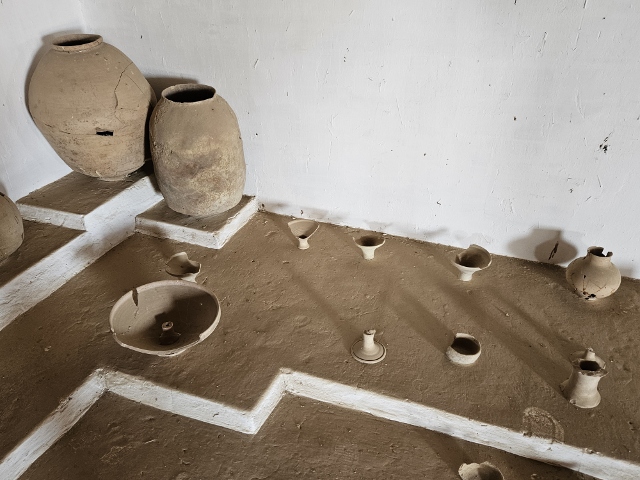
also, in the site museum, a large collection of pots, already made using a pottery wheel (which in Europe had to wait until the 1st C AD)

ceramics from Gonur Depe, 3rd/2nd C BC

and just to prove it was the bronze age – also from Gonur Depe, in the museum of Mary

antromorphic male figurine, Gonur Depe

and a female one

more pottery from Gonur Depe

beautifully decorated with simple animal images
Back in Mary, the flexibility of our group is once again demonstrated, as I suggest that we could perhaps visit the local museum. Not in the program, no time – those two times four hours, remember? – but still, we are given 30 minutes to rush through the place, and try to identify the highlights of the Gonur Depe culture. Unlike the National Museum in Ashgabat, the collection here has not been curated very carefully, and there are lots of artefacts to admire, far too many for 30 minutes. Yet, some amazing pieces are on display, indeed suggesting that this was an important, advanced culture. Which, apparently disappeared around 2000 BC, because the Murgab River changed course, and cut off the source of water for Gonur Depe. Or so we think.
