
one of the decorated graves at the Gozli Ata cemetery, a short distance away from the Yangykala canyons
We head into the Karakum desert, which occupies some 70% of the country. Initially, much of the surface is still covered by some sturdy vegetation, good for camels, sheep and the occasional cow. Although there appears little around, we do come across one of the houses of the first president – why on earth he wanted a house here, is beyond me, and why on earth it is still maintained, there is staff on site, I also fail to understand, but it is there, with a piece of land and a fence surrounding the large building. I can – and do – open the gate, but our guide strongly discourages me from entering the site.

there is not much in the Karakum desert, except for a road – and a motorbike

one of the houses of former president-for-life, now deceased Saparmurat Niyazov, in the middle of nowhere

a bus stop in the absolute middle of nowhere
A little further is a bus stop, completely in the middle of nowhere; I cannot believe there are busses here. But there are, a little later we see one passing. And then we hit upon a village, or hamlet, rather, a handful of houses with a fuel station, and a small supermarket. Our group travels in a convoy of five SUVs, this time, better equipped for the terrain than our mini bus of yesterday. When we stop at the supermarket in the village, another SUV convoy – another tourist group – is already there, stocking up on Pringles and Bounties. So much for our adventure travel to a non-touristic country.

including fire fighting equipment

yet, we also encounter a small hamlet, with supermarket and fuel station

convincing fuel station, that is

this part of the desert doesn’t support much more than the ocacsional small herd of camels
The Canyon
After our brief stop we continue further into the desert, which becomes dryer and dryer, less and less vegetation. On occasion, we encounter small dune fields, but most of the area is just a dry surface, with little in terms of sand blowing around. In the distance we see stacks of horizontally layers rocks, covered by a hard sandstone – it looks. And then we turn off the road, and up into the hills. To our first stop, the view of the Yangykala canyon. Several other tour groups have reached the same spot already…

from the valley rise almost vertical rock walls, topped with a layer of hardrock, and underneath heavily eroded

in a variety of colours, quite attractive

approaching the top layer, hardrock

and from the viewpoint, looking down into the Yangykala canyon
Yet the views are spectacular. We are standing at the beginning of the canyon, which is a collection of hundreds of gullies and valleys deeply eroded into the marls or shales by thousands of years of occasional rainfall. The top layer, on which we stand, turns out to be a dark limestone, rich in fossils, but looking into the canyon the various lighter colours, from white to red, play out until they reach the flat part of the desert that we have just been driving across.

which is protected on the sides by the same hard rocklayer
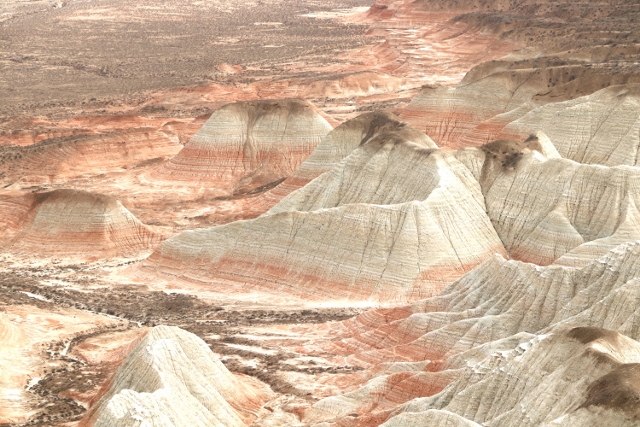
further afield, mostly marls and shales

with the occasional more resistent layers

at the end of the road, the picnic platform, not just for us, but for everybody else, as well – we are definitely not the only tourists!
A little further we come to the end of the road, for more views of the canyon on both sides of the limestone promontory. Where we are planning to have lunch. Like quite a few other tour groups, that have arrived already. Hmmm. But the views are great, again.

from here, another view of the canyon

as well as of the occasional remnant on the valley floor

which in close up looks equally nice

the mausoleum of Gozli Ata
The Cemetery
In the afternoon we visit the mausoleum of Gozli Ata, an important 14th C Sufi teacher, who died at the hands of the Mongols. Far more interesting than the simple brick building is the cemetery, that has sprung up next to the mausoleum – being buried close to such a holy man is important. The graves are decorated with a variety of colourful cloths, tied to a chopped tree, or in its absence a plank, which is located immediately behind the tombstone. The custom is to carry the body of the deceased to the cemetery, wrapped in white cloths, but also with colourful scarfs or other textiles tied to the body. Before burying, these additional cloths are removed, and attached to the tree or plank.

the colourful scarves have been attached to wooden poles

many of the more modern graves have a brcick wall around

the wooden poles are often next, or behind, the tomb stones

the classic form of a tomb stone, eroded

some of the older tomb stones

have been carved with Arabic script
Nowadays the tomb stones are made of cement, mostly, and many graves are surrounded by a low brick wall, but the older graves have just a tomb stone cut from natural rock; in one section of the cemetery these are often a more old fashioned type resembling a full tomb, and encrypted with Arab writing – the newer graves use Cyrillic script. The cemetery is completed with a wish tree, at the beginning: circling it three times makes your wish come through. Or so they say.

part of the site is a wish tree
We move on to Balkanabat, for the night.

more desert on the way to Balkanabat

nearer the town, animals start appearing again
