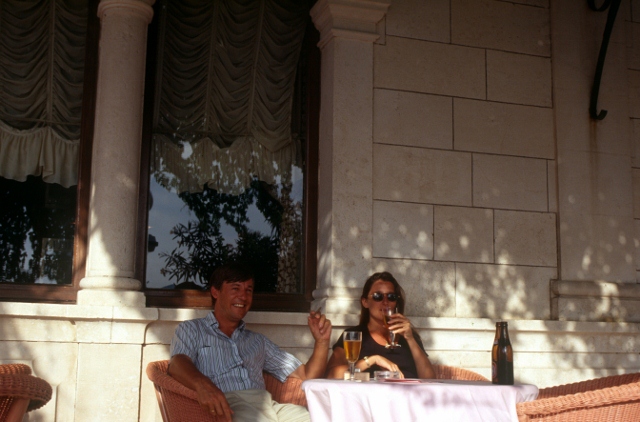
During our years in Albania (1995-1997) we travelled in the region; not only Albania, but also the surrounding countries. In the beginning this wasn’t easy, on account of the Yugoslav war, the multiple conflicts between the now ex-Yugoslav republics. We couldn’t cross into Montenegro, for instance, or into Sebia, where anything Albanian was sensitive. But with the end of the Croat war in 1995, this country became accessible again, so we stepped in a plane, flew from Tirana to Ljubljana in Slovenia, and took the train to Zagreb for a two week trip exploring what had been left of Croatia.

In Zagreb we rented a car and drove first to the Istrian peninsula, to Porec and Rovinj. Then we continued via Rijeka, a rather ugly industrial town and harbour, and further down the coast to Zadar, another not very attractive port city, down the Dalmatian coast; perhaps one of the prettiest coasts of Europe. One comes through places like Sibenik, where the cathedral is a World Heritage site, and Trogdir, on the way to Split. Here we returned the car, and took a public ferry to the islands of Korcula and Hvar – definitely recommended! – and on to Dubrovnik in the south of the country.
I have no notes left from this trip, 20 years ago, so it needs to come from memory only, and the photos I took (scanned slides that unfortunately had started to discolour a bit). So there is not much of text here, just a photo essay. But because Croatia is now such a popular holiday destination, I thought it would be nice to show how it was, at the time, just after the war that was such a defining period in modern Croatian history.


The Capitals
The two capital cities, Ljubljana in Slovenia and Zagreb in Croatia, were quite attractive, and well developed in comparison to the rest of the Balkans. Ljubljana is really an extension of Austria, rich in architectural highlights of Middle European origin (Jugendstil), and not war-damaged like most of Croatia, thanks to an early independence declaration, quickly accepted by all parties. Zagreb is a compact capital, equally nice, and a cultural centre, boosting lots of theatres and museums, although in 1996 the art scene was, understandably, somewhat subdued.


Istria
Istria is an almost self-contained peninsula, just south of Trieste in Italy – and definitely sporting the same attractive beaches. On top of that, it has several old coastal towns, like Rovinj, with narrow alleys, a harbour and lots of old churches. One of those, the Euphrasian Basilica and its Roman mosaics, is in Porec, just north of Rovinj, and has made it to Unesco World Heritage Site.


Zadar
In my memory Zadar, at the beginning of the Dalmatian coast further south, wasn’t particularly attractive, although present day guidebooks claim otherwise. It does have the noteworthy – because of its uncommon shape – Saint Donatius church, as well as a historic city entrance. In 1996 the traces of the war were still clearly visible, looking down from the church tower.


The Dalmatian Coast
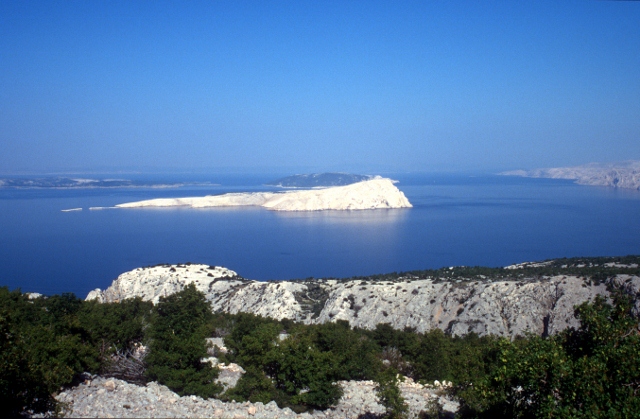
Further along the Dalmatian coast is Sibenik, with a huge cathedral of which I somehow have no photos, but there are also smaller churches along the coast, quite nice and again, quite unusual sometimes. Just north of Split is Solina, where some of Croatia’s Roman remains can be found, in the form of an amphitheatre, in those days an unprotected, open site where one could freely wander around.


Split


Split, also Unesco World Heritage Site, is a fabulous town, mostly on account of its Palace of Diocletian, a Roman emperor who ordered the construction of this extraordinary place in around 300 BC. Extraordinary, because now it is large inhabited by the towns people of Split, who have transformed the palace into small apartments, shops and other community necessities – apparently, they have done this already since the beginning of the 8th Century, when the palace was populated by refugees from a nearby war. Walking the narrow streets, Roman columns are everywhere, neatly incorporated in the structure, and decorated with colourful laundry.


The Islands
Whether it still exists, I don’t know, but 20 years ago a public ferry connected the islands in front of the Dalmatian coast. You could buy a ticket from Split to Dubrovnik, and hop on and off wherever you saw fit. Approaching Hvar, the town of the same name looked quite attractive, so we decided to stay the night, and continued the next day to Korcula, another gem of an island, and gem of an old town. Regrets, regrets, with enough time, one could do a lot more then we did.


Dubrovnik
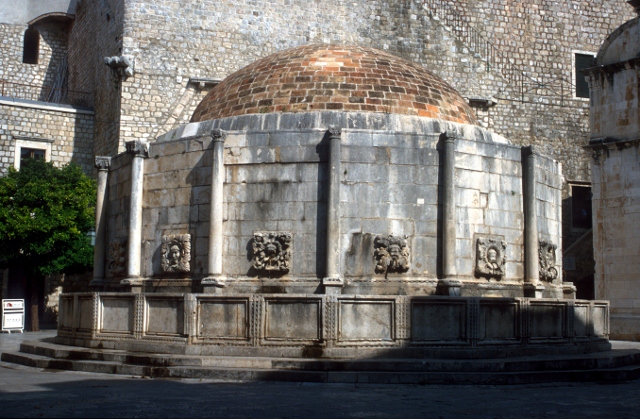
The highlight of Croatia must be Dubrovnik, the walled city full of palaces and churches, gates and squares, and roads paved with ancient slabs of rock. We arrived a little over one year after the Independence war ended, the war that had badly damaged Dubrovnik and its historical monuments. A damage of which there was hardly anything visible anymore: as soon as the bombing raids stopped, the local people had collectively gone out again, and repaired the shot-up ancient fountain, the city walls that had crumbled under mortar shells, the burned out church roofs, and most of the other bombed buildings, an incredibly impressive achievement. And somebody had been so smart to make a picture book, with on each left-side page a corner of the town as it was, immediately after the war, and on the right how it looked now, a year later. An inspiring example, and a great end to a short trip, of which I cannot remember that many details anymore….


Hope you enjoyed the photos.