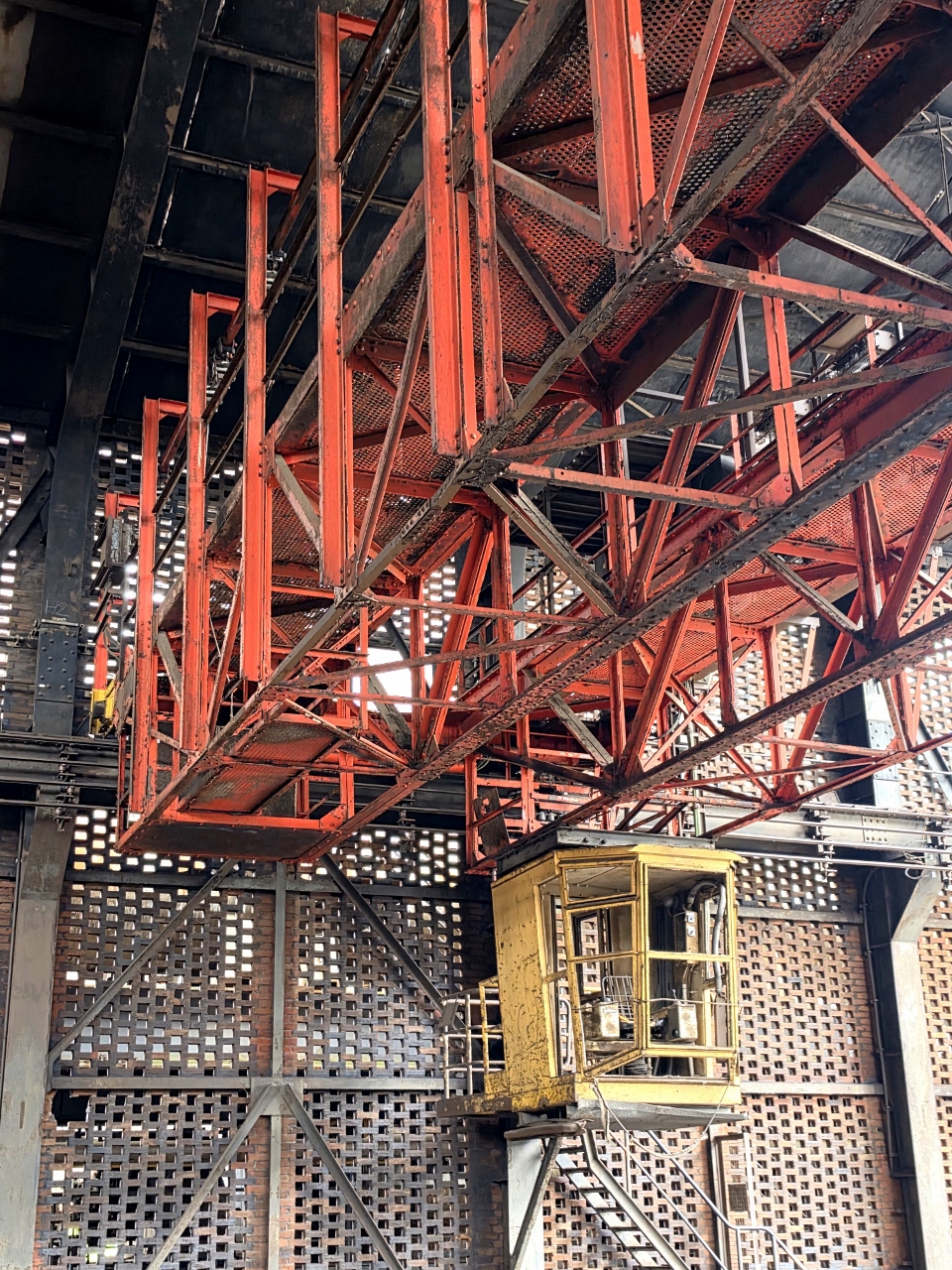
The Ruhrgebiet (Ruhr region) is one of Europe’s largest urban agglomerations, covering towns like Essen, Dortmund, Bochum, and Duisburg. The discovery of easily accessible coal seams in the early 1800’s was pivotal in transforming it into Germany’s industrial heartland. The mines provided the coal, which was turned into cokes needed for iron and steel production. Demand for this grew quickly after the founding of the German Empire in 1871, which required rapid military and economic expansion.
A second surge came under the Nazi regime, when industry was geared toward rearmament. Due to its industrial importance the area was subsequently heavily bombed during WWII by Allied forces. After the war the Ruhrgebiet was once again critical, as a motor for West Germany’s recovery, the “Wirtschaftswunder” (economic miracle) But from the 1960s onward, cheaper foreign coal and steel led to a long, painful decline — mine and factory closures, job losses, and economic restructuring.

Former industrial sites were repurposed; rather than demolishing its industrial past, the Ruhrgebiet turned much of it into industrial heritage and cultural infrastructure. This is often called “Industriekultur” (industrial culture), and it’s become central to the region’s identity. The Zeche Zollverein in Essen, once the largest and most modern coal mine in the world (closed 1986), became a UNESCO World Heritage Site, but many other factories and other industrial spots were also redesigned as tourist sites.


In addition, many of the ‘Halden’ – artificial hills made from the waste rock with no commercial use itself, brought up from underground during coal mining – were landscaped, planted, and opened to the public rather than left as barren, unstable slag piles. These ‘Halden’ form often hundreds of meters high hills in the otherwise flat landscape of the Ruhrgebiet. Several of them have now been adorned with land art, in the form of sculptures or other artistic expressions, worthwhile to climb up for, and enjoy the views across the area at the same time.


All of this is now captured in a network of connecting museums, exhibitions, panoramic viewpoints, and historically significant worker settlements, tracing the region’s industrial development. There are over 50 main locations, and about a 1000 smaller sites, packed into several routes. https://www.route-industriekultur.ruhr/en/
Obviously, we did just a few of them, not all…. To make my enthusiasm slightly more managable, this story comes in three entries.


Industrial setting
It is important to realise the tightly interconnected nature of the Ruhr heavy industry in its heydays. The ‘kokerei’ (cokes plant) received hard coal from neighbouring collieries, and supplied its coke to the ironworks. In turn they received blast furnace gas (Gichtgas) back from the ironworks — generated when the ironworks blast furnace smelted pig iron. This is where the gasometers come in. Nothing operated in isolation; everything fed everything else. The pig iron was turned into steel using open-hearth furnace, or (later) basic oxygen furnace.
The rivers, especially the Ruhr, Emscher, and Lippe rivers that empty in the Rhine, and several canals, created the ideal transport network for import of iron ore (which, however, also became locally available) and the export of finished products. A dense railway network was created to move materials in between the various components of the industrial process; in some places mines, cokes factory and furnaces were all part of one big complex.

Zechenpark Friedrich Heinrich, Kamp-Lintfort
Coming from The Netherlands, Kamp-Lintfort is one of the first sites of the Industrial Heritage route. It is one of a smaller, lesser-known site on the Route der Industriekultur, and it has a distinctive twist: it’s the only one located west of the Rhine. In 1906, a French banking group bought the mining rights from the heirs of industrialist Friedrich Heinrich Freiherr von Diergardt, specifically to secure coal supplies for local ironworks. Starting in 1907, a double-shaft mining complex with its own coking plant was built — a scale and design unique in Ruhr mining at the time. The mine essentially created the town: where before there were just two villages, Kamp and Lintfort, a whole mining settlement grew up within a few years — shafts, brickworks, company housing, shops, schools, churches, streets, and squares.
In 2020, the site hosted the Landesgartenschau (State Garden Show), and today much of the former mine and garden-show grounds form a free, publicly accessible green space — the Zechenpark.
As a first stop it was impressive, the buildings and the mine construction, but in retrospect there are more striking sites further east.

Lineg exhibition
Opposite the Zechenpark is the office of Lineg, a local water company. They happened to host an exhibition on plastic, made up of works by photographer Dirk Krull. In addition to the photographs, there was this wonderful plastic chair construction, outside the office, which drew our attention in the first place.


Halde Rheinpreussen, Moers
On top of the more than 100 m high ‘Halde’ Rheinpreussen, a hill of mining waste, towers the art work “Geluminary” (The Light) van Otto Piene, allegedly the largest mining artwork in the world. It requires a short stroll up the hill, which then also provides a fabulous view over the Ruhrgebiet and the Lower Rhine.


Landschaftspark Duisburg Nord
This is the conversion of the former Thyssen iron and steel works in Duisburg-Meiderich, which was built directly on the coalfields and started operating in 1901. The first blast furnace fired up in 1903, and by 1912 there were five furnaces in total.
Here, too, overcapacity on the European steel market ultimately led to the plant’s closure in 1985. Thyssen initially wanted to hand the site over to public authorities — including its pollution — but demolish all the industrial structures to sell the scrap. But the ironworks was seen as an iconic part of the skyline, and local residents formed a group to fight for its preservation. Citizen protests ultimately prevented demolition, and the site was transformed into a leisure area.
Nowadays you can climb the walls of the ore bunkers and dive into a pool inside the old gasometer. Apparently, you can even stay on site, in a youth hostel. Our interest was mostly focussed on the old plants, and on climbing one of the blast furnaces to a panoramic viewing platform. This is industrial heritage at its most dramatic, a rust bucket which is fabulously photogenic.
for the next entry of this trip, part 2 of 3, click here.