


Turkmenistan’s presidents like their statues in gold
Left out from our first Central Asia ‘Stans’ trip in 2015, we finally got the opportunity to visit the missing ‘Stan’ in March 2026. We joined a small group of like-minded travelers – those who do not necessarily focus on the most touristic destinations in the world. With them, and our obligatory guide, we crossed the country, fitting in the surreal capital Ashgabat, several other towns, some natural beauty and a couple of UNESCO World Heritage Sites. An interesting experience, shall we say: a fearfully authoritarian country that has grown very rich from plentyful hydrocarbon resources, wasting it on extravagance and presdiential personallity cult. A week was enough.

the missing ‘Stan’
01. the missing ‘Stan’
In 2015 we travelled through the so-called ‘Stans’, the name given to the old Soviet Republics in Central Asia. We spent six weeks on a loop from Uzbekistan through Kyrgyzstan, with a sidetrip to Almaty in Kazakhstan, and then back through Tajikistan. We omitted Turkmenistan, because at the time you would only receive a three-day transit visa, or a ten-day visa with obligatory security accompaniment – not to protect you, but to protect the people of Turkmenistan from the potential bad influence of foreigners. And in any case, there probably wasn’t a lot to do in Turkmenistan anyhow.
Fast-forward eleven years, and we have changed our mind, opportunity-driven by the people of Nomadmania, with whom we have earlier travelled successfully through, shall we say, less touristic places.
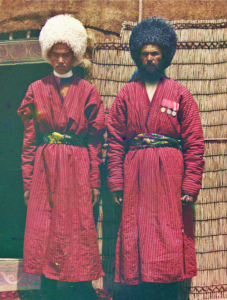
Turkmen history
02. a brief history of Turkmenistan
I am aware that Turkmenistan is not the most obvious travel destination for most. But perhaps that is just one of the things that appeal to us, it is utterly non-touristic. And for a reason, of course: 70% of the country consists of the Karakum desert, the dryest desert on earth. It is also a pretty totalitarian state, with rulers – only three since independence in 1991 – regularly receiving 97-99% of the votes in elections. And they are not particularly welcoming to foreigners.
Perhaps that’s a remnant of history.

arrival in Ashgabat
03. the arrival
Many of you have already realised, of course, that Ashgabat is just 40 kms north of the Iranian border. Iran being the country that is heavily being bombarded by Israel and the US, as we speak, and also the country that seemingly randomly lashes out to its neighbours in retaliation. The good news is that they have so far not looked north, and that to fly from Western Europe to Ashgabat, one avoids the war zone – so far, flight to and from Turkmenistan have not been cancelled.

Wepaly, the dog mascote from the Ashgabat 2017 games
04. Ashgabat
Our first day consists of a bus tour through Ashgabat, with the occasional stops. I had been prepared, but the initial impression of the city is still one of complete amazement, unreal. Wide avenues, with two times four lanes, are lined with white marble apartment buildings, where, apparently, ‘the elite’ is living – dixit our guide. Presumably, they are all working in some of the other extravagant marble buildings, the ministries and the banks, the flashy hotel, or the multiple-domed presidential palace. How much of it is really in use remains unclear – there are no signs of habitation of the apartments, no laundry outside, for instance.

Old Nisa
05. Old Nisa
Just outside Ashgabat is Old Nisa – or Nusay -, the old capital of the Parthian empire, which dominated the Turkmen region from the 3rd C BC to the 3rd C AD. Unfortunately, the construction was mostly done with mud bricks, which, thanks to the elements, have largely disappeared. A massive earthquake in the 1st C AD, which destroyed most of the city, didn’t help either.
Part of the structure, however, has been tastefully reconstructed, to give an impression of how the city, and especially its Royal palace, may have looked.

Turkmenbasy
06. Turkmenbasy
After our visit to Old Nisa we head for the railway station. We have been booked on the night train to Turkmenbasy, Turkmenistan’s port at the Caspian Sea – the Caspian being an inland sea, of course, so this is not a very large harbour. Turkmenbasy was named after the first president, Niyazov, who awarded himself the title Turkmenbasy – Leader of the Turkmen -, but before that it was Krasnovodsk, originally a Russian garrison town established in the 19th Century.

Awaza
07. Awaza
Just outside Turkmenbasy is Awaza, or, to be precise, the Awaza National Tourist Zone. An unreal collection of futuristic hotels, all huge, complemented by the occasional holiday cottage enclaves, everything connected by wide avenues. Never mind these avenues, and the six lane entry road, only busses are allowed in; at the edge of the complex is a mega parking where you leave your car – to take the bus to your hotel, and afterwards to any other attraction, the mini concert hall, the sports facilities, the malls. Or what about the 30-hectare Awaza Aquapark, including water attractions, shopping areas, cafes, an amphitheater, and artificial mountains, lakes, and waterfalls. No doubt there is a lot to do in Awaza.

the Gozli Ata cemetery, near the Yangykala canyon
08. the Yangykala canyon
We head into the Karakum desert, which occupies some 70% of the country. Initially, much of the surface is still covered by some sturdy vegetation, good for camels, sheep and the occasional cow. Although there appears little around, we do come across one of the houses of the first president – why on earth he wanted a house here, is beyond me, and why on earth it is still maintained, there is staff on site, I also fail to understand, but it is there, with a piece of land and a fence surrounding the large building. I can – and do – open the gate, but our guide strongly discourages me from entering the site.

Balkanabat
09. Balkanabat
Balkanabat is a surprisingly large town, bigger than Turkmenbasy. And there is very little to do in terms of touristic attractions. A modern Orthodox church, with a basic, equally new iconostasis; a new mosque with four minarets and gold-glittering domes. All not particularly attractive.
Read on – to learn about khrushchevkas, the ones I have always called palatis.

Nokhur village
10. Nokhur village
I am sure that there are many villages in Turkmenistan. But none is apparently more special that Nokhur, located in the Kopet Dag mountains fairly close to the Iranian border. Why, it beats me, from the look of it. The place is not particularly attractive, it is just a village.
However, the inhabitants, a little over 1000 of them, claim to be descendants from the army of Alexander the Great, who passed through here in the 4th C BC. The villagers at the time looked after the Greek soldiers that got wounded and stayed behind, and that bloodline, it is said, is still evident. Right.

the Köw-Ata cave
11. Köw-Ata cave
In the foothills of the Kopet Dag Mountains, not too far away from Nokhur, is the Köw-Ata Cave. “Köw-Ata” roughly translates to “Father of Caves” in Turkmen, and indeed it is quite a structure, stretching over 250 meters. There are several entrances, but from the main one it is a 60-70 m descent, along a sparsely lit wooden staircase, to a large subterranean lake at the bottom. And there are changing cubicles, where we switch into our swim gear, to take a plunge in the warm, sulphuric water. Which – obviously – heals all our current ailments.
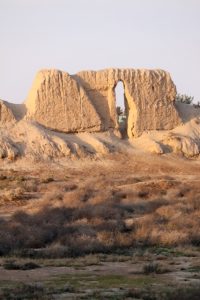
Ancient Merv
12. Ancient Merv
Turkmenistan’s best known cultural heritage, UNESCO-recognised, is Merv, close to the city of Mary, in the east of the country.
Ancient Merv, as it is now called, was once one of the greatest urban centres along the Silk Road, thriving as a crossroads of trade, culture, and ideas. It served as the capital for several political entities, like that of the Abbasid Islamic caliphate in the 9th C, and most importantly, as the capital of the Seljuk empire in the 11th-12th C. Under the Seljuks it may have been the world’s largest city.

Gonur Depe
13. Gonur Depe
During my reading up on things Turkmenistan, ahead of our trip, I had come across a description of Gonur Depe, another archaeological site, even older than Merv. The site was discovered by a Russian-Greek archaeologist, Viktor Saraidini, in 1972, and he spent the rest of his life excavating here. (He died in 2013, well in his 80s). From his work we know that Gonur Depe was one of the Bronze Age settlements along the Murgab River, probably as early as 7000 years BC. The place grew to dominate its surroundings, and some – Viktor, perhaps – equate it to the big Mesopotamian and Egyptian cultures. True or not, it was certainly an impressive culture – of which we have seen artefacts already in the National Museum in Ashgabat. It may also have been the place where the first monotheistic religion in the world was born, Zoroastrianism, whose founder, Zoroaster, may have lived here part of his life.
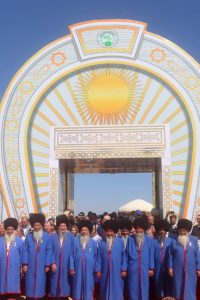
Nowruz celebration
14. Nowruz
We are back in Ashgabat, and we happen to be there, not entirely coincidentally, at Nowruz, the Iranian celebration of New Year. Which is not only celebrated in Iran, but also in neighbouring Turkmenistan.
A little outside town is a huge exhibition ground, where the official celebrations are being held. This is not a thing for the public, so much is clear. There is a very rigid invitation schedule, which includes the politicians, the Corps Diplomatic, and some further important people, carefully selected not to overwhelm the site. And the small group of tourists from our tourist agency, which obviously has the right connections to be invited – on our own we wouldn’t have managed this, I think.

the Darvaza Crater
15 the Darvaza Crater
The reason to interrupt the Nowruz celebrations prematurely was our next item on the program, the Darvaza Crater. Turkmenistan tourist attraction number one. Which perhaps says more about the tourists than about the tourist attractions.
The crater is another four hours’ drive, once again into the desert. What started as something resembling an airport landing strip, a stretch of tarmac fit for landing an aircraft, without markings, turns into a badly potholed, still airstrip-wide, road, with unsurfaced tracks on both sides to avoid the worst parts of tarmac. Once again in SUV convoy, our drivers go much too fast, swerving from left to right to avoid the potholes, or speeding irresponsibly through the soft sand on the side. Suggestions to slow down somewhat are met with a big grin, and if possible even faster speeds. Turkmen men are macho men.

Ashgabat again
16. Ashgabat (2)
The last day of our trip we spent in Ashgabat, without the group, but still with guide; the concept that you would wander around without is too uncomfortable for the Turkmen authorities (although at the end of the day I do manage to leave the hotel unattended, and make a few purchases in nearby shops).
We have a few things on our list, like an old, Soviet-era hotel – the former Ashgabat Hotel – that would fit well in our Brutalist photo collection from former Soviet and Eastern European republics. Except that the hotel has been refurbished (and renamed Paytagt Hotel) and painted white, and looks quite flashy now. Fitting for ‘the White City’, as it is commonly called. Inside are a few old Soviet mosaics, outside the hotel blends in well in the surrounding collection of further white buildings, from theatres to apartment buildings and yet another monument.

a Turkman
17. the verdict
Is it worthwhile visiting Turkmenistan, admittedly not the most touristic country in the world? Obviously, it depends on what you want to achieve, but for most people it probably isn’t. Most of the places on our itinerary weren’t that impressive, there are better canyons, better deserts, better mountain villages and better lakes at the bottom of a cave to be experienced elsewhere in the world. My highest hopes were for the Darvaza Crater, a long-burning oil exploration disaster, but in reality the flames are a lot less impressive than what I have seen on photographs; perhaps the fire is finally dying out. The UNESCO World Heritage Sites Old Nisa and Merv, hmm, they are OK, but again, you will find more inspiring examples of capitals of ancient civilisations elsewhere, and besides, mud bricks don’t conserve well over time.
Having said so …. – Read on
