
old lantern in the colonial town of Campeche
Colonial city-wise, things are getting better. Was Valladolid a bit of a disappointment, and Merida quite nice, but a little big and crowded, Campeche is a charming and well-preserved town, with a lot of atmosphere. Well, it is a big city in its own right, but the historical centre, within its original defensive wall – of which quite a bit still stands, or has been restored, including several of its bastions -, this centre is easily manageable on foot. Street after narrow street with pastel-coloured houses, some multi-story but most just ground floor affairs only. Many of the houses are newly stuccoed and painted, and quite a few of those who need maintenance are actually worked on, with scaffolding raised on the side.
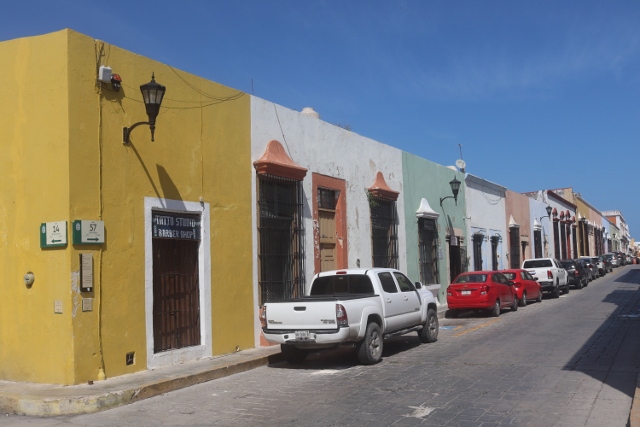
another street, more pastel-colour, low-rise only

a street in Campeche, pastel-coloured

a church in Campeche

courtyard of the Edificio Cuauhtemoc, a former hotel

another view of a pastel-street, two-stories this time, with balconies

a window in one of those streets

and a typical balcony
Campeche was conquered by the Spanish in 1540, and was turned into a transit port for salt, wax, honey and wood. This created a significant wealth, which not only stimulated smuggling, but also made the city a target for pirates. The first sacking of Campeche was done in 1568 already, by Francis Drake, and this continued for another 100 years, notably by the Dutch, until the Spanish king decided to fortify the city, with a defensive wall and bastions completed in 1704. Part of the wall was pulled down in 1893, but what is left of it, partly restored in the second half of the 20th C, now makes for an attractive city element.

the pirate history of the town is remembered in a museum, but also through this type of sculptures

the cathedral, as seen from the walls of the Baluarte de San Francisco

cathedral more close up

and its impressive entrance
The main attractions in town are around the Zocalo, the central square, which is bordered by the Santa Isabela cathedral. Nearby is the Baluarte de la Soledad, a fortification near the coast, which also contains a small museum. Next to it is the Puerta del Mar, as opposed to the Puerta del Tierra, which is further inland, next to another fort, the Baluarte de San Francisco. (I have taken lots of pictures of both forts, which look alike, and cannot guarantee that the captions are entirely correct.). A big contrast is with the Palacio de Gobierno, a 1962 construction adorned with a mural in mosaics from a pupil of Jose Clemente Orozco – who we will be meeting later, in Mexico City.

the Baluarte de San Francisco, a fortification in the middle of the town

the fortifications of the Baluarte de San Francisco
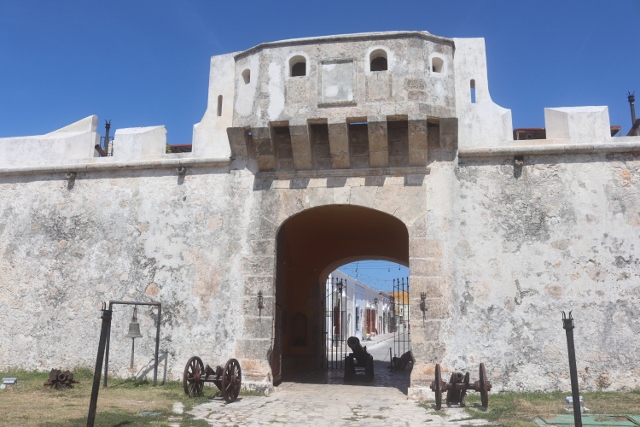
which contains the Puerta del Tierra

and a view down from the walls

the bell at the Baluarte
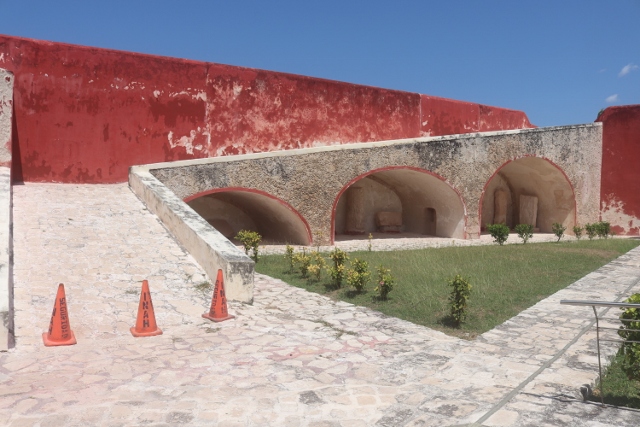
ramp to the ramparts, in the courtyrad of Baluarte de la Soledad

a sculpture in the small on-site museum

and a burial mask, complete with ears

the Palacio del Gobernador, a strikingly modern building – well, from 1962 – in old Campeche

decorated with a mural depicting the progress of the people of Campeche, painted by José Chávez Morado, a student of José Clemente Orozco

the fishing port nearby Fuerte de San Miguel, outside Campeche

with its tiny lighthouse

and plenty of fishing boats
To complete the defences, several other forts, outside the city, were built, of which the Fuerte de San Miguel, built in 1801, still exists. It is a striking building in itself, painted yellow and white, with a large inner courtyard and a ramp leading up to the top, from which enemy ships could be spotted, and shot at. Plenty of cannons to prove the point.

the Fuerte de San Miguel, a rather extensive fort

corner tower

courtyard, from above

the attractive courtyard, with access to the walls
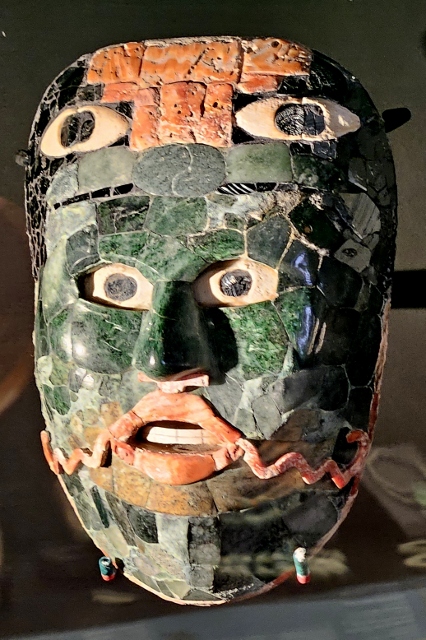
one of the striking burial masks in the Museo Arqueologia inside the Fuerte de San Miguel
What we hadn’t anticipated was the absolute splendour of the collection of the little Maya museum, inside the fort. These are artefact found around the state of Campeche, part of the Yucatan peninsula, and mostly date from what is called the Early Classic (200-600 AD) and Late Classic (600-900 AD) period. Some exquisitely painted plates and pots, lots of small-scale, maybe 10 to 30 cm high statues, jewellery, obsidian tools, and the masks! There are several death masks, made from jade, and they are fabulous! I have not dug too much into the history and the origin, save that most of these pieces have been offerings that have been found back in the graves of important men. My focus, taking the pictures, has been wholly on the aesthetics, and let me tell you, I took a lot of pictures! more here.

at night, it is not vey busy

even the terraces are empty
What during the day is still a lively town, dies down in the evening. Sure enough, parts are attractively lit, but now it becomes clear that there are actually very few people living here. Except for the hotels, and for the restaurants, bars and the shops, that rent the ground floor of a house, the houses are mostly dark, abandoned. Yet somebody pays for their upkeep, perhaps the municipality, to ensure the town doesn’t lose its UNESCO World Heritage status.

the Malecon, the boulevard along the coast
