
the museum of Xalapa has a lot more to offer than just Olmec heads
We had planned a stop-over in Xalapa, to admire more of the so-called Colossal Heads that define the Olmec civilization, the oldest in Mexico. The Olmecs flourished between 1200 – 400 BC in the present-day Mexican states Vera Cruz and Tabasco, and are thought to have laid the foundation for the later, more famous civilizations.
In our first visit to Mexico 20 years ago we had seen some of these heads in Vera Cruz, and on the way up to Yucatan, this time around, we had seen more of them, so this seemed a fitting end to our adventure. Except that the museum has much more than only Olmec artefacts: we spent hours there, enjoying not only the heavy stone objects, but also lots of delightful ceramics, from colourful vases to lovely little statues and impressive masks, from Olmec and from later periods.
A small selection:

the museum itself is beautiful, modern, well laid out and lit

and in one of the rooms, no less than three colossal heads displayed

colossal head no.1, together with an unsuspecting tourist

colossal head no.8, from the Olmeca era (1200-900 BC

the eyes of colossal head no.3, very expressive

not all the heads of the Olmecs were colossal

a ceramic statue, also from the Olmec era
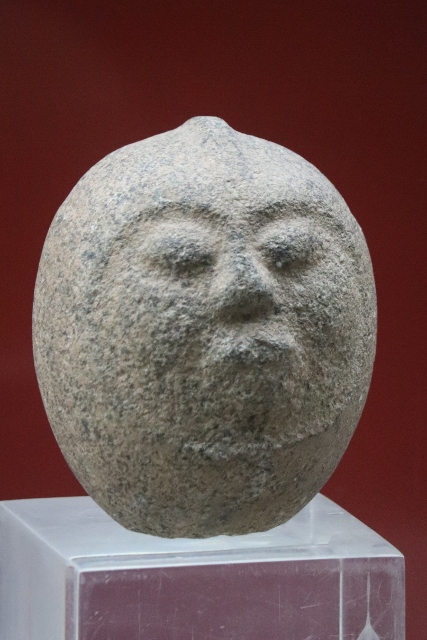
and this is another Olmec head, much smaller, but fits staight in a modern art gallery
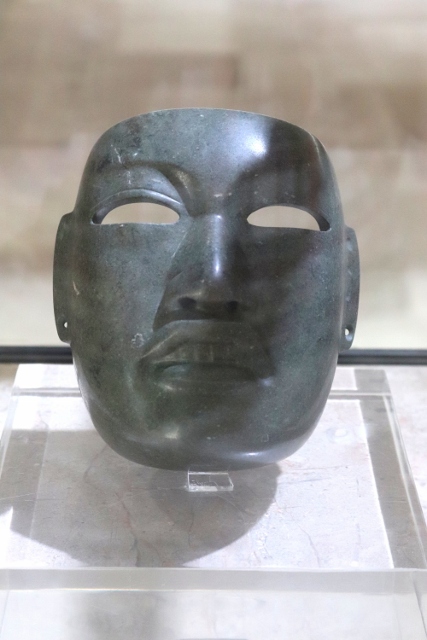
like this jade mask

and a jade figure

These three figures from the North-Central Vera Cruz culture (300 BC to 300 AD), found in Remojadas, belong to an offering, encountered under the floor of a platform. The man is thought to be connected to the Sun, whilst the woman is linked to the moon; the smaller figure in the arms of the man is Venus. Yet, it has also been suggested that this just depicts an everyday scene of a family with a child. It is noteworthy because it is one of the oldest articulated figures in Mesoamerican history.
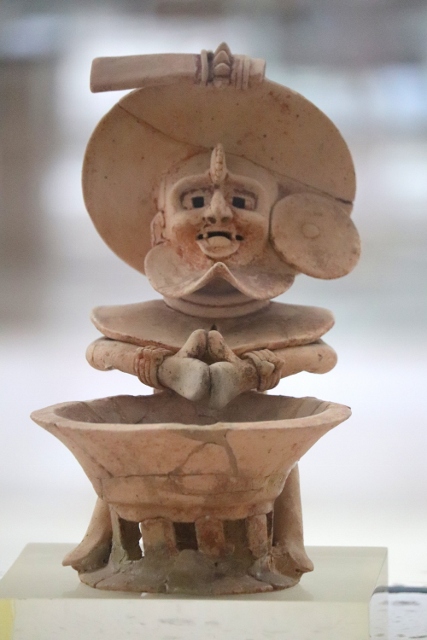
sculpture of a fire deity, from a much later period (800 – 1000 AD)

equally old female figure (300 BC – 300 AD)

two clay figurines (300 BC – 300 AD)

an effigy vessel, from the Remojadas culture (300 BC – 300 AD)

animals are also a popular subject matter, like this monkey

and they even produced a clay snake!
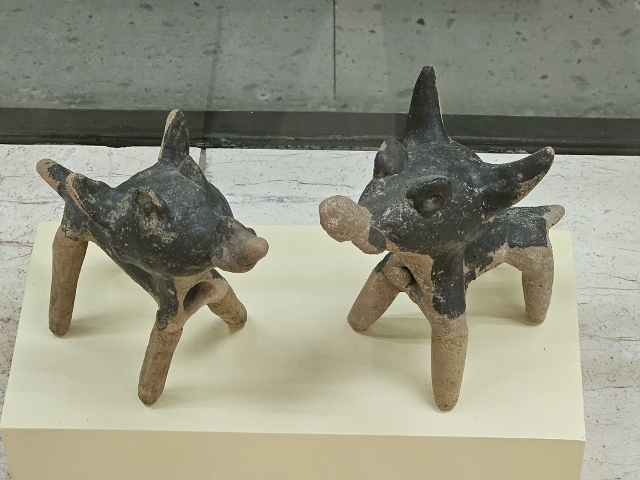
as well as these two lovely dogs, proving that Chihuahuas are as old as Mexico!

This Early Post-Classic period (900-1200 AD) sculpture, called after the deity Xipe Totec, shows a man dressed in the skin of a flayed person; flaying – skinning a person – apparently was widespread in Mesoamerica at the time

a ceramic head, very expressive! (300 BC – 300 AD)

and this one, with fabulous headdress (300 BC – 300 AD)

a female figure (1200-1521 AD)

less smiling, this one: an impressive skull sculpture (Centro de Veracruz culture, 600-900 AD)

The Lord of the Underworld, Mictlantecuhtli, in the form of a skeleton. The concept of death was of great importance to the pre-Hispanic cultures of Mesoamerica.

This female sculpture represents a woman that died giving birth, they were considered warriors, or Cihuateotl – the motherhood and fertility Goddess.

The closed eyes and open mouth show she are dead, the snake she carries around her waist represents fertility (Centro de Veracruz culture, 600-900 AD)

another life-size Cihuateotl, or motherhood and fertility Goddess.

with snake around the waist, child in hand

this is one of the so-called smiling figures (Centro de Veracruz culture, 600-900 AD)

and this one, too (Centro de Veracruz culture, 600-900 AD)

this smiling lady has still paint remains on the body and head (Centro de Veracruz culture, 600-900 AD)

and another one, equally detailed, given the size

a wistle, a tiny little figure (Centro de Veracruz culture, 600-900 AD)

this is how a burial place must have looked, complete with offerings (Centro de Veracruz culture, 600-900 AD)
