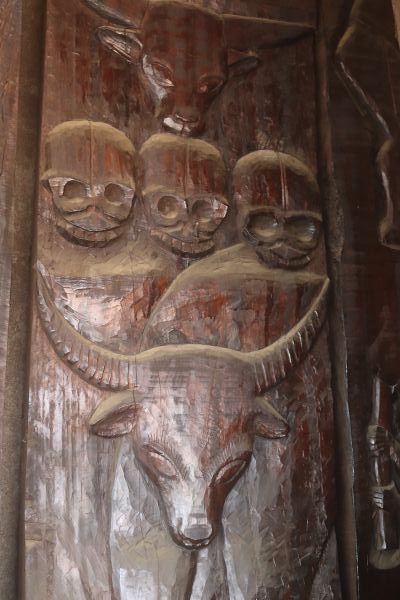
typical Naga themes, a mithun and skulls, carved on the walls of the king’s palace in Longwa
Longwa is a curious village. At some 1500 m altitude, it is right at the border with Myanmar; in fact, the king of Longwa has jurisdiction over some villages in India, but also over Konyak people living just across the border in Myanmar. Which is why the king’s palace is half in India, and half in Myanmar.

the king’s palace in Longwa
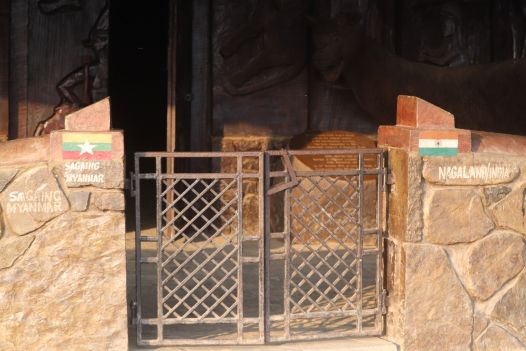
on the border of India and Myanmar – the living room is in India. The bedroom in Myanmar, or so goes the story

one of the officials, well prepared for the festival, in front of the palace
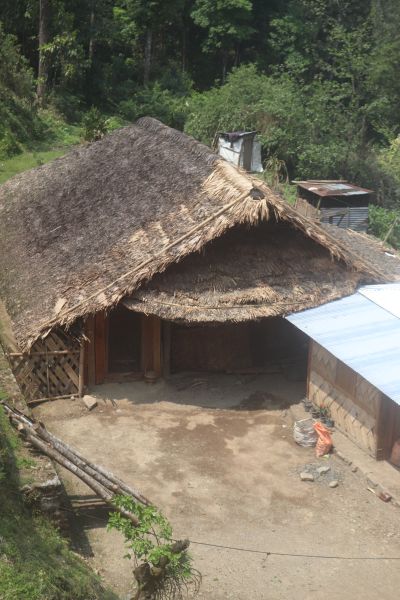
a village house, traditional design
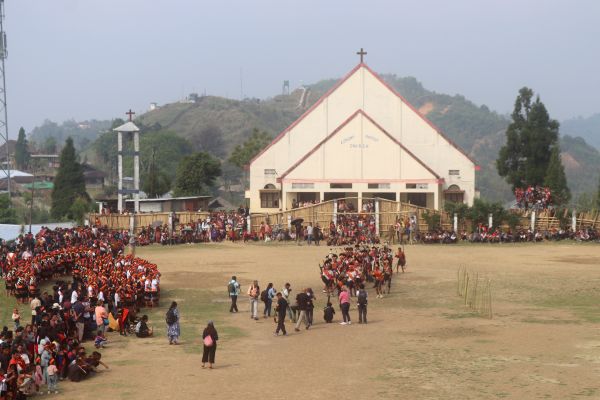
the Baptist church and the football pitch, centre of town and of the upcoming festival

although his more creative side is the making of quite attractive sculptures

close to the church is Longwa’s blacksmith, whose focus is on repairing the old fashioned guns and the machetes
The Border
The actual Zero Point, where the road ends, is a little further. And it ends here, really, if you walk on you tumble down a steep slope, into Myanmar. Mind you, it is not that we suddenly have become border junkies, like some of our group members in Bangladesh, but it is a strange thing, this border. No formal crossings here. In fact, the local Nagas have permission to travel up to 15 km into Myanmar, to visit relatives and, apparently, also to work on some of their fields, across the border.

the end of the road in India

and the official Indo Myanmar border sign, together with haphazard tourists

and this is the view inside Myanmar
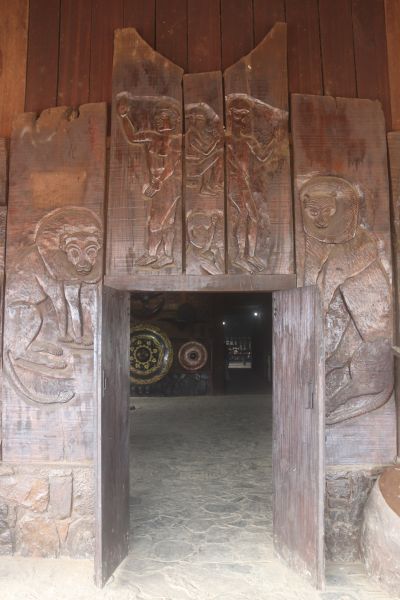
the door of the palace, in between the carved outside walls

this is one of the walls
The Palace
The king’s palace is an impressive structure, made mostly of thick wooden logs. The front is decorated with wood carvings, images of Naga culture, the inside consists of a large front room, which contains a number of gongs, of which one real big one, and lots of mithun and buffalo skulls and horns. Through a corridor, with smaller rooms on the side, you get to a huge kitchen. This is where the food for festivals is being prepared – and where they have this fabulous collection of baskets hanging above the hearth. We can just walk in, nobody stops us, the king has no body guards. The atmosphere is again very relaxed. The king himself, and several of his queens, are around, preparing for the Aolyang festival, which is to commence in a few hours’ time.

the collection of Mithun skulls on the wall
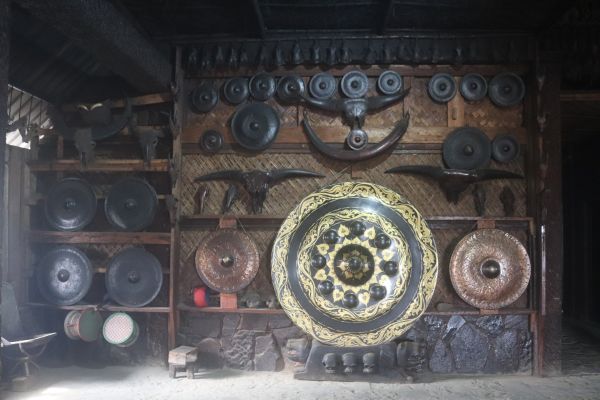
the main reception room, full of gongs and skulls
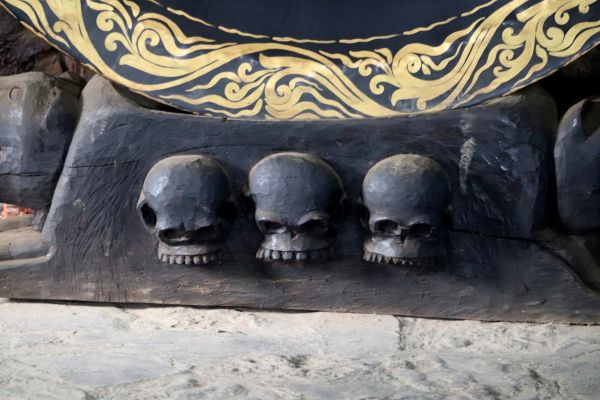
and once again, obsession with the heads

the impressive kitchen of the palace, and the impressive collection of baskets

and there is also a section with festival-ready artefacts, for sale

in the run-up to the Aolyang festival artefacts are a popular market item

like these mostly wooden pieces, many of them to be worn by the dancers
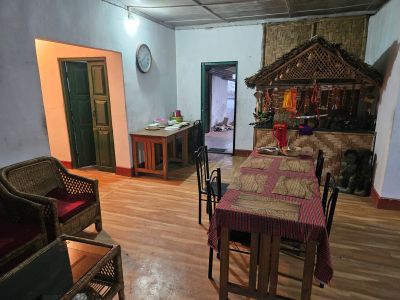
the interior of our guesthouse, the lobby
The Guesthouse
Our guesthouse is right opposite the king’s palace, and is not exactly a palace itself. The rooms are very basic, the bathrooms even more: one tap, with a trickle of water that we catch in a bucket, and we use for washing, and for flushing the toilet – we have been assigned a room with western toilet, though, which, at our age and agility, is much better than the standard crouching toilets that are still very common in India, and in most other rooms. But I suppose this is a function of the remoteness of Longwa, there are no hotels here, no restaurants, we are totally depending on the guesthouse. Which is run by wonderful people, who immediately come with candles when the power fails. Also a function of remoteness, and no generator here. I cannot remember when we last depended on candles for light, but that must have been quite some time ago. But he, we do have the full village experience. For three long nights.
The compensation for the hardship? The Aolyang festival!
