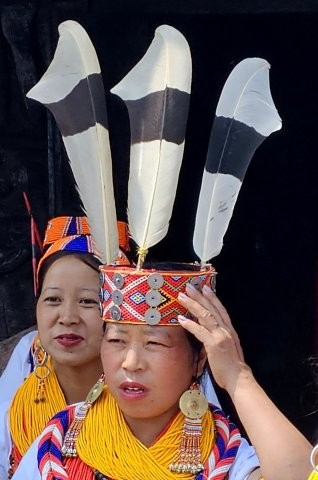
one of the clan queens readying herself for the Aolyang Festival in Longwa
The annual Aolyang festival of the Konyak tribe in Longwa celebrates the start of a new year, linked to the growing season. It is a six-day festival, for which the people dress up in traditional gear. The men wear a loin cloth – and a sports short underneath, these days, or simply trousers -, and jacket or colourful sash over their tee-shirts. They also have a colourful set of ankle and wrist bracelets, and necklaces with beads and heads, of wood or metal, in the old days signifying the number of heads they had taken, nowadays just for the show. On their heads many have a round hat, wherever possible topped with one or more hornbill feathers. Which is a protected species, so most of the feathers we see are actually old. And of course, they carry their machete and gun. Very colourful, but also pretty chaotic as a group, everybody does something just slightly different. Plus the fact that there are several groups, linked to village clans or neighbourhoods, but all more or less with the same outfit.
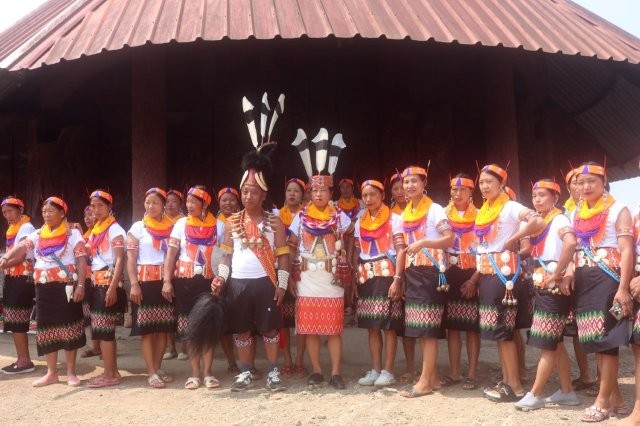
one of the clans in front of the chief’s morung

the men with their spectacular outfits

including plumed hats, decorated with pig teeth

some of the outit still waiting to be installed

including a set of real guns
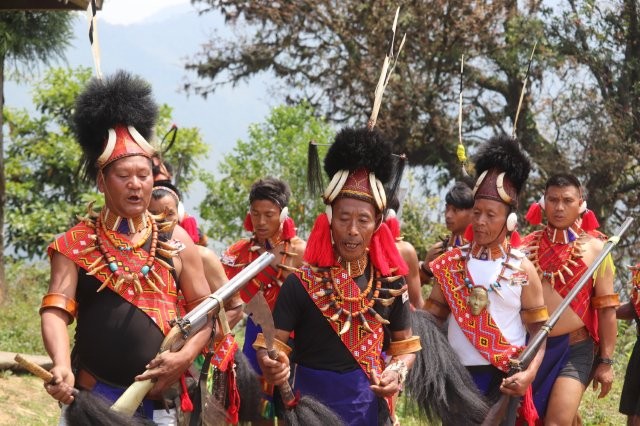
this group of men is practicing for the march later

under the firm leadership of this guy

not everybody is equally seriously excercising
The women, in contrast, are all clothed in the same dress, with a broad belt and mostly wide, orange necklaces. Only the queen, and perhaps the deputy queen, may have a different colour outfit, and only the queen has hornbill feathers. Here, too, are different groups, like with the men, three or four, but they distinguish themselves through slightly different colours, predominantly white, or black, for instance. And unlike the men, the women operate in a much more homogenous and disciplined way, dancing in large circles. Yet, an equally colourful sight.

another curious piece of equipment

is the buckets that the men carry
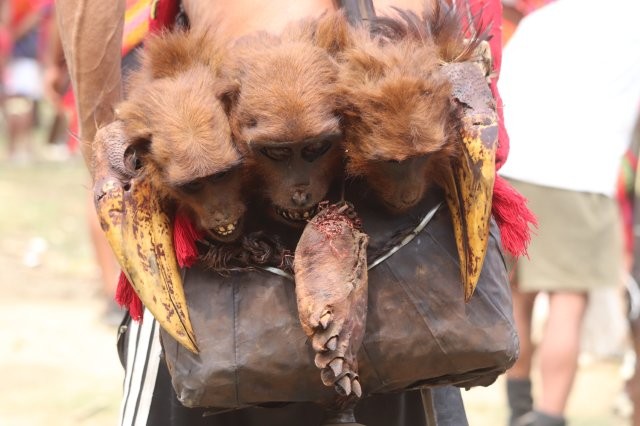
monstruously decorated with skulls
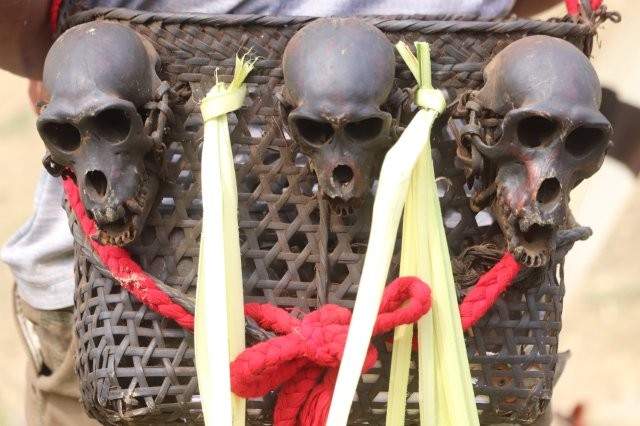
like these monkeys – I think

and this guy is the real thing, with a horn through his ear lobe

and this, younger guy, is fake, having the horn tied to his ear, instead

the women’s group, also practicing for the real thing later on
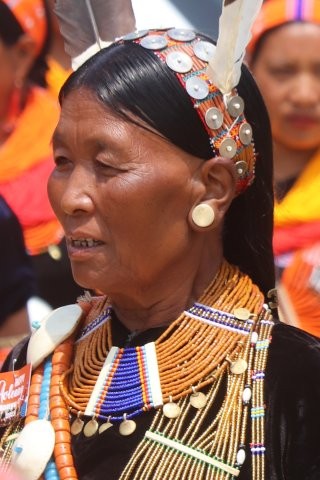
under the stern eye of this queen

practice with this queen is no joke

and can be exhausting at times
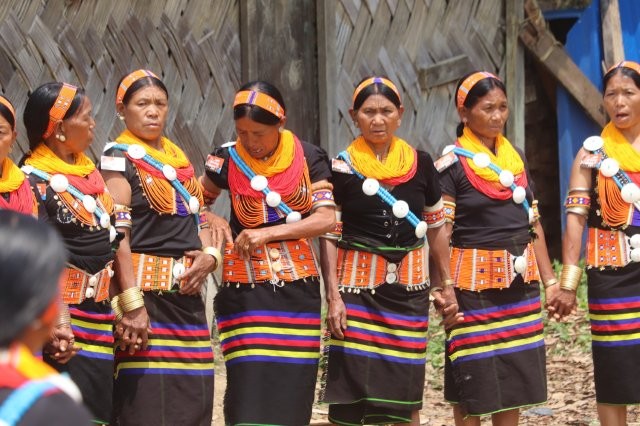
but the ladies are all properly lined up
The Practice
The big event, on the football pitch in front of the church, is supposed to start at 11 am. But this being India, the various neighbourhoods that participate are all still practicing at that time. And practice is a serious business, as at the end of the day one neighbourhood will be chosen by a jury of experts as the winner, the best performer of what turns out a rather repetitive dance. In one of the neighbourhoods near Zero Point, the queen herself is checking the outfit of the other women, and gives directions during the practice, in a not-to-be-misunderstood manner. With the men it is the same, the ‘lead man’ – not the king, I think -, tells the others repeatedly what they are doing wrong, and how to correct it. Never mind that during the practice some late-comers are also joining in, who have to be sternly instructed, as well.
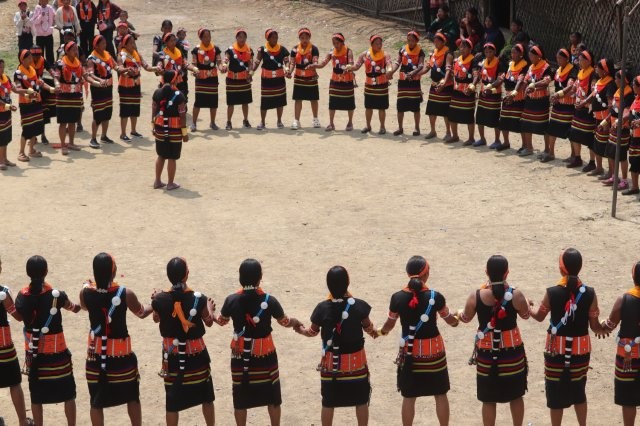
and from a distance it turns out to be a circle
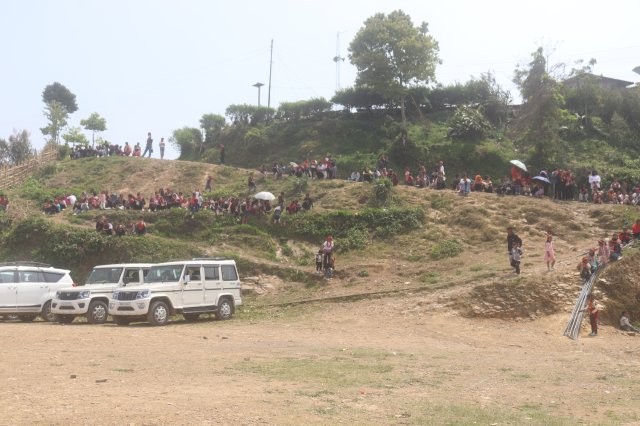
and this is the start of the venue, the football pitch in front of the church; spectators already taking positions

one of the groups of men marching onto the pitch

their leader proudly in front

and including all sorts of characters

you jave heard about tattoos amongst the Naga, well, this is obviously a fake

like I also doubt this is a real human skull

waiting for the many official speeches to end
The Performance
In the end the various groups from the various neighbourhoods march onto the ground a little past noon – and then have to wait well over an hour for the important people to finish their speeches. But then the festival finally bursts into action, first the men singing and dancing past the jury, and off the pitch again, followed by the women, who, by individual group, carry out their circular dance accompanied by a low-voice chant.

and then, finally, the parade in front of the jury

with the Baptist church as the backdrop

the remain a fabulous picture, these men with their hats and feathers

did I say feathers?

the women, too, are preparing for the real thing, leaving their shoes behind
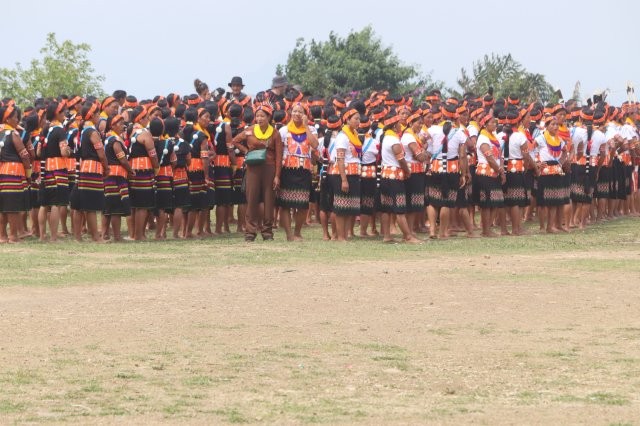
and lined up to start their performance

it is a crowd, but much better organised than the men

and this one? probably a princess

dancing in a slowly rotating circle

they, too, have their own specific decorations
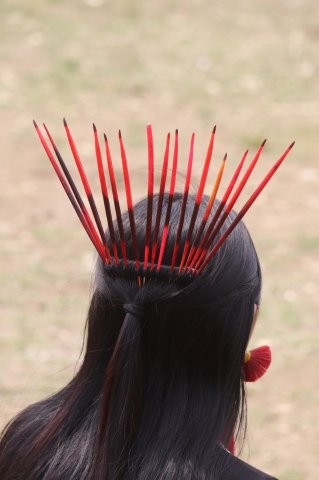
and another princess, perhaps?
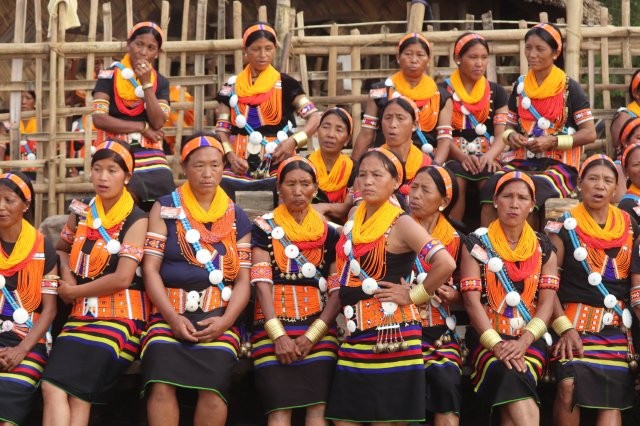
resting on the benches, after the performance
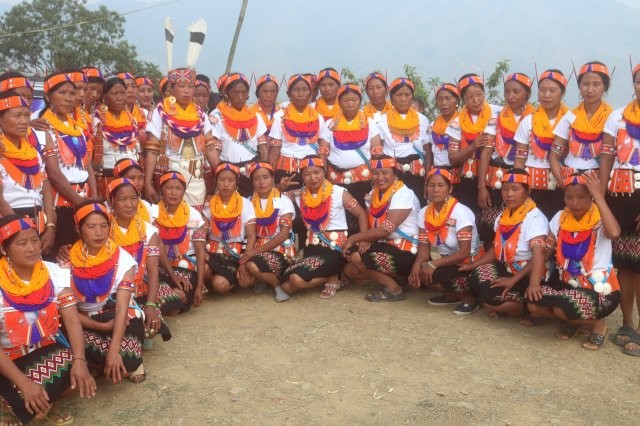
and always ready for the team photo

cutting down the fence, a political message of protest

shooting blanks, obviously, but creating lots of smoke – and noise!

in the last act, the men come shooting down from the hill
The final act is a war dance, in which all the men, of all the groups, participate. This is where the guns come in: every man, upon coming down to the pitch, fires his gun – no bullets, of course, just blanks – creating a lot of noise and smoke. They then proceed to chop down a piece of bamboo fence erected on the pitch. A political statement, the Indian government want to build a fence along the border, but the Naga people, who need to freely cross to visit their relatives and work their fields, are dead against this. And subsequently, the war dance evolves into a mildly chaotic process of men walking seemingly randomly in circles around each other. All very entertaining to watch. Some have had enough, and just walk out to join others who have done so earlier, and in the end only a small group of warriors is left. Including a few very young ones, who proudly participate!

and once all of them are on the show ground, it is a complete mess, everybody moving seemingly randomly

it has been enough, all this marching

well, at least some go in the same direction

and others have given up, take a break

the women, at the end of the afternoon
And that is it, really. The women come back once again to repeat their circular dancing, but after a while the groups disseminate, and get back to their homes. Where no doubt the celebrations continue, apparently by age group. And apparently, with a lot of alcohol among some of the groups. Never mind Nagaland is a dry state, no?
Inevitably, a lot of photographs!
The Tourists
Oh, and a word about the touristic power of this festival. There are perhaps twenty foreigners, mostly for the day – shipped in from Mon, and returning early -, and maybe twice as many Indian tourists; we meet people from Delhi, Chennai and other places. But what is clear is that this is not a festival performed for others, this is a truly local custom, and the tourists are welcomed as guests. That they not always behave that way, especially those with cameras with outsized lenses, is gracefully accepted by the Konyaks. They don’t object to the many photos, are happy to pose, too – after all they are proud of their heritage, remember, and they like their own outfits. Nobody gets upset, but as a photographer, I am disgusted and ashamed by the behaviour of some of my fellow photographers, both Westerns and India.
There are a few more photos, of the kids participating. And such a festival obviously also invites a lot of portrait photography, or at least what looks a bit like it.
Next, we spend the day in Sheanghah Chingnyu, for more festival.
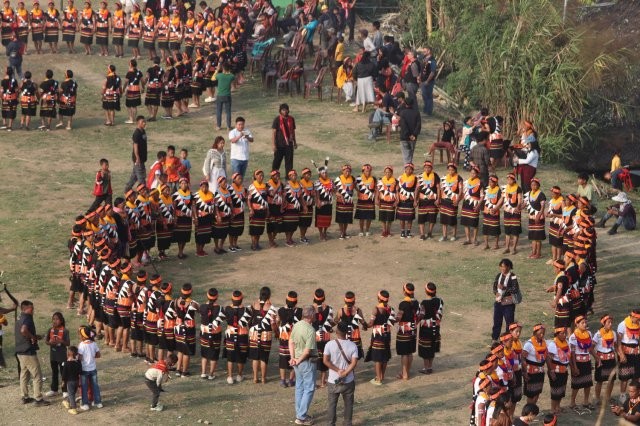
they come together in an encore

What a delightful read, Bruno :-)
Also, that bit about the ‘photographers’, well… what to say about it. What rightly fits here is the saying. ‘commonsense is not so common, sadly!’
Cheers!
Thanks, Rajiv. And thanks to you, because without you I probably would not have been able to stay in the village, and would have been one of those foreigners ‘shipped in from Mon’ :)