
the Turkmen State Circus, one of the characteristic buildings of Ashgabat that is not on the standard tour
The last day of our trip we spent in Ashgabat, without the group, but still with guide; the concept that you would wander around without is too uncomfortable for the Turkmen authorities (although at the end of the day I do manage to leave the hotel unattended, and make a few purchases in nearby shops).
We have a few things on our list, like an old, Soviet-era hotel – the former Ashgabat Hotel – that would fit well in our Brutalist photo collection from former Soviet and Eastern European republics. Except that the hotel has been refurbished (and renamed Paytagt Hotel) and painted white, and looks quite flashy now. Fitting for ‘the White City’, as it is commonly called. Inside are a few old Soviet mosaics, outside the hotel blends in well in the surrounding collection of further white buildings, from theatres to apartment buildings and yet another monument.

but the decoration is still Soviet-era

the former Ashgabat Hotel, now refurbished in gleaming white
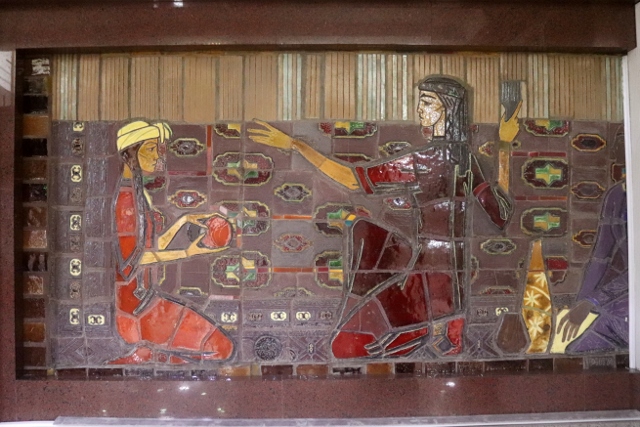
including some of its mosaics inside

this is the monument to the City of Ashgabat
We continue to other parts of this unreal city, cruising vast boulevards with few cars, and even fewer people – except for the occasional cleaner, or the ever-present policemen. Many of the junctions have modern sculptures, apparently sponsored by hotels. Lots of buildings are peculiarly-shaped, shall we say. My favourite, the office of the Oil and Gas Corporation, is supposed to look like a lighter – and that in a city where smoking outside is forbidden (inside, also in restaurants, there are no limitations on smoking, of course, this is Central Asia, after all). The Ministry of Foreign Affairs has a blue globe on its roof (see the first entry on Ashgabat). There is a rocket-shaped thermometer, an egg-shaped five-star hotel (in dark glass, admittedly, dissonating with the overwhelming white), the wedding palace which looks more like a moon lander, and an enormous shopping centre. Some of the earlier buildings were constructed with Italian white marble, but after a while the Turkmen discovered that there was cheaper marble to be had from Pakistan and Afghanistan – but marble it still is.

your standard apartment building, lining the avenues

and the avenues themselves, devoid of cars notwithstanding its eight-lane lay-out

even though there are no cars, there is lots of police on the streets

one of the traffic circle monuments
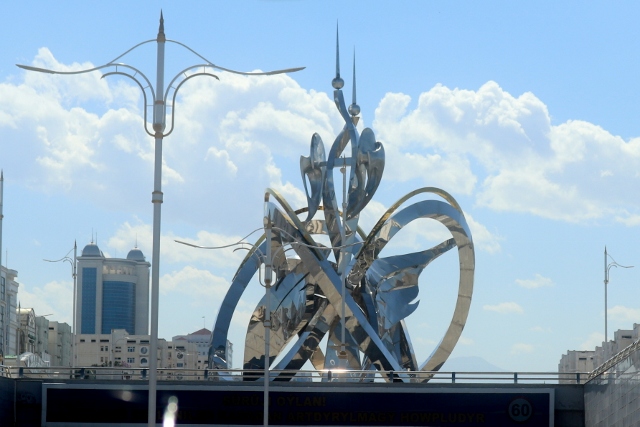
and another one, rather abstract modern art

I think this is the Ministry of Health, one of Ashgabat’s architectural gems

the Lighter, or, rather, the building of the Oil and Gas Corporation
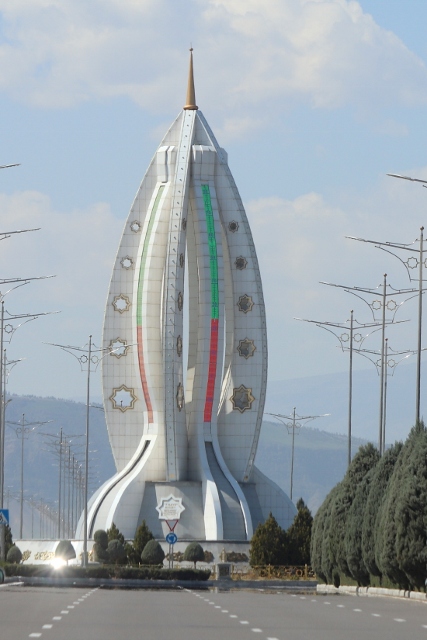
the thermometer, useful monument in another traffic circle

a five star hotel, obviously
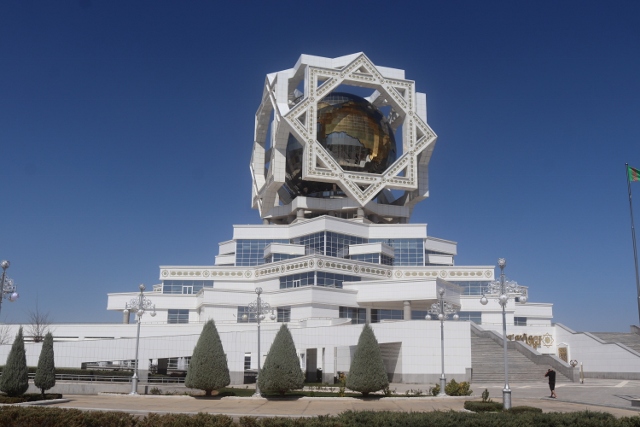
the wedding palace, resembling a moon lander
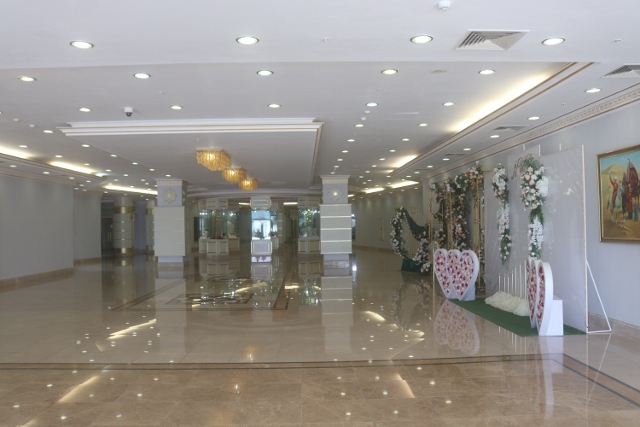
inside, everything breathes wedding

and shops cater for the same

this, apparently, is Ashgabat’s biggest shopping centre
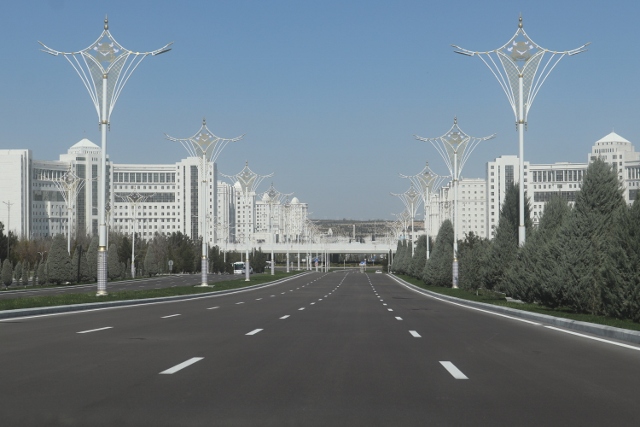
another view of wide, empty avenues lined with white apartment buildings
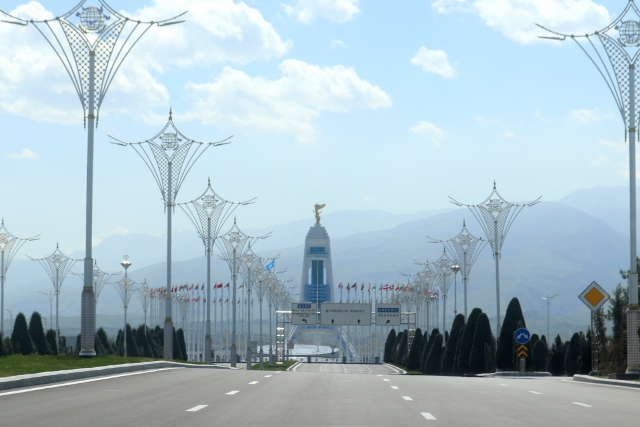
approach to the Monument of Neutrality, one of Turkmenistan’s most important international principles

a monument it is, although not very attractive

and the man who managed all this, the first president, in gold, no less

tricky photograph, because you are not supposed to picture anybody in uniform – he didn’t notice

a city full of ponds and fountains, never mind that it is surrounded by desert
Endless wide avenues, lined with endless, high apartment buildings, in white marble, do create a sense of spaciousness. The occasional cars we encounter are all white, and occasionally silver or gold; other colours are not admitted in the city (I am not joking…). In between the buildings enormous parks have been constructed, interspersed with copious fountains – in a city that is surrounded by desert. The parks are empty, the fountains splash their water around for nobody. Bus stops, often in futuristic shapes, pop up every few hundred meters, apparently without any information about which bus and at what time it is supposed to come. But nobody cares, there are no people waiting anyhow.
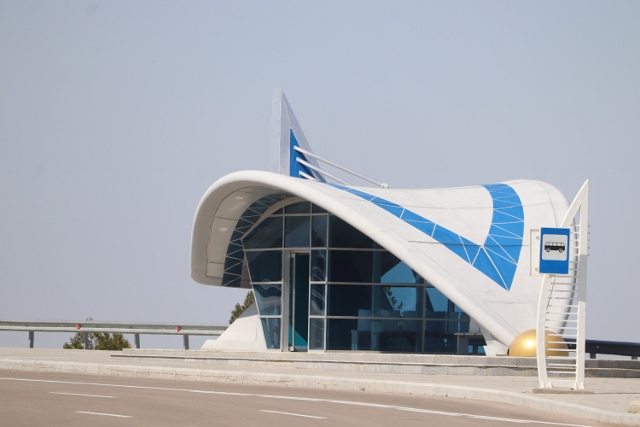
a futuristic busstop, without further information, and without potential passengers, too
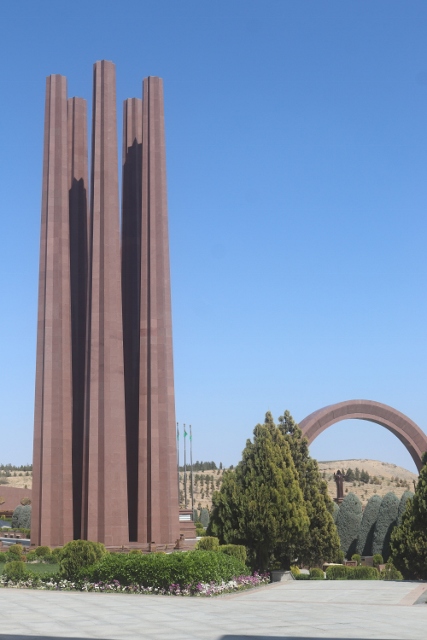
Halk Hakydasy Memorial Complex, outside Ashgabat, for those killed in the Battle of Geok Tepe in 1881, in World War II, and in the 1948 Ashgabat earthquake, all together

this is the memorial to the earthquake victims of 1948

the murals depicting a battle in 1881

not sure who this is, could well be the first president again, in gold, just somewhere in the city

Turkmenistan’s second president does try to outdo his predecessor, by posing on the back of a horse instead of in a chair
The big missing is the Presidential Palace, of the finest marble, for sure, and gold-domed. Our guide is terrified of me getting close, because he fears that I will start taking pictures, which is strictly forbidden – and enforced by the presence of lots of policemen, every ten meters, or so, surrounding the palace. It is another impressive building, and impressive square in front of it, and further impressive buildings surrounding it, next to another impressive monument. But, no photo’s. And in reality, the palace’s architecture is a bit too conventional to rank high on Ashgabat’s architecture top ten.

amazing, that they allow these trees in Ashgabat, a clear break with the white colour dominance

the palace, from a distance – sneakily my own photo

and a palace photo, from the internet

the Russian Market, another sterile experience without atmosphere

lots of stalls, lots of produce, but no people to buy, it seems

colourful it is, with heaps of spices for sale

two of the many caviar sellers

and the caviar, in several varieties
My original feeling, that this is a fake town, was probably too harsh: it is a fascinating town, and the architecture is at times mind blowing. But it remains soulless, sterile. Even in the Russian market, inside another large, rather featureless building, there are very few people except the sales people at the stalls. I don’t think many locals come here to do their shopping; once again it seems to cater for tourists, mostly. It lacks the atmosphere of a real market. We buy caviar, for about 10 Euros per 100 grams, after having tried spoonfuls of four different varieties. The vicinity of the Caspian, I suppose.

Lenin, on a pedestal of 100 year old tiles, a far cry from ‘white’
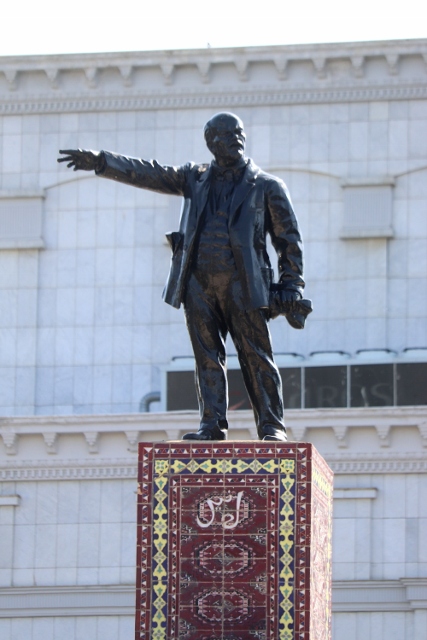
closer, it is Lenin indeed, classical posture

and just in case you doubt, here is the proof, in the same century-old tiles
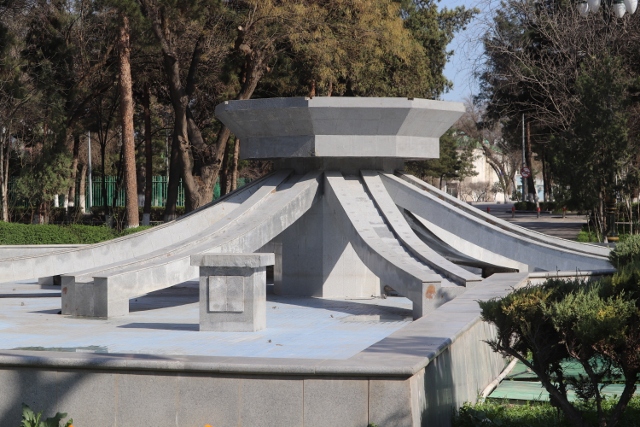
and nearby the statue, a true Brutalist fountain, finally – and not repainted in white, just the original concrete
Yet, there are the occasional remnants of history. We find the Lenin statue, in a small square in the centre. Nothing compared to the huge, golden sculptures of Turkmenistan’s past few presidents that adorn Ashgabat in many different places, but still. Something from the past has survived, and that includes the 100-year old tiles that have been used for the base of the sculpture. And a short walk from Lenin are some real old-style Soviet mosaics in concrete, fabulous. And the fountains next to Lenin, they are also concrete, true examples of Brutalism, finally!
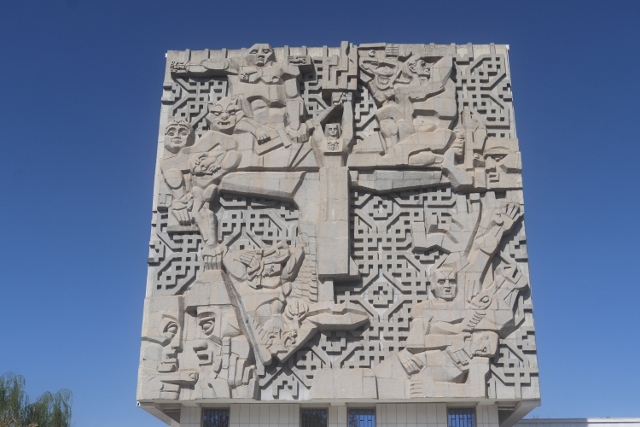
a vintage Soviet piece of decorative art, close to the Lenin statue

this too, another detail

and a detail, of anothe one, next to it

the park in Central Ashgabat, with stalls and food and entertainment

familiar? buying a ticket for one of the fun fair attractions in the park

children enjoying the fun fair, like they do everywhere in the world
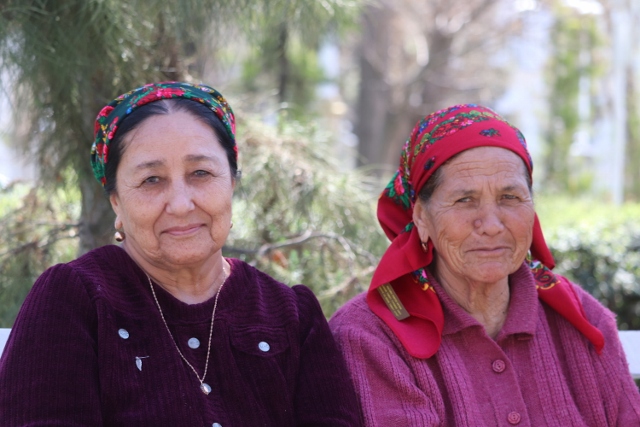
two ladies enjoying the Sunday afternoon in the park
Things are getting better, even. We leave the car for a walk, which leads to a park with lots of children’s play attractions, like a fun fair. And, it being Sunday afternoon, here we find lots of people, very colourful. Cotton candy, ice cream, it is all there, and people are enjoying it. How different from that sterile city we have seen so far.

in the neighbourhood of our sculptor friend, suddenly some more normal houses
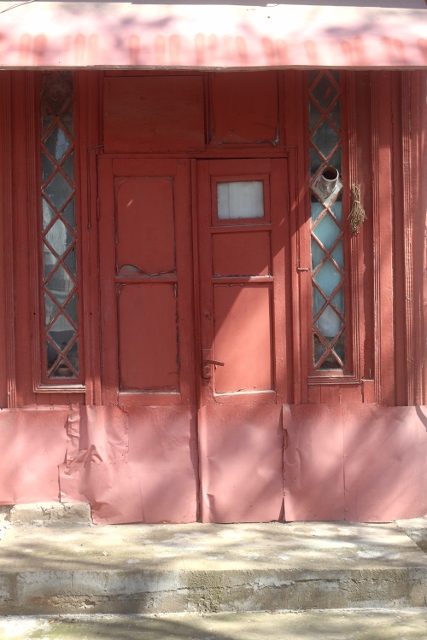
away from the main boulevards, red doors (God forbid, they are not white!)

the entrance to the atelier is the stairs right

and the atelier is like, well, an atelier, strong contrast with what one would expect in Ashgabat

the artist himself
We visit a sculptor, Velmurad, in his atelier. He is an accomplished artist, quite famous in Turkmenistan, apparently. One of the sculptures of Saparmurat Niyazov, sitting in a chair, and in black, is from his hand – I have seen the sculpture in Ashgabat, but I cannot find it back. His workspace is that of an artist, so much is clear, full of finished and unfinished works, and the walls full of paintings and prints from artist friends. Coffee, and the obligatory glass of vodka – it was not yet lunchtime.

and with us, at the coffee table – the vodka comes later

the neighbourhood behind our hotel, with children’s playground
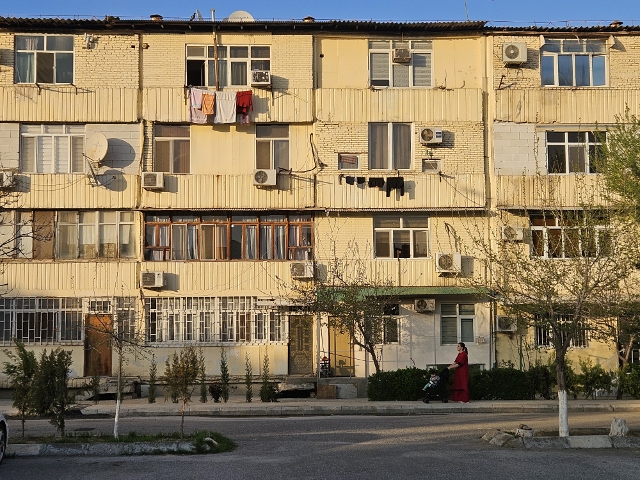
and non-white buildings, non-white laundry, even

really, your standard palati, or khrushchevka

another Soviet reminder, the mural
At the end of the day we return to our hotel, from where I finally manage an unaccompanied walk, in an effort to find shops to spent our last manats – the local currency which is, surprise surprise, not convertible. Not having seen a single shop along the long avenues today, the neighbourhood behind the hotel is actually full of them. And full of the much smaller apartment buildings which we now call khrushchevkas, see the description earlier. They are beige-coloured, and the laundry that hangs from the windows is also far from white. Here, too, there are quite a few people in the streets, enjoying the late afternoon sunshine, and children playing outside. Guess what, it is a real city, after all, with real people. Carefully hidden from the main streets, behind the white facades of the buildings lining the prestigious avenues. You would never see this from the car, or from the windows of the bus, cruising the monuments of Ashgabat.
lastly, some closing observations
