
the Turkmen are known for their traditional dress, here two men in front of a yurt
I am aware that Turkmenistan is not the most obvious travel destination for most. But perhaps that is just one of the things that appeal to us, it is utterly non-touristic. And for a reason, of course: 70% of the country consists of the Karakum desert, the dryest desert on earth. It is also a pretty totalitarian state, with rulers – only three since independence in 1991 – regularly receiving 97-99% of the votes in elections. And they are not particularly welcoming to foreigners.
Perhaps that’s a remnant of history. Turkmenistan has been invaded multiple times, Alexander the Great being the first conqueror, in 327 BC, of what was then known as Bactria and Sogdiana. The Greeks didn’t last long, and were overthrown by the Parthians, an Iranian nomadic tribe, in 247 BC. They established their capital in Nisa, close to present-day Ashgabat, and one of the World Heritage sites in our itinerary. The Sassanid Empire took over from the Parthians in the 3rd C AD, also the time that the Silkroad gained importance; Merv in Turkmenistan – also on the itinerary – became an important commercial hub, along with nearby Samarkand and Bukhara (in Uzbekistan). The Islamic conquest of the 7th C was the next invader, and turned Merv into an important centre of Islamic scholarship, trade, and culture during the successive rules of powers such as the Umayyad and later the Abbasid Caliphates, and the Seljuk Empire in the 12th C. Only for the Mongols of Genghis Khan to sweep through Central Asia in 1221, and be particularly catastrophic for cities like Merv, which was all but destroyed.

another Turkmen family, another yurt, photo taken in 1911
It was only after the retreat of the Mongols that the current ethnic groups, Turkmen nomadic tribes, settled in the area, and lived in relative peace with their neighbouring entities, the khanates in Persia and in Kiva and Bhukara. After all, there wasn’t much to envy the Turkmen, who lived a relatively simple life in mostly the desert, and in small oasis towns. Except that the Russians, drawn into the Great Game with the British at the end of the 19th C, expanded their colonial ambitions and incorporated what they called the Transcaspian territory in the Russian Empire. Which then turned into part of the Soviet Union, as the Turkmen Soviet Socialist Republic, in 1924, sometime after the Russian Revolution.
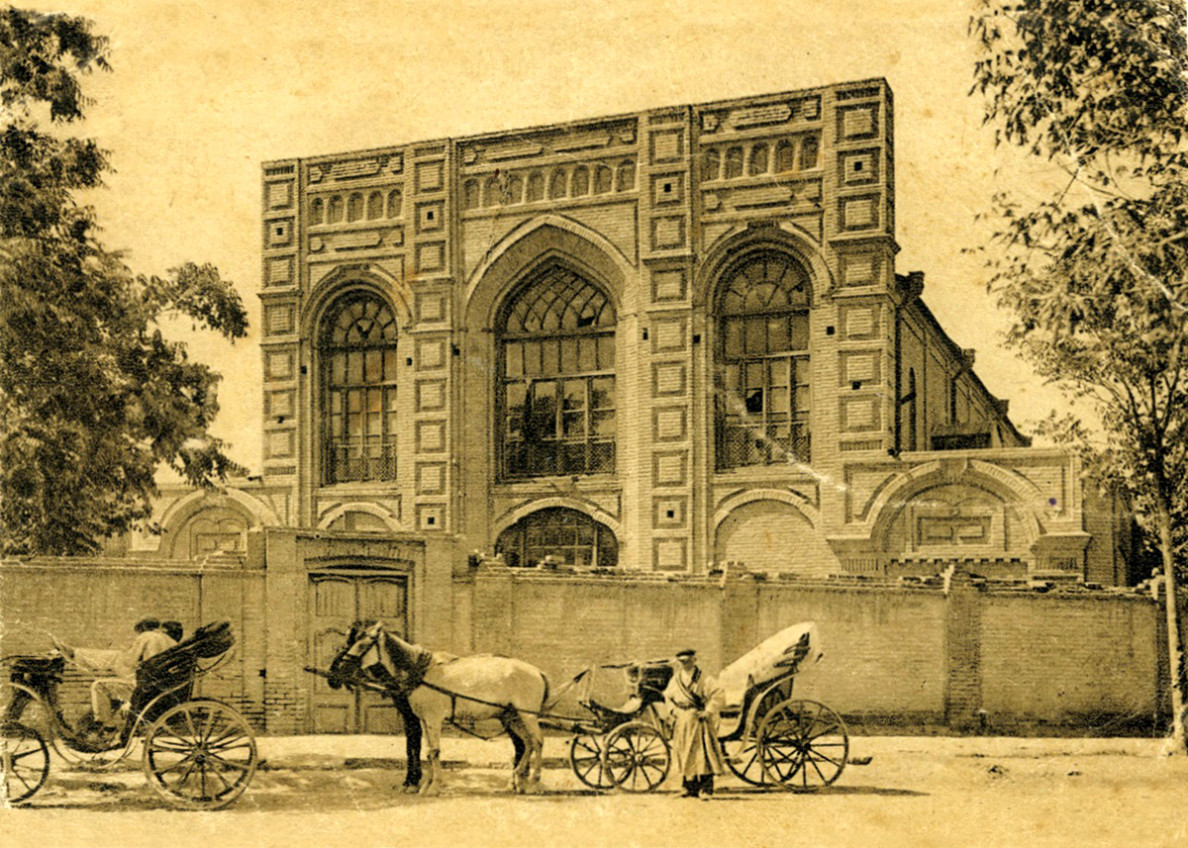
a mosque in Ashgabat, probably somewhere early 20h C
The Russian cum Soviet domination lasted until 1991. In the meantime the agricultural initiatives of the Soviets had destroyed whatever was left of the nomadic lifestyle. As in the other ‘Stans’, cotton became an important export product, in addition to nuts and fruit. But all of this paled into insignificance compared to the vast quantities of natural gas, and to a lesser extent oil, that had been discovered under the surface of Turkmenistan, and the Caspian Sea, since the 1960s.
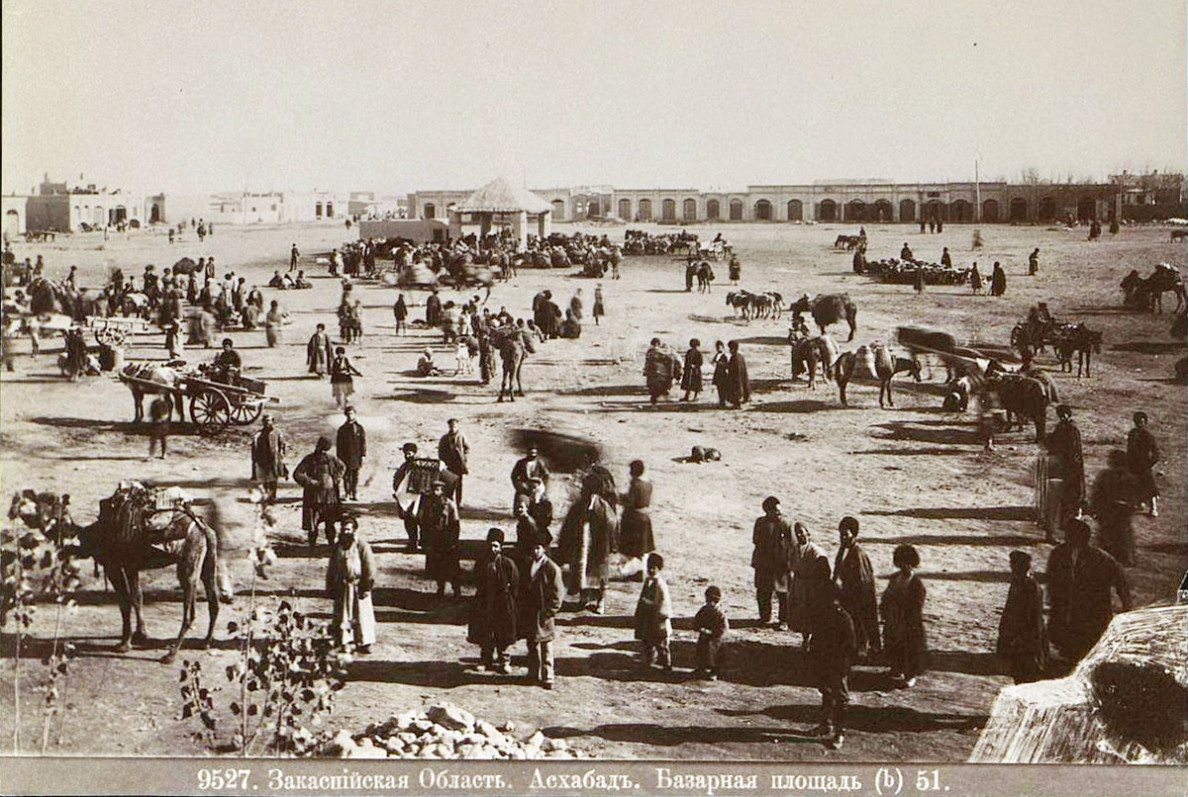
the Ashgabat market, also quite some time ago – but lovely old photograph

one of the many golden statues of Saparmurat Niyazov, Turkmenistan’s first president
Independence came reluctantly, as Saparmurat Niyazov, a former official of the Communist Party of the Soviet Union, who had ruled Turkmenistan from 1985, was actually against the break-up of the Soviet Union. But when that became inevitable, Niyazov had himself quickly elected president, and in 1999 even president for life – which ended with his sudden death in 2006. He also gave himself the title ‘Turkmenbasy’, meaning head of all the Turkmen, and established one of the world’s most brutal and autocratic regimes, enlightened by an excessive personality cult which is still visible in Turkmenistan today.

the current president, Berdimuhamedow ‘fils’, is everywhere, to start with on the front page of every edition of the local newspaper
Upon his death, Gurbanguly Berdimuhamedow took over the presidency, initially with a rather meagre election result of only 89%, but for his second term he got the more familiar 97% of the votes. If Niyazov was an autocrat, Berdimuhamedow was little better, establishing an even more repressive system. However, in 2022 he voluntarily stepped down as president – and was succeeded by his son Sedar, who then appointed his father as chairman of the newly created People’s Council and granting him the title “National Leader of the Turkmen People”. You cannot fault the country on political stability. It hasn’t done much to improve human rights abuses, lack of free speech and rampant corruption, though.
next: arrival is Ashgabat
