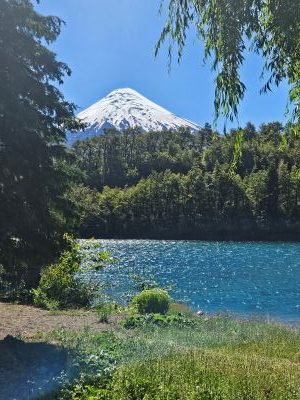
 As part of our European Winter escape we went back to Chile in December 2025, for a couple of weeks experiencing the south of this fascinating country. Part of the south, actually, it is just too big to do all in such a short timespan. Volcanos and mountain lakes in the high Andes, and along part of the Carretera Austral, alternating with the occasional coastal village, provided for a varied trip.
1. the Chile plan:
We have been to Chile before. In 2019 we travelled from Argentina to Santiago, and then turned north along the Costa Pacifico. An epic, four months journey. This time we aim for more southern parts of this fascinating country, in only a little over two weeks.

the first day traveling
2. the first day
Already before we started our already rather short trip, we had to make adjustments. Less time, so cut down further on the program. We sacrifice the colourful Mapuche markets and the museum of Temuco. We just sleep in Temuco, but only because the plane arrives there, and the car rental company is based here.

Panguipulli
3. Panguipulli
A little south of the Pucon/Villarica region is the zone of Las Siete Lagos, the seven lakes, another rather touristic area. It is nice enough, with lots of green, forests, but also cattle farms, expansive grazing areas, quite like Argentina on the other side, actually. Interestingly, lots of construction – houses, barns, but also churches – is made out of wood, or at least they have a significant wood component.

Valdivia
4. Valdivia
Time for a change of scenery. On our journey south we deviate towards the coast, to Valdivia, one of Chile’s larger towns. On our way we first drive to Niebla, a small town at the entrance of the estuary of the Valdivia River, and part of the Spanish defences put in place after the Dutch threat of 1643.

Volcan Osorno around Petrohue
5. Petrohue and Volcan Osorno
Having enjoyed the coast briefly, we head further south, to more volcanos and more lakes. After a few hours on the Ruta Panamericana, the main north-south motorway, we turn off towards the mountains again, with spectacular views of the Cordillera, including several snow-capped volcanos.

Cochamó
6. Cochamó
From Osorno we continue south, checking out another scenic route which ultimately leads to the Carretera Austral, via Puello. It is a bit repetitive, more lakes, more volcanos, but scenic it is. There are few villages, few opportunities to eat, until we reach Cochamó, at the edge of Estero Reloncavi, a fjord in connection with the open sea, with the Yates volcano in the distance.

the ferry journey from Hornopiren
7. the ferry from Hornopiren
We have hit the Carretera Austral, the epic road that runs from Puerto Montt in southern direction, to the far end of Chile. We don’t know exactly what to expect, what the road conditions are going to be, whether most of it has been paved by now or whether there are large sections of ripio – the dirt road, surfaced with small stones, always treacherous in the bends, where one is bound to loose grip on the road with even medium speeds. Potholes, landslides, they can all be part of the adventure, apparently.

Chaiten
8. Chaiten
In fact Chaiten is lovely. Nothing like a considerable town, it is a small village instead. Badly destroyed by a completely unexpected volcanic eruption in 2008 – the volcano with the same name as the town, 10 km north. But built back, spaciously, all wooden houses. Of which one is a pleasant B&B, and another perhaps the best fresh fish restaurant of the trip so far. King crab, and Congrio, a fabulous local fish.

Futaleufu
9. Futaleufu
To get to Futaleufu, we first follow the Carretera Austral further south. The clouds are slowly clearing, and once the sun is out, we enjoy another spectacular view of the mountains. At one stage the entire Cordillera is visible, with snowy peaks as far as the eye can see. The local people keep on telling us how unusual this weather is.

La Junta
10. La Junta
It is not only the delay with the ferry from Hornopiren that has forced us to adjust the program once more. We have also not been able to book ferry tickets to cross to the island of Chiloe, which was initially part of the plan. There are several crossings listed on the company’s website, but every time we try to book online, we fail to get any further than selecting a boat, and seats: at the next step we get a failure notice.

Puyuhuapi
11. Puyuhuapi
Next up is Puyuhuapi. Just as insignificant as all the other villages along the Carretera Austral, but equally charming. Wooden houses, a restaurant or two, and – rather unique along this road – access to the sea. So there is a jetty, and some fishing boats moored along the Costa Nera.

Puerto Chacabuco
12. Puerto Chacabuco
We continue to Puerto Chacabuco. The mountain scenery is equally spectacular as before, but in a different light. Sometimes dramatic, with the clouds hovering above the highest peaks, and sometimes enlightened, as some sunshine manages to get through. Most of the road is actually in pretty good condition, only part of it is ‘ripio’, although in some parts the question is not if, or when, you are going to hit the potholes, but more like, which ones are you going to hit to avoid the others.

the San Rafael glacier
13. the San Rafael glacier
From Puerto Chacabuco one can book a boat tour to the San Rafael Lake and Glacier, a full day affair. We are a bit uncertain about the idea, because the tour is not cheap, and there is no refund should the trip be cancelled. The weather forecast is 100% rain. But then, when else do you get the opportunity to go to the base of a glacier without serious mountaineering, in a comfortable seat, instead, on board of a well-stocked catamaran?

Coyhaique
14. Coyhaique
If you think this entry is going to be about the town of Coyhaique, the furthest south we get on the Carrera Austral, you are mistaken. There is really not much to write about Coyhaique, except that it’s only tourist attraction is a monument to the sheep herder, and that it has – confusingly – a main square which is in fact a pentagon. Highly unlikely for any South American town, which is always laid out rectangularly.

the fjord coast of Contao
15. Contao and the Coast
Those locals who claim that, if it rains, it only rains briefly, were wrong. The next two days it continues to rain, incessantly. We make our way back, up north along the Carretera, back to Puyuhuapi, back to Chaiten, and back onto the ferry to Hornopiren. Glad we have seen this stretch of the road earlier, because now there is not much to see at all.

Puerto Montt
16. Puerto Montt
Puerto Montt is not a particularly attractive town. But it is the first big town in a while, so we decide to brace the traffic – not too bad, after all – to get some supplies, and change money. And then we drive on, along the coast, to the Angelmó neighbourhood, where the port is, and the fish market. And, not unimportantly, the fish restaurants, where we have another lunch feast from all those products we have just seen in the market down below.

Puerto Varas
17. Puerto Varas
Had the weather been better, we would have reconnected with Volcan Osorno, on the other side of the lake from Puerto Varas, Lago Llanquihue. But the peak remains obscured in the clouds, this time. Puerto Varas is a small town, its lake side quite touristic, with a small beach, kayaks for rent and several bars and restaurants. But away from the lake it has a nice, quiet neighbourhood with many of the houses of the original German settlers still in good condition.

Osorno
18. Osorno, the town
Some 100 kilometres away from the volcano is the town of Osorno. There is no real, touristic reason to stop here, but the weather is miserable, not inviting for a drive through the country side, as any lakes and volcanos will not be very photogenic on a day as today. So we decide to spent the afternoon in town, and you know, we could have done worse. Osorno, too, has some old German houses, and a pleasant centre.

the Auracanian coast
19. the Auracania Coast
We need to get back to Temuco, to return our rented car. But rather than going in a direct line, Ruta Panamericana further north, we decide to detour in the direction of the coast, which we reach at Mehuin, a small fishing village just south of the provincial border of Auracania – the province of which Temuco is the capital. In fact we reach an even tinier village, Missisippi, located at a pretty bay, with a beach and boats moored offshore.

Carahue
20. Carahue
We had no intention to stop in Carahue, just a small town in between the coast and our end destination, Temuco. But upon entering town we are confronted with the railway museum, always a reason to have a quick look.

Temuco
21. Temuco
Where we had to drop the tourist attractions of Temuco on our first day, because of changes in our program, due to further changes we suddenly find ourselves with time on our hands, and a full day in Temuco for the things listed in my guide book. Worthwhile here are the regional museum, with its collection of Mapuche art and artefacts, and the colourful central market, also dominated by colourful Mapuche stalls.


