
Mercado Fluvial, the market along the river in Valdivia, being cleaned at the end of the day
Time for a change of scenery. On our journey south we deviate towards the coast, to Valdivia, one of Chile’s larger towns. On our way we first drive to Niebla, a small town at the entrance of the estuary of the Valdivia River, and part of the Spanish defences put in place after the Dutch threat of 1643. The fort here has been heavily restored, and can only be accessed via metal walkways that have been constructed over the original walls. It diminishes the authenticity experience somewhat, but at least we don’t break our necks on an uneven rocky surface. In fact there is little left of the fort, except for some low walls that represent the original chapel, the munition storage and some other small buildings. The highlight is the row of canons – which once again can only be observed from a respectable distance. About half of them are originals, the others reproductions.

the bay overseen by the old Spanish fort in Niebla, without mist this time

the fort itself, made accessible through metal walkways

one of the few remaining walls, no doubt heavily restored

the battery of canons, some original and some reproductions

and one in more detail: no idea whether this is an original one or not
The natural rock faces, which also form part of the fort’s defenses, are all covered with graffiti, some carved the 1920s – the oldest we found -, others as recently as well into the 21st century. Signs note that the present administration of the fort is not responsible for this vandalism occurred under an earlier administration, the present one is not responsible. Why that needs to be stressed, I have no idea.
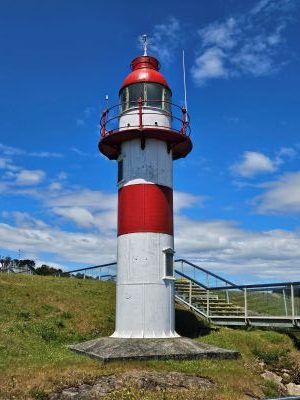
the lighthouse, no doubt a later addition to the fort

the beach at Los Molinos, which tries to frame itself as a resort town

but with secondary, or primary, industry being small scale fishing
There is not much else in Niebla, so we drive along the coast of the island to Los Molinos, a more enterprising fishing village posing as tiny little beach resort. But this, too, can’t keep us long, so we continue to Valdivia.

further along the coast, no beaches anymore

the river side in Valdivia, with some old buildings
In fact Valdivia is not on the coast, but along the banks of several rivers that merge into the estuary. Most activities centre along the Calle Calle River, separating the Isla Tega from the main land. On the island side are a few museums, housed in 19th C buildings, but we arrive too late, and in any case the old stuff on display here doesn’t interest us much. Neither does the ‘maritime museum’, consisting of a submarine moored on the other side of the river. Much nicer is the fish and vegetable market, not only for us, but also for the hundreds of vultures waiting to catch some of the scraps that the fish sellers leave behind cleaning the fish. First in line, however, are the seals; one of them has inserted himself right next to one of the stalls. Further along are the cruise boats, attracting tourists for a trip on the river.

and the same, from the other side of the river, the low market building dominating the quay

and from the bridge, the tourist boats that cruise the river in the afternoon

and anywhere along the river, a chance to meet seals
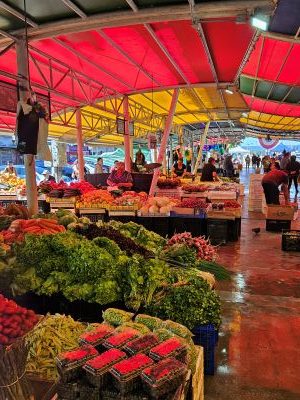
the Mercado Fluvial in the morning, in full swing

fresh fish being the dominant selling point

and fresh fish they have, fabulous

as well as some undefined shell fish
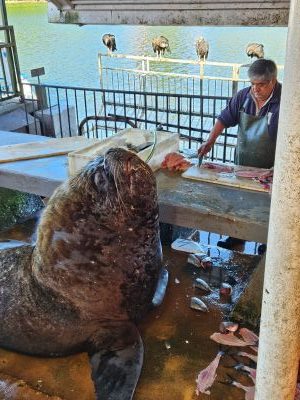
a large seal has installed himself inside the market

leaving very little for the vultures that have lined up around the market

there is some reasonably good graffiti in town, this one under the bridge

and this is my favourite mural, could be a Banksy all along

the 18th C Torreon de los Canelos, landmark of Valdivia
Away from the river side is the Torreon de los Canelos, a 18th C tower, now a historic landmark, originally built as part of the defences of the city. Not against the Dutch, but against the local population, the Mapuche, a far more cumbersome enemy at the time. The other main site is the Plaza de la Republica, where, like in Panguipulli, the Christmas atmosphere is already tangible.
We enjoy the evening in Valdivia, although without pisco sour, this time – which is compensated by a plate of very tasty, small but fat oysters.
next: Petrohue and Volcan Osorno
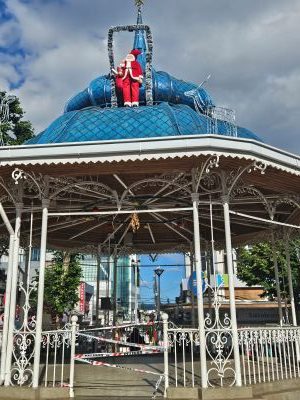
and here, too, Chrismas is around the corner

to be celebrated with colourful baloons, why not?

and the lack of pisco sour is compensated for with a plate-full of small oysters
