
Wepaly, the dog mascote from the Ashgabat 2017 games, is perhaps the only non-white element in the otherwise white city
Our first day consists of a bus tour through Ashgabat, with the occasional stops. I had been prepared, but the initial impression of the city is still one of complete amazement, unreal. Wide avenues, with two times four lanes, are lined with white marble apartment buildings, where, apparently, ‘the elite’ is living – dixit our guide. Presumably, they are all working in some of the other extravagant marble buildings, the ministries and the banks, the flashy hotel, or the multiple-domed presidential palace. How much of it is really in use remains unclear – there are no signs of habitation of the apartments, no laundry outside, for instance. The ‘Olympic’ village, constructed for the Asian Indoor and Martial Arts games held ten years ago, is empty, and the monorail, part of the same construction, is also not working anymore. The in my eyes quite impressive stadium has, in the meantime, be replaced by an even newer stadium.

wide avenues, white buildings, and no cars, no people – this is the approach to the neutrality monument, which explains all the flags

one of the buildings in Ashgabat, this is the (former) ministry of oil and gas: the bulding represents a lighter…

another one, the ministry of foreign affairs, with a world globe on the roof

and what about the ministry of communications, in the form of a book? (really…)

some of the white buildings, rather ostentatious, not to mention the golden statue

street view, with endless rows of street lamps

the independence monument, one of the many monuments in town

one of those monuments for former presidents, this is Turkmenbasy (formerly known as Saparmurat Niyazov) in gold
In addition to the white buildings, all over the city enormous monuments rise up, celebrating independence, neutrality, or just the glory of one or another president. In between all these buildings land monuments lots of green space, often adorned with fountains, and copiously provided with hundreds, no, thousands of white street lanterns.
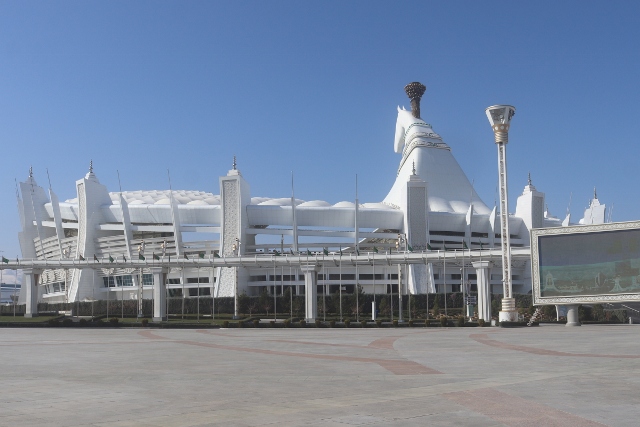
the stadium for the 2017 games

fountains, not all of them working

but in plenty of places they do work, and they do splash lots of water around

wide avenues, lots of green parks, and no people, except for the occasional street cleaner
There are hardly any cars in the streets. There are no people. The city is empty. Sterile, a complete lack of atmosphere. The first ten minutes the impression is overwhelming, but soon afterwards it wears off, and the feeling I am left with is that of a fake town. What a waste, for nothing, really, except prestige.

the ferris wheel, inside this circular building

the gondolas, trapped

a cleaner near the ferris wheel, just in case somebody else turns up, today
We arrive at the only closed-in ferris wheel in the world. Which is turned on, especially for us. There is nobody else. At the national museum a guide is awaiting our arrival, and I have the strong impression that she just switched on the lights. We are the only visitors.

and a rare view from the gondola through a not-so-dirty window, of Ashgabat below
Which in no means affects the experience, mind you. The ferris wheel is a rather useless one, anyhow, as through the windows outside the gondolas you cannot see much, because the glass is pretty dirty. But the museum is quite nicely arranged around the history of the various civilizations that have been through Turkmenistan, starting some 3000 years BC, and continuing to the arrival of Islam, with an exquisite selection of not too many artefacts – an art for a museum. And with the accompaniment of an excellent guide, knowledgeable without wanting to share all she knows – an art for a guide.

one of the 5000 year old female figurines in the National Museum of History
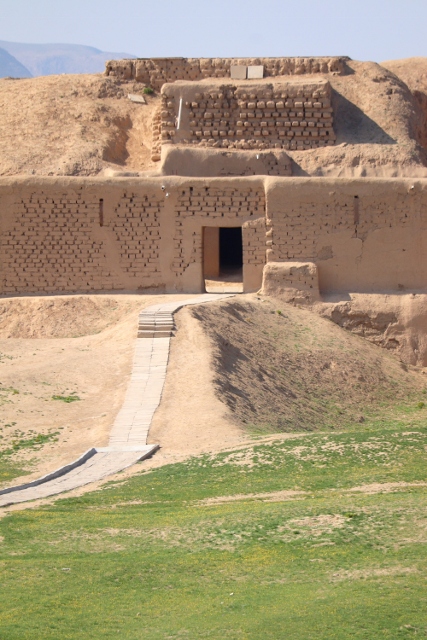
the entrance to the restored part of Old Nisa
After the museum we drive to our first UNESCO World Heritage site of the trip, Old Nisa, the capital of the Parthian empire from 3rd C BC to 3rd C AD. Most of what is to see there has been restored, but with some imagination, a portfolio of A4 PowerPoint slides the guide holds up so once in a while, and the knowledge picked up in the museum, we can create our own impression of how it must have been, back then. Some further details, and some pictures, here.

the Saparmurat Niyazov mausoleum, fitting for Ashgabat

and the tomb of the first presidents and members of his family, inside
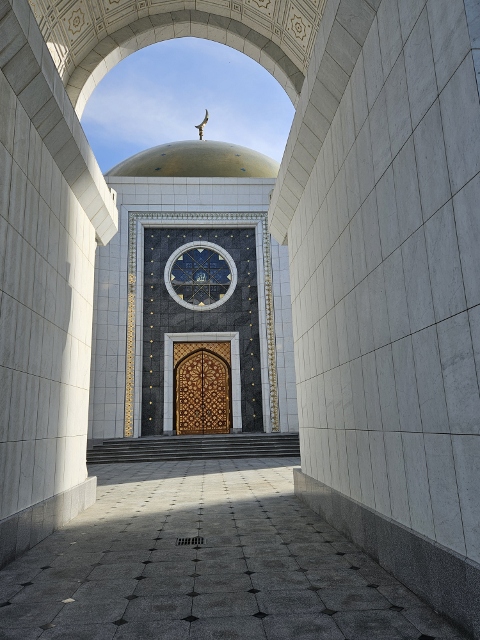
appraoch to the mosque, nearby the mausoleum

and one of the doors of the same mosque
Just before we take the train to our next destination, Turkmenbasy, we pass by the mausoleum of, er, Turkmenbasy, the name given to the first president of the Republic – by himself -, who subsequently also decided to name a city after him. What can I say? Fitting for this white marble city, and fittingly sterile.
At the end of our trip we have another day in Ashgabat, during which we may have a little more time to enjoy the architecture. A somewhat hurried bus tour is perhaps not the best introduction to the city. Or, who knows, the extra day turns out to be a waste of time. We shall see.
outside Ashgabat is Old Nisa

a man at the railway station, proudly showing off his traditional costume

more passengers getting ready to board

and then the train arrives at the platform

heading for Turkmenbasy
