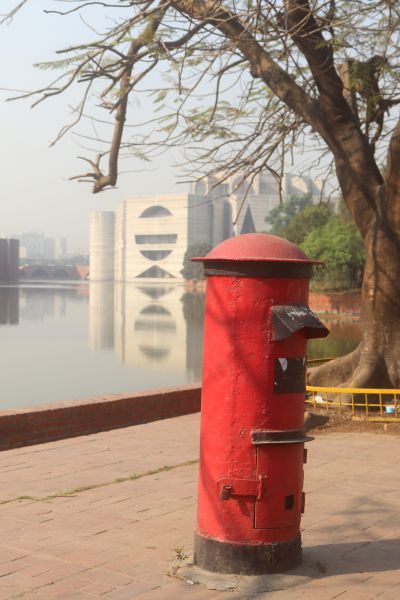
the Jatiya Sangsad Bhaban, Bangladesh’s parliament building in Dhaka
As I said earlier, Dhaka doesn’t have a lot of tourist sites to visit, yet, we manage to squeeze in several stops in our one-day tour. On the evening of our arrival, almost two weeks ago, I mentioned that there was even some mildly attractive modern architecture around. I hadn’t seen the Parliament Building yet!

another view of the parliamnet building Jatiya Sangsad Bhaban
The Jatiya Sangsad Bhaban, as it is known in local language, is one of the largest legislative complexes in the world, covering over 200 acres. It was designed by famous American architect Louis Khan in 1962, when Bangladesh was still part of Pakistan. Ironically, the man who commissioned the project was by Ayub Khan, who had grabbed power in a military coup in 1958, and is not known for his democratic credentials, shall we say. But the building is fabulous. And even better, fits very well with our newly developed interest in Brutalism. Unfortunately, we cannot visit inside; the building is closed, because since the last president, Sheik Hasina, has been sent into exile in August 2024, there is no parliament anymore. The ‘special advisor’, as our guide refers to caretaker president Mohamad Yunus, has not yet managed to hold new elections.
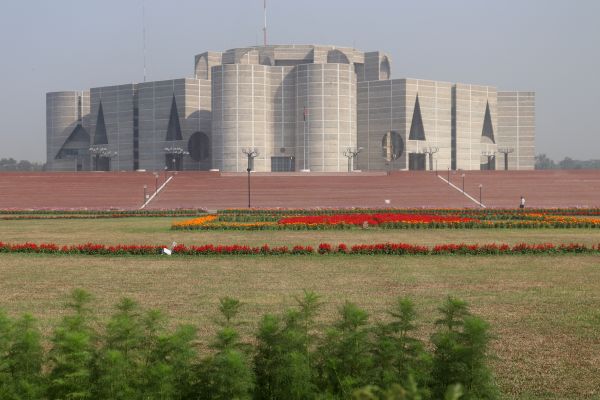
and this one, from the other side
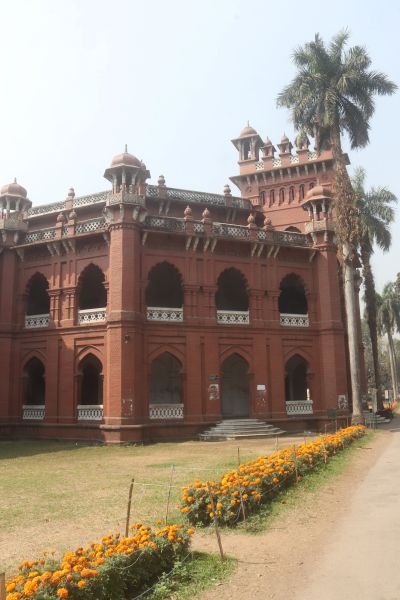
the Lord Curzon building, now the university’s Science Faculty
Curzon Hall was built in 1904, named in honour of the then British Viceroy Lord Curzon. The building was initially meant to be the townhall, but when finished in 1908, was turned into a collage library. It was not until 1921, with the establishment of Dhaka University, that it became the main building of its science faculty. Whether the large campus with many buildings, all in the same style of red brick and turrets, was added then, or also dates from 1908, I don’t know. It is not ugly, but not very beautiful either, and in need of maintenance – a euphemism for slowly falling apart.

and a student’s hall, where exams are taking place today
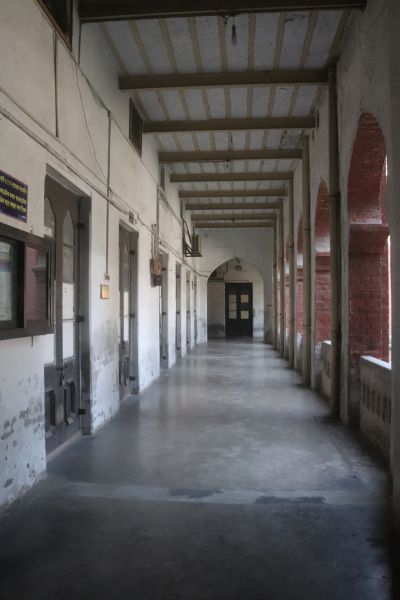
great corridors, in old buildings

a window at the university, where maintenance could do wonders
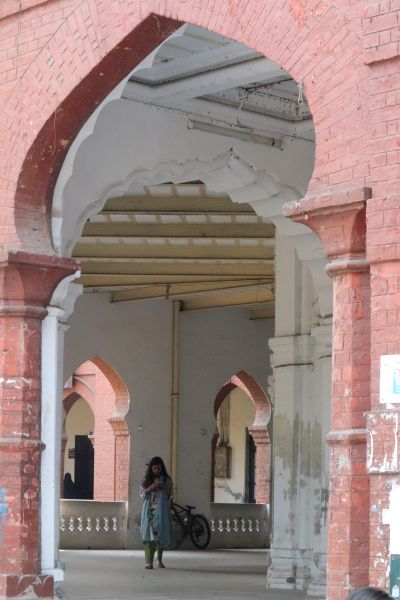
yet, some parts are really elegant, still
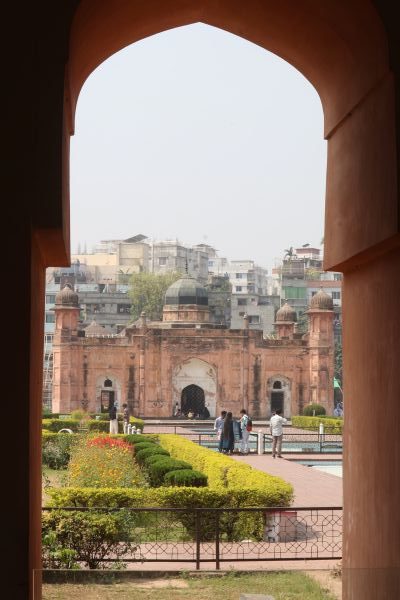
view of the Pari Bibi tomb in Lalbagh Fort
Perhaps the nicest tourist site in town is the Lalbagh Fort. Its construction was started by a Mughal prince in 1678, then abandoned, picked up again in 1684, but ultimately never finished, as the then-governor Sheista Khan lost his daughter, and declared the site unlucky. The main building, in the centre of the complex, is the tomb for the daughter, Pari Bibi. Two other buildings are a mosque that is being restored, and a hammam that already has been restored, albeit fairly basically. One of the more attractive parts is the extensive garden, an oasis of peace in otherwise chaotic Dhaka, and somehow very well maintained – which cannot be easy in this climate.

another view, of the same; it does have some resemblance with the Taj Mahal

and a view of the same, from higher up
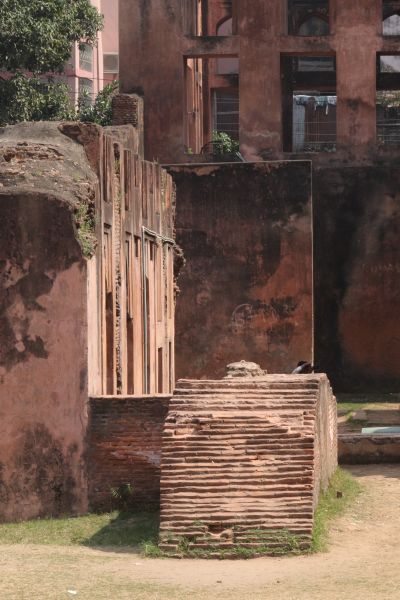
one of the corners of the Lalbagh Fort complex

which did have elaborate walls and towers, at the time
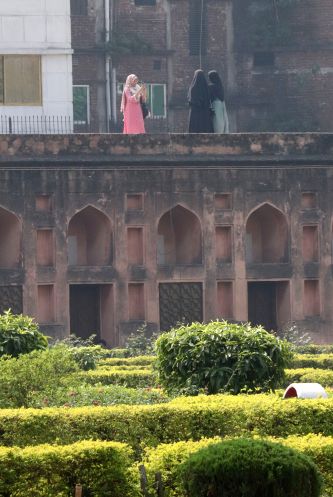
the outer wall of the complex, and the garden inside
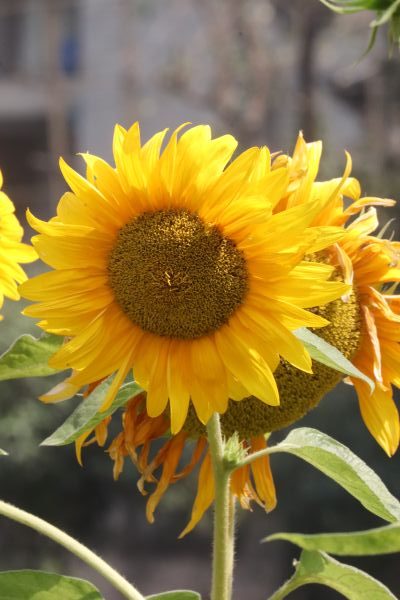
a sun flower, also in the Lalbagh Fort
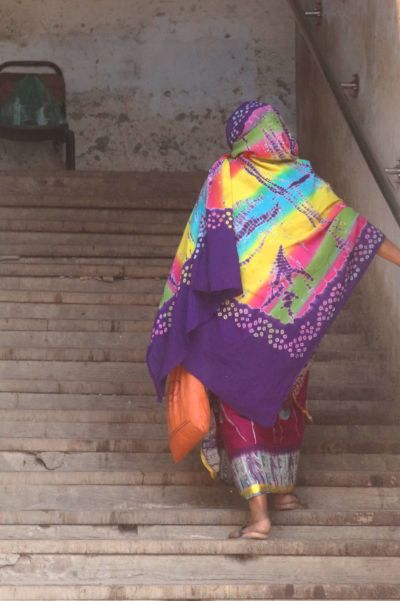
a lady walking up the stairs of her apartment building in Dhaka

the Dhakeshwari Hindu temple, nothing special really
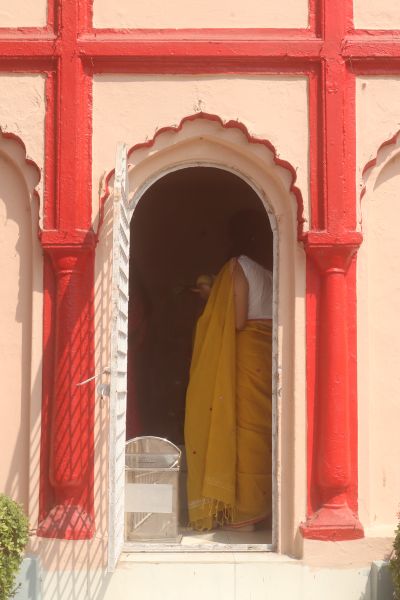
same temple, one of the entrances
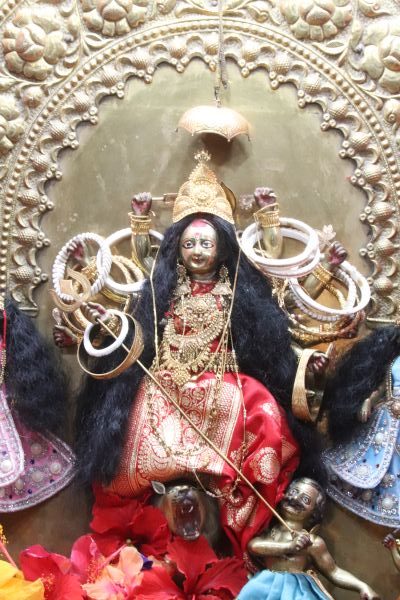
and inside the deity, Goddess of Dhaka reincarnated Durga
We also visit several other buildings. There is the Dhakeshwari Hindu temple -Dhakeshwari means Goddess of Dhaka, an incarnation of the Goddess Durga -, also referred to as the national Hindu temple, as it is state-owned. Apparently, it originated in the 12the Century, but the current architecture is obviously much more recent, probably well after 1971 liberation war, when more than half of the temple buildings were destroyed.
The Star Mosque, locally known as the Tara Masjid, was originally mosque built at the end of the 18th C, and was decorated with Japanese tiles. This is the left side. In 1987 the government extended the mosque, and added the righthand side, which looks similar, but uses different tiles, so you are really looking at two mosques, here.

the Tara Masjid, or Star mosque
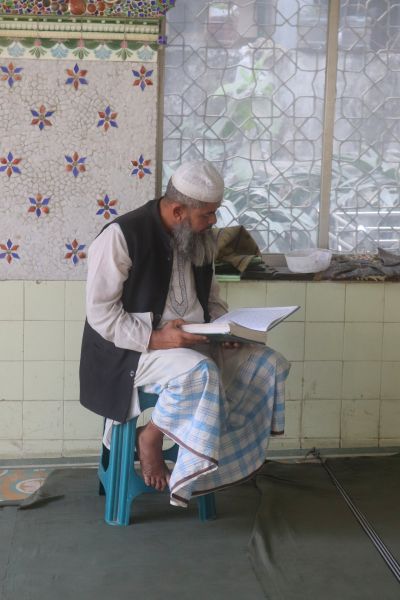
a quiet place to study books
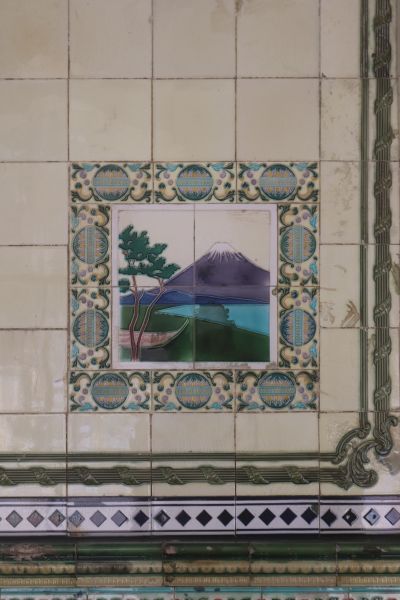
and just to show that the tiles were Japanese, indeed
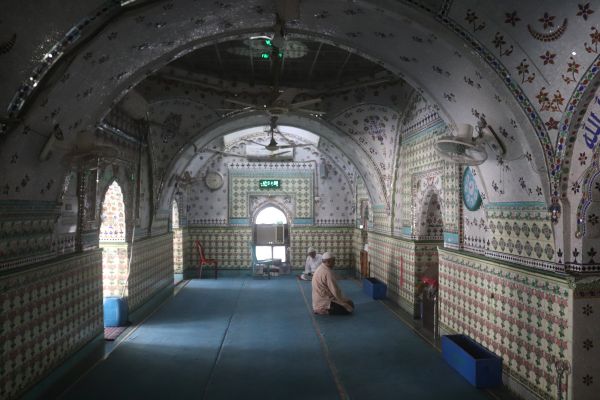
inside, too, decorated with tiles

the Armenian church in Dhaka
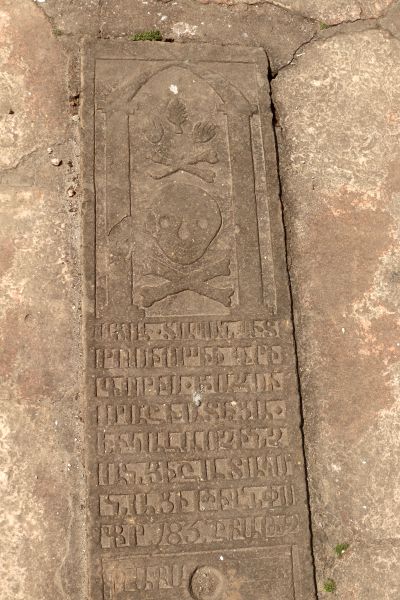
one of the older tomb stones

and a whole series of them, simple graves
The Armenian church was established in the 17th Century, by Armenians who came to work in Bengal, mostly in the leather industry. The church dates from 1781, on the site of the then cemetery. The Armenian community has long since left, but the church has been supported and protected, against all odds, by an American-Argentinian benefactor. Nowadays, there are occasional services with the Church of Bangladesh, and probably other Christian faiths, as the cemetery has also some recent additions, with Western names. But the old, simple, weathered tombs going back to the 1700s are most appealing.
And I am sure that there is more to see in Dhaka, but whether it is of any real interest, I doubt it. The attraction of this town, and this country, is just experiencing it.
next: nearby Panam Nagar, the old capital
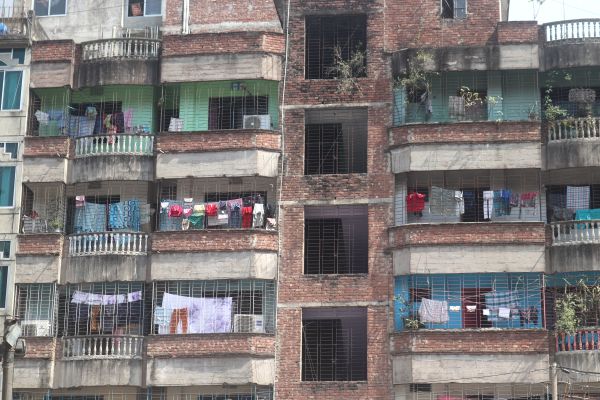
a Dhaka apartment building, I haven’t mentioned thse yet
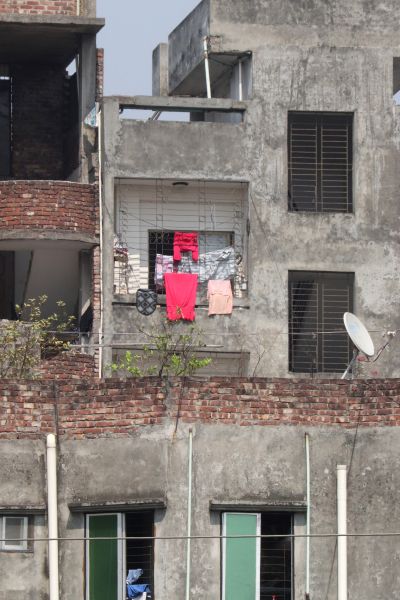
bricks and concrete, in combination

and airco’s added, at a later stage
