
a door through a door in the historical city of Panam Nagar
Panam Nagar, or Panam City, was the 15th C capital of what was called the Bhati region, obviously predating Bangladesh – although de people here refer to it as the old capital. It flourished during Mughal times, but declined in the 17th C, when it lost its status as a capital city. In the 19th C wealthy Hindu traders revived the town during the British colonial period based on cotton fabric trade. But the Partition of India in 1947, and further riots in 1964, led to the abandonment of Panam Nagar, which is now just an archaeological site.

the main, winding street along which the Panam houses are located
Panam Nagar
In effect, Panam Nagar is a collection of dilapidated buildings lining a winding street. There are 52 houses, two- to three-stories high, and in many cases supported by wooden beams to prevent them from collapsing. And yet, the place has a lot of character, thanks to its variety of construction styles, its various ways of decoration – Corinthian columns, different windows, brick patters, even metal pillars. Great to walk around, and quite photogenic. And we are not the only ones, it is clearly a popular destination for local tourists, too.

one of those houses, with roof cupola

highly decorated Corinthian pilars flank a window of a veranda

selfie taking is pervasive, in Panam, even if you hardly recognise the person

another house, with balcony missing, it seems
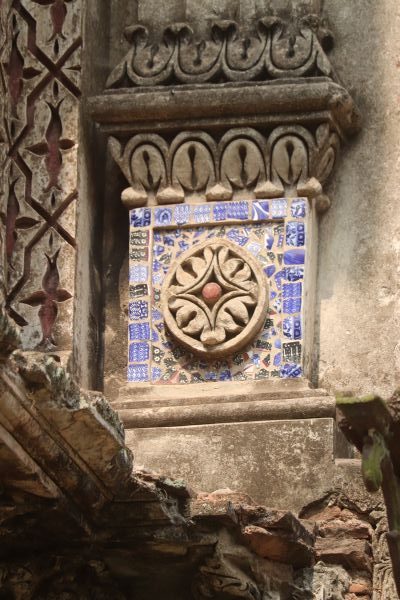
subtle decoration on the side of the missing balcony

the veranda here is supported by cast-iron pillars, intricately worked

a plaster next to the door of another house

one of the best preserved buildings
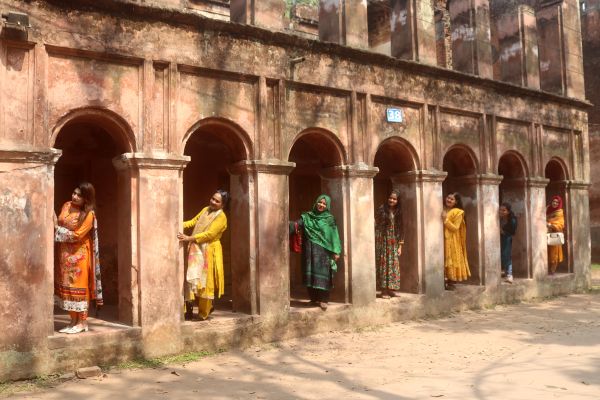
a group of women posing for the photo – not for mine, but I took the opportunity
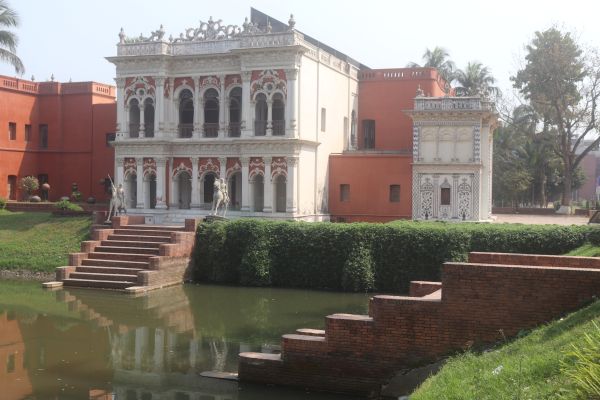
the Boro Sadar Bari, housing the museum

with a fabulously restored entrance

and further decoration above the door
Outside Panam Nagar
Outside the historical city is the Sonargoan Art and Craft museum, like all the museums we have targeted so far, also closed. So we only see the outside. It is housed in the Boro Sadar Bari, a beautiful building built for a rich Hindu trader in 1901, which has been neatly refurbished, perhaps as an example of what would be possible in Panam Nagar, too.
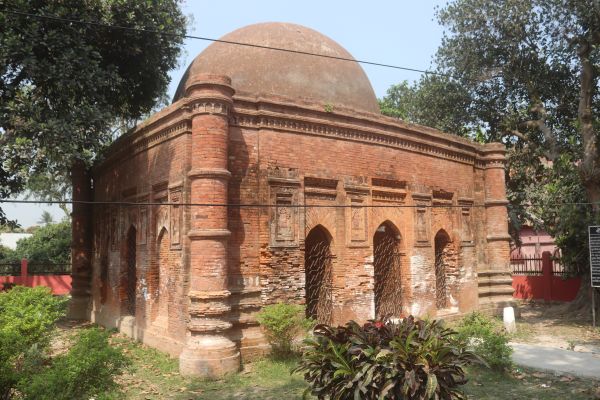
the small, brick-built Goaldi mosque,

again beautifully decorated with friezes

with its three entrances
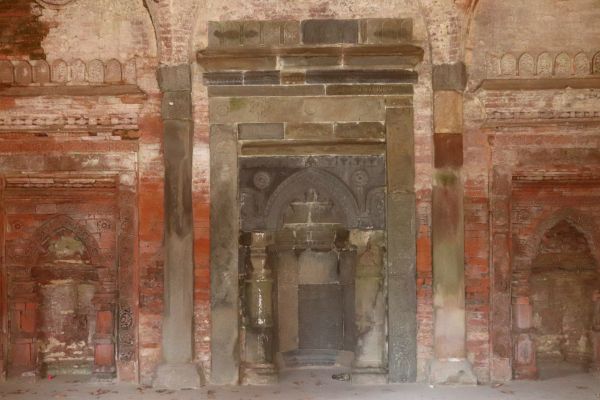
and inside the central mirhab, from black stone
A nearby Goaldi mosque, built in 1519, is one of the few remaining structures from the Mughal times in Sonargoan – the name of the region, once an important Mughal base. It is a lovely little mosque, brick work in the style of the 60-dome mosque we have seen earlier, but this one with just one dome, a nicely vaulted inside and a black-stone carved mihrab – which we can only observe through the grills, because the mosque is also closed.

the boat ride past another village, colourful with laundry
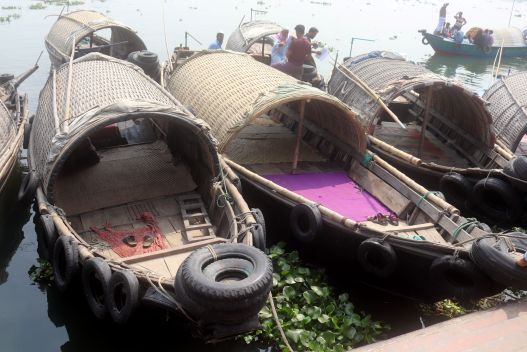
this is the type of boat we take to the Chalibanga village
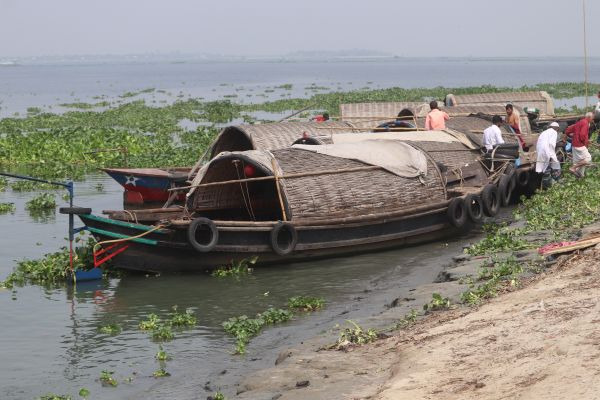
we arrive at Chalibanga just as the ferry also docks

allowing a stream of people off the boat
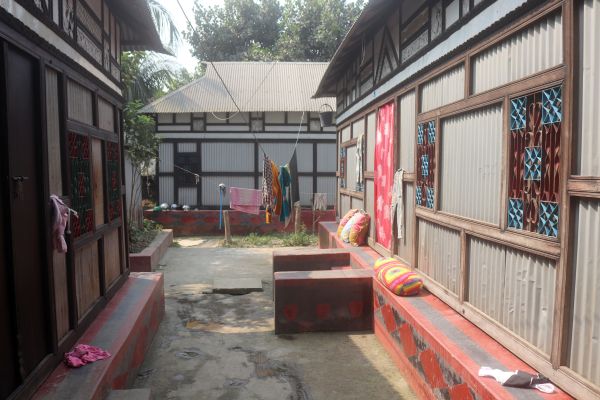
a look-through between two houses in Chalibanga

and here, too, the use of colour with the stencils
The Village
In the afternoon we take yet another boat ride, across the Meghna river, to Chalibanga, a fishermen village on a char – a sandbank – in the river. The village is remarkable for its specific decoration of the houses, with colourful, cut-out metal sheeting, like stencils, just below the roof. The houses themselves are very simple, pretty new, too, it looks. Mostly corrugated iron, but the owners have made a significant effort to decorate, with these stencils, but also with metal grills for the windows, and carved wooden doors.
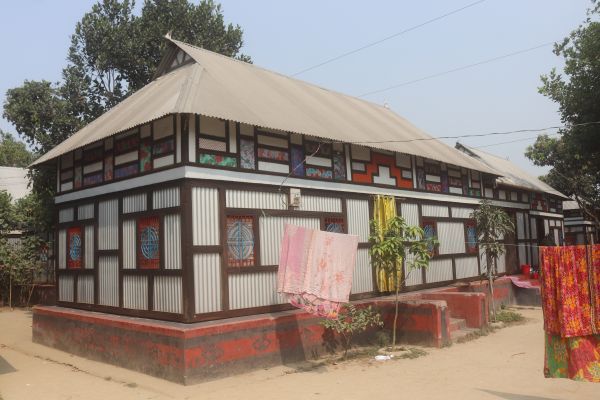
a typical, new house, corrugated iron, decorated window grills and the stencil work just below the roof
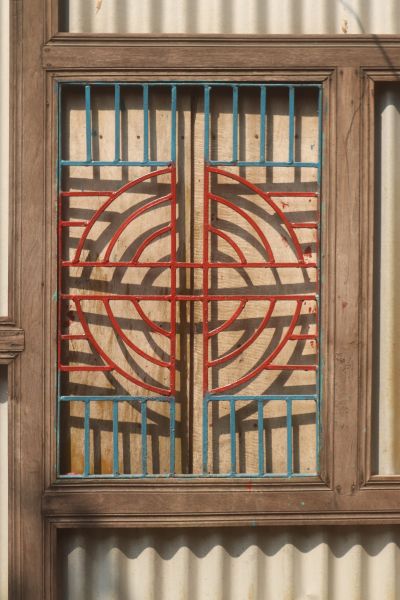
and an example of the window grills
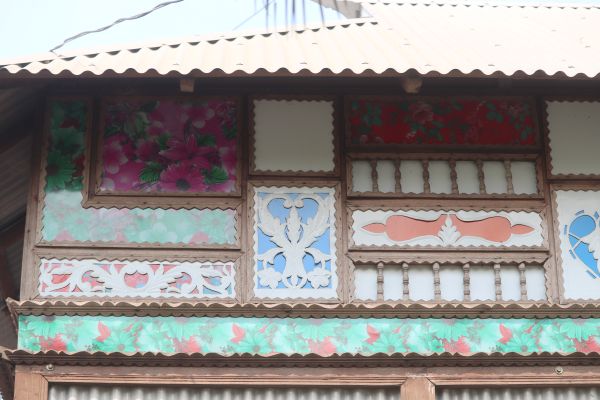
more detail on the stencils

the stencils in some more detail
The other distinguishing characteristic of this village is that this is the only place where we have been in Bangladesh that the people are completely indifferent, not engaging, they couldn’t care less. Their good right, of course, but remarkable it is – it cannot be the constant flow of tourists, as I don’t think many will come here.
next: a bit about the roads in Bangladesh
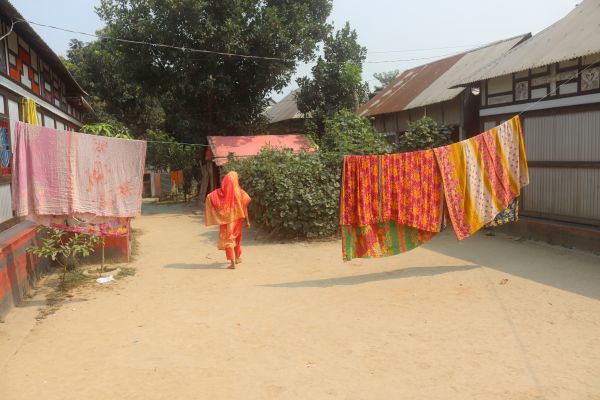
but most of the colour in the village comes from the laundry and the women
