
Pristina’s signature building, the National Library, highlight of Yugoslav Brutalist architecture
Pristina is by no means a beautiful city; like all the towns we passed on our way in Kosovo, construction is here also a dominant feature, and it looks like not much has been finished yet. Nevertheless, there is an old town, sort of, where some of the historical buildings from Ottoman times have been preserved. The best examples are part of the Emin Gjiku Ethnographic Museum, and have exhibits inside ranging from utensils and costumes to weapons. For us, the actual buildings are the most interesting.
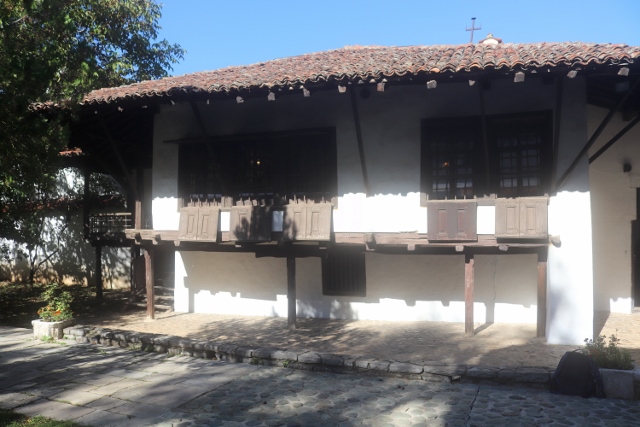
the best example of an Ottoman-era house in the Emin Gjiku Ethnographic Museum
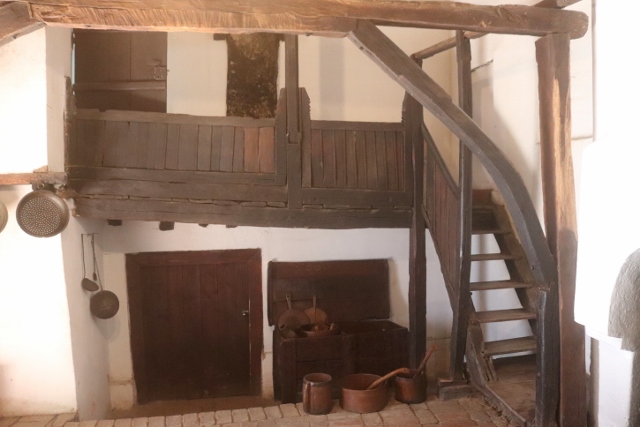
and largely wooden interior
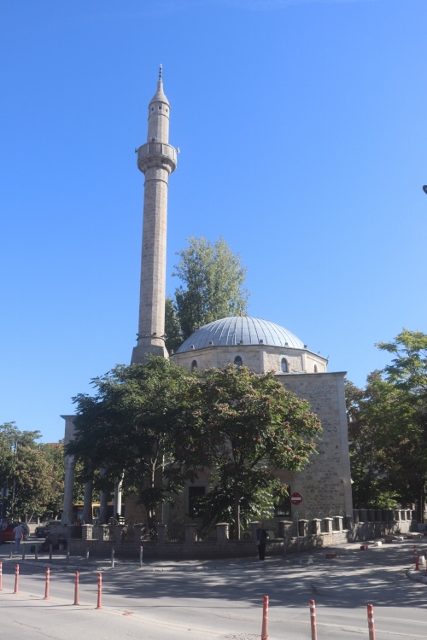
the Yashar Pasha mosque, a compact structure with a tall minaret

and special because of its wooden extension
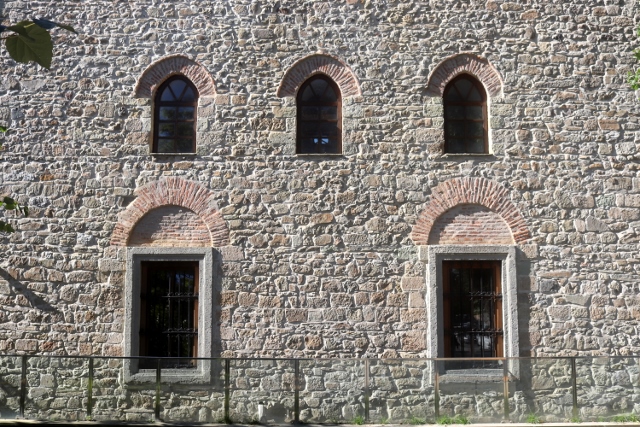
most of the mosque is solid stone work, and windows
In the same area are also several older mosques, the most prominent amongst them the Sultan Mehmet Fatih Mosque, or the ‘imperial mosque’, as locals call it. Built by Mehmed the Conqueror around 1461, it was converted to a Catholic church during the Austro-Hungarian era, but was restored to its original purpose following renovation after WW II. It is closed, but on the roof of outside porch we can already see the decorations, which no doubt are similar to those inside. The second mosque, built much later, in 1834 by Yashar Pasha, equally closed, has a lovely wooden extension on the side.
Nearby is the bazaar, with stalls not only selling vegetables and other food items, but also all other things, cloths, cooking utensils, cigarettes. Not different from the market we visited in Belgrade, but far more chaotic. More fitting in a Turkish environment than a European one, perhaps. Oeps.

which is wonderfully decorated
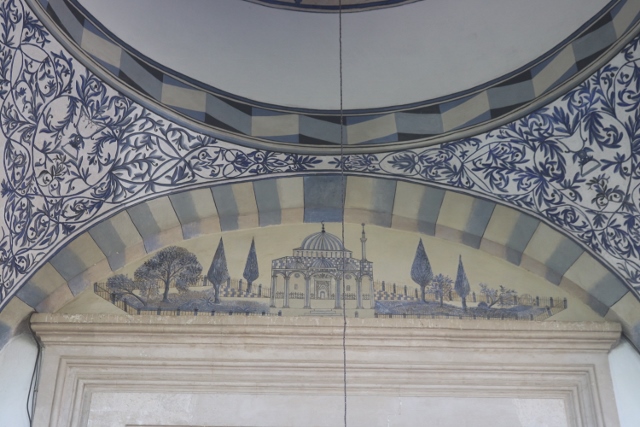
the Sultan Mehmet Fatih Mosque is closed, so we don’t get further than the outer portal

the market, or bazaar, is mostly an inside affair

colourful market produce

more colour in the market’s fruit and vegetables

neatly stacked bags with spices and nuts

men drinking tea on a terrace, can it look more Turkish than this?

happy man
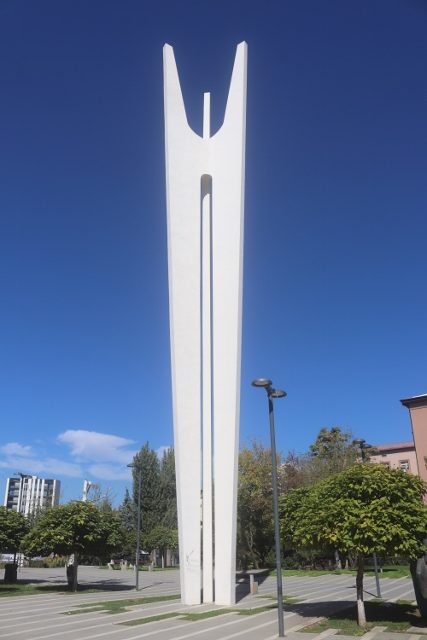
the hyper-modern monument on Sheshi Adem Jashari, in fact built in 1961, and officially called the Monument to the Heroes of the National Liberation Movement, dedicated to the fallen partisans during World War II
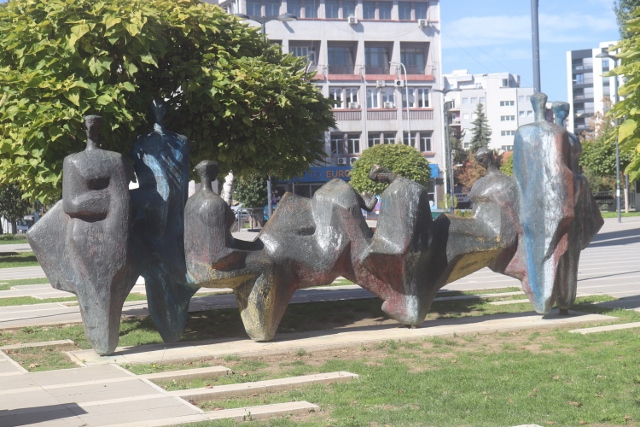
and this is the second part of the monument, a group of eight, interlinked bronze figures with stylized cubist-style bodies, at the base
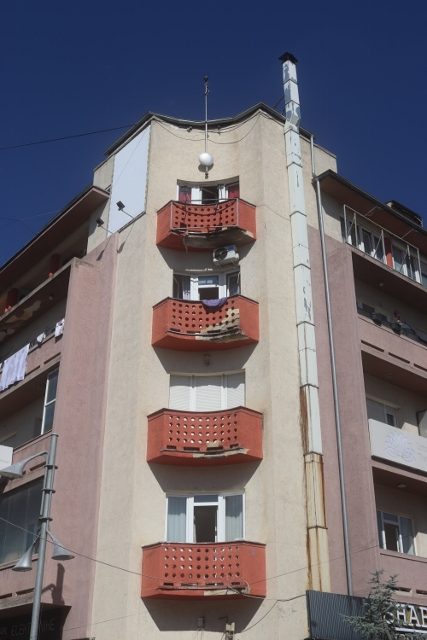
I love the architecture in the older part of town, along Mother Theresa Boulevard

like this one, everybody their own little balcony
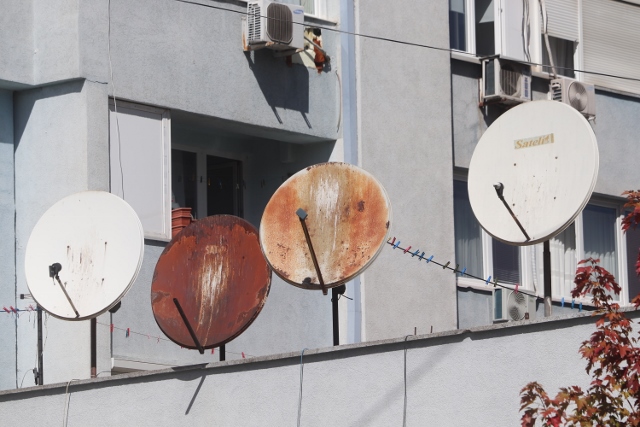
and the inevitable satelite dishes

another scupture, Mother Theresa, who is being claimed by anything that is Albanian – but who was actually born in Skopje, North Macedonia
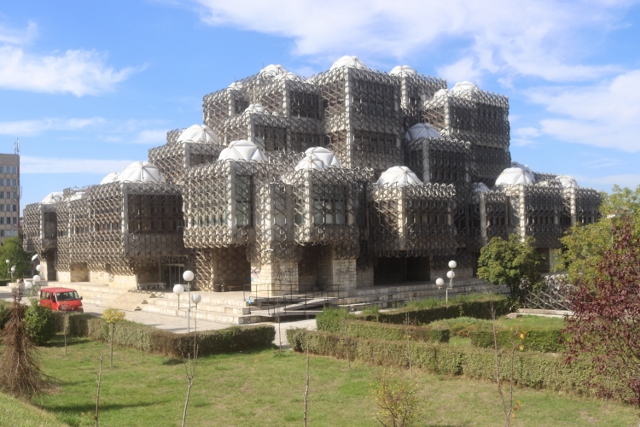
as I said earlier, the National Library is the most recognisable building in Pristina, with its 99 domes and metal fishnetting
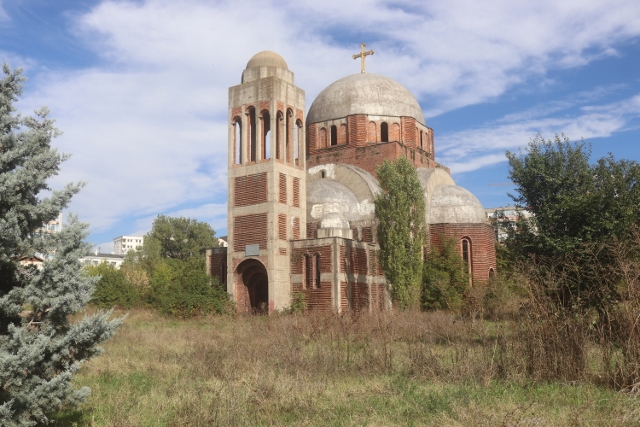
much sadder is the Serbian Orthodox cathedral behind the library, just about standing, but obviously not active anymore – the church of the enemy
Brutalism
But Pristina also has its share of Brutalist architecture. The most expressive building in town is, without any doubt, the National Library, built in the 1980s. Made up of cubes and domes – 99 of them, that let natural light in at every level -, the whole is surrounded by metal grids, giving the structure a rather surrealist look. Apparently, the building was largely destroyed after the Kosovo war, as the Serbian military had established their command centre inside. It has since been restored and is now a great place to visit, also for the inside. More photos here.

the New Born monument, rather underwhelming
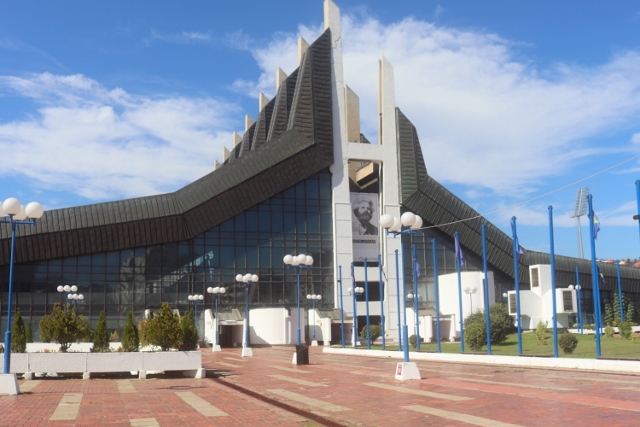
and a more complete view of the Palace of Youth and Sports

the Palace of Youth and Sports

however, away from the well-kept front, the side and the back of the Palace is rotting away, and full of senseless graffiti

to the side of the sports complex is the National Theatre, equally Brutalist in its construction of concrete
But the library is not alone. Just behind the Newborn Monument – which in itself doesn’t deserve a beauty price, unveiled on 17 February 2008, the day of Kosovo’s declared independence – is the Palace of Youth and Sports, completed in 1977. It has two arenas, but the larger one is currently used as a car park (!!) because it has been damaged by fire in 2000. The roof pillars curving upwards are fabulous, but although the front of the building looks kind of OK, the sides show severe decay, with broken wall panels, and lots of graffiti. But monstruous it is.

this is another fabulous Brutalist building

and I love thse stairs
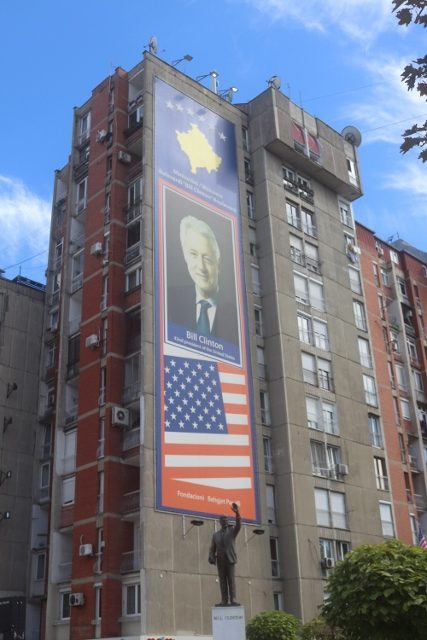
obviously, the former president of the USA is still quite popular in Pristina
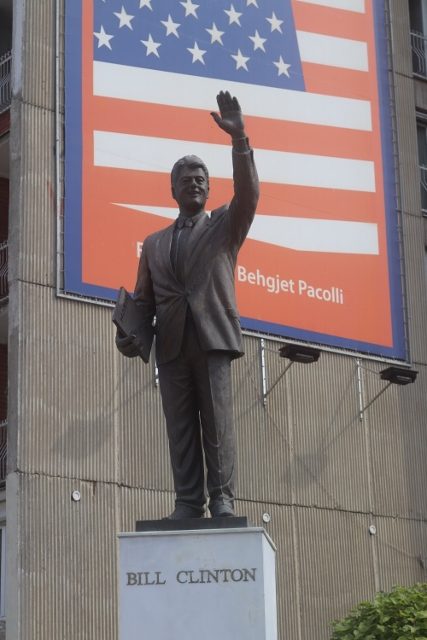
with his own sculpture, even

would it be a coincidence that the apartment building next to the Bill Clinton statue has a shop called ‘Hillary’ on the ground floor?
And so is some of the general architecture of the apartment buildings in Pristina. On my way to the Bill Clinton statue – really! – I come across several pallatis, albeit well over five storeys high, which would not have been misplaced in some of Belgrade’s Brutalist blokus. Next to hyper-modern new structures of course; like everywhere in Kosovo new construction is going up as we speak, around the clock, in every part of town. Without much planning, it seems.
Yet, nobody seems to be bothered too much. Pristina is a vibrant city; Friday night the restaurants and terraces are packed, and Saturday the shopping streets are equally busy, with mostly young people. Someone told me that the population of Kosovo is for 70% under 35 years old, the youngest of entire Europe. How long that will last? I don’t know, the rest of Europe does have a pull on lots of Kosovars, but for the time being it is happening here. And that gives good vibes.
next: the Gazimestan monument
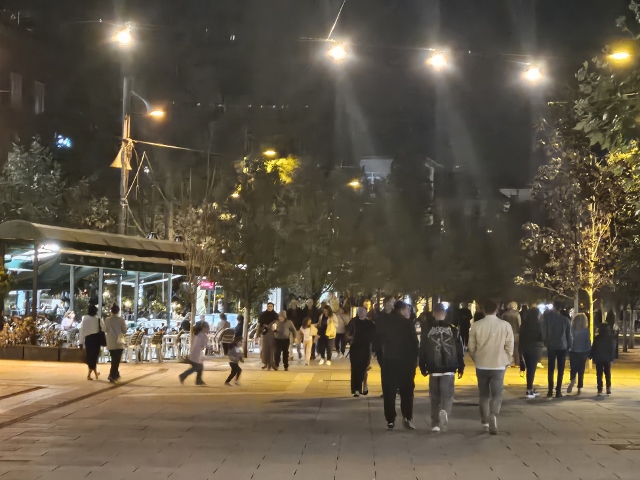
the pedestrian Boulevard Mother Theresa at night, full of people
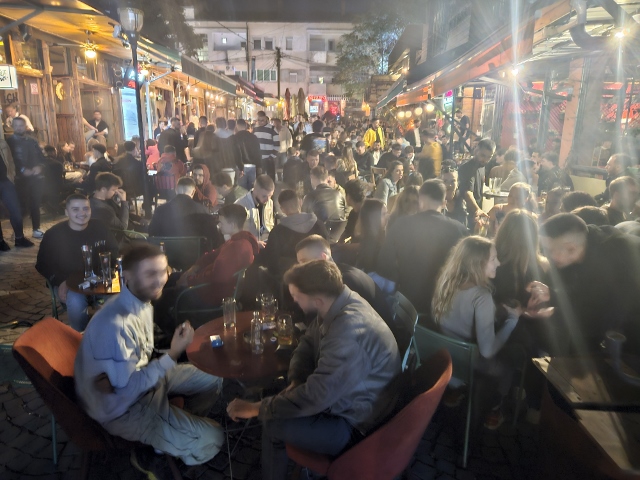
and the nearby terraces are full of those youngsters
