
the Golubac Fortress is a castle like you would imagine a castle to be
The Castle
We have left Belgrade behind, but we will be seeing the Dunav – the Danube – one more time on this trip, at the Golubac Fortress. This is a fabulous castle, located at the place where the Dunav changes from what looks like a wide lake into a rather narrow gorge, ultimately ending at what is called the Iron Gates, an incredible change. And a strategic location for it, of course, hence, the castle. But not just a castle, this one has a number of separate towers, which apparently could be defended independently of each other – they are unconnected. Which means that we, as visitors, could potentially climb to many of the towers individually, quite an effort from the looks of it. Unfortunately, on a weekday like today, only the lower three towers are open to the public.

part of the castle extends into the Danube River, just to make sure
Golubac was probably constructed in the 14th Century. Unusual for such a structure, it is actually unclear who built it, the Hungarians, Bulgarians or Serbs – what is clear is that it changed hands between them several times. After the Battle of Kosovo it fell briefly into Ottoman hands, then became Hungarian, and in 1403 was ceded to despot Stefan Lazaravic – this is how he is referred to, a despot, who had established the Serbian Despotate that lasted another 70 years after the Serbian Empire had collapsed. When Stefan died, he was succeeded by another despot, Durad Brancovic, and then some of his offspring, until in 1459 the Ottomans took over the remains of what had been Serbia in one form or another.(To be fair, in those days the title ‘despot’ was conferred upon a local ruler by the Ottoman emperor; its current meaning evolved over the later centuries.)

Golubac Fortress located at the Danube, just ahead of what is called the Iron Gates

along the way, traces of mining, perhaps?

like this one, but what they were mining remains unknown to me

and solid bridges across local rivers

the traffic in Serbia

the wine in our hotel comes in three varieties, red, rose and white, and in plastic 2 liter bottles
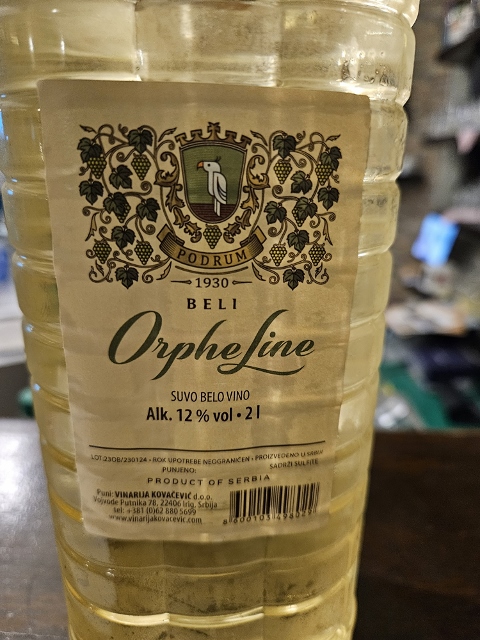
and it doesn’t do a lot for our faith in Serbian wine in general…

the entrance to the grouns of the Manasija Monastery

and the monastic church, inside extensive defense works

entrance to the church itself

and the same, from the inside
The Monastery
From Golubac we head south, to the Manasija Monastery, which is located in the municipality of Despotovac. Really! Not surprisingly, the monastery was founded, at the beginning of the 15th century, by despot Stefan, who is also buried here. The church and the refectory are built inside a fortress consisting of a massive wall, with no less than eleven towers. The inside of the church is decorated by frescoes. Apparently, only a quarter of the original paintings survived, following abandonment of the monastery during Ottoman times, roof collapse and later explosions. But what is left, is impressive and very beautiful, indeed. I understand that people who know about these things – much more than I do – consider these to be predecessors to the Serbian equivalent of Renaissance art. Of course, no photographs allowed inside, so what I can show you here is sneakily taken with the phone (I find all these ‘no photographs’ rules such a nonsense: show what you have, share it with the rest of the world, also those who cannot come to see it in real).
next: the monuments

the tomb of a despot, Stefan Lazaravic

the columns in the church are elaborately paintid

the church is extensively decorated

lots of the frescoes remaining

and even in the cupola – where the white washers couldn’t reach, perhaps?

more frescoes, just because they are so nice
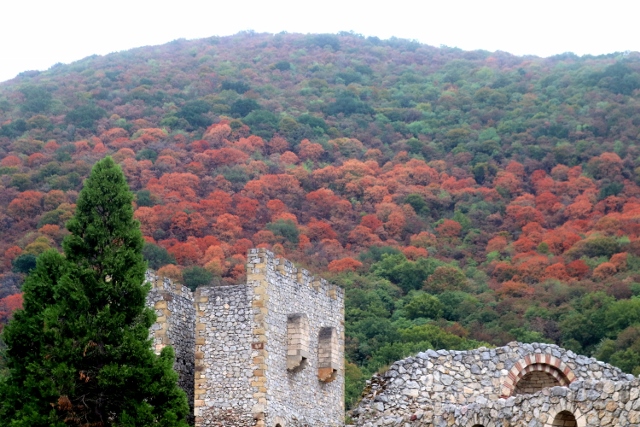
autumn starts to take its effect on the landscape beyond the monastery

further reference to alcohol, our B&B is busy distilling its own calvados (apples) and slibovic (prunes); we treid them all
