
the mosque of Peje
Already on the way to the Visoki Decani Monastery we notice all along the road small cemeteries adorned with the double-eagle Kosovo flag. These are the graves of the martyrs, or, as they are also being called, the heroes of the liberation: those who have fallen during the Kosovo war of 1997-1999, when Kosovo wrenched its independence from Serbia. To be clear, the relationship between ethnic Albanians and Serbs in what used to be the autonomous province of Kosovo has been strained for as long as generations can remember, and that is a long time in the Balkans, with atrocities committed on both sides. Following the break-up of Yugoslavia, the Kosovars felt left out, and started their own independence campaign, which received a boost when in 1997 during riots in neighbouring Albania lots of weapons were looted from army and police, which found their way into Kosovo. Brutal Serbian suppression of the resistance combined with the forceful removal of ethnic Albanian population ultimately led to NATO interference, and the withdrawal of Serbian forces in June 1999. There is much more to this conflict, of course, but the many cemeteries, as well as the many bronze statues of individual commanders who lost their lives, depicted with gun, or other war equipment, are remarkable, here.

monument for fallen KLA fighters in Peje – KLA is Kosovo Liberation Army, UCK in local language

cemetery for KLA fighters, this one a particularly important one, it would seem
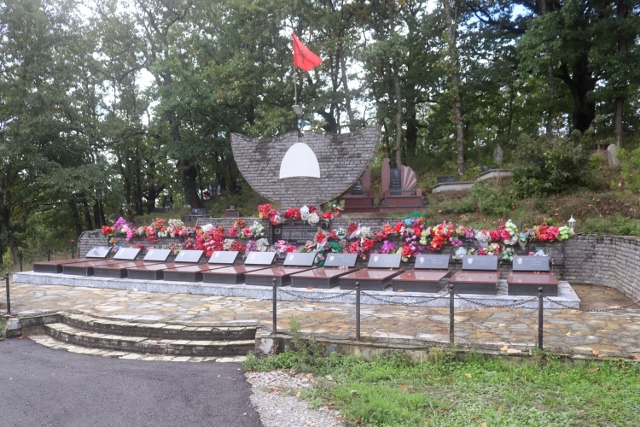
a cemetery remembering a specific battle in March 1999

where I am used to sculptures of heroes on horses…

modern heroes carry automatic weapons

another bill board commemorating victims in Decani, near Peje

the Osdautaj Kulla in Isniq

with its entrance on the first floor

and the special guest room on the third

and the top of another kulla, Kukleci’s tower
The Kullas
In the area around Decan are still some examples to be found of Kullas, the tower houses that occur all over the Balkans, but especially in Kosovo, Albania and Montenegro. They are a medieval invention, but flourished during the decline of the Ottoman empire, and up to the beginning of the 20th Century, mostly built by Albanian craftsmen. That there are some left in Kosovo is a small miracle, as during the war Serbian forces have tried their best to wipe out anything related to Albanian-Kosovar ethnic history.

also, outside Juniq, a small mosque, with a new minaret added behind the old one
The best preserved, and formerly even a museum house, is the Osdautaj Kulla in Isniq. It is no longer a museum, but a young boy is kind enough to let us in and show us around, up the typical wooden steps to the first floor – the ground floor of those often one meter thick-walled structures has no openings, which is easier to defend -, and on to the top floor, the men-only reception area, and another couple of rooms. He was even prepared to show the room where his grandfather was sleeping, at that moment, but we respectfully called it a day. Another, even older kulla is Kukleci’s tower, built at the end of the 18th C, now closed to the public, and pretty closed full stop, it seems. Nearby Juniq apparently had many more kullas, but most of those have also not survived the Serbian onslaught

traffic jam caused by sheep in town

in no hurry whatsoever

one of the main shopping streets in Peje
Peje

with a particular focus on jewelry and gold and silver shops
We overnight in Peje – better known as Pec, its Serbian name, not to be used anymore, of course. (Nationalism goes so far that on many place name signs in the area the Serbian way of writing has been made illegible.) It is a pleasant enough town for a stroll in the morning, past its bazaar and busy shopping streets, that seem to be dominated by gold and silver shops. But as in so many other Kosovar towns, chaos reigns, with unfinished roads, construction projects and half-baked temporary pavement solutions that make negotiating Peje on foot rather complex – by the way, by car is not much better.
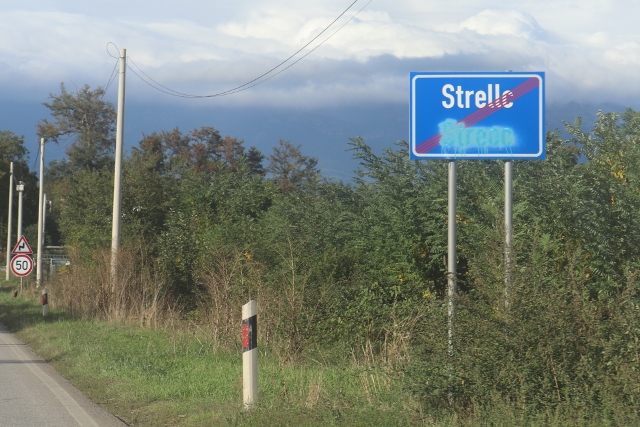
the Serbina spelling of place names has been covered in many instances, to emphasize the ethnic differences in Kosovo

the various churches of the Patriarchate of Pec

with vivid colours on the outside, probably a recent restoration

the narthex, providing access to all three churches
The Pec Monastery
We escape town to visit the Patriarchate of Pec – the Serbian Orthodox patriarchate -, at the outskirts. Once again, a KFOR protected compound, where we need to show our passports before being allowed in. There is nobody, we are the only visitors. A very kind nun shows us around, even allows me to take a picture of the family tree of the Nemanji dynasty, the ones who established and expanded the Medieval Serbian Kingdom, later Empire. The other pictures I need to sneakily take when she is not paying attention – or is being distracted by my chatty travel companion.
There are three churches here, connected by a narthex. Each of them is painted from top to bottom, as we are by now used to, from the Serbian monasteries. The frescoes are fabulous, some as old as the 13th C, when the monastery was built, others from a later date, 17th C, but all of them equally bright and well preserved. It is incredible, unbelievable, that Albanian Kosovars tried to destroy all this as recently as 2004, during ethnic riots. In 2006 the Patriarchate was included in the UNESCO World Heritage List, as well as on the List of World Heritage in Danger. More photos here.

the family tree of the Nemanji dynasty

entrance to one of the churches

a familiar scene in the church

a fabulous fresco spectacle

the road into the Rugova Valley, partly hewn out of the rock
The Rugova Valley
Outside Peje is the Rugova Valley, finally a section of natural beauty on this trip, that so far has mostly seen flattish to mildly hilly, not very attractive scenery. But the valley is different, starting with a spectacular narrow gorge formed by the not even so spectacular Lumbardhi River – White River, in local language -, through which the road winds its way up. Once outside the gorge, the valley broadens into what is called the Accursed Mountains, and we climb to the village of Boge, at some 1300 m high, all the way in the far corner of this small country, close to Montenegro. All but deserted, this is a sky resort, which at the end of September is closed up, but boy, have they developed this little place. There are some truly gigantic hotels going up, next to a wild growth of chalet complexes, once again apparently with very little planning in mind. But for the time being the surrounding countryside is beautiful. The more distant peaks even have snow on top.
next: Prizren

at the far end of the gorge, great views back over the river valley

and snowy peaks in the distance

with added colour from the aurumn leaves
