
the skeleton remains of Ljubljanska Banka, also dubbed Sniper Tower, in Mostar
Perhaps Mostar is not one, but two cities. We are staying in the old town, the Muslim quarters, cobbled streets, souvenir shops, plenty of restaurants, terraces that sell Bosnian coffee, baklava. Even more than the old town in Sarajevo, it is the feeling of being in Turkey. There are also several mosques, and the remains – the women’s quarters, the men’s have been destroyed in the war – of an authentic Ottoman house, called Kajtaz House. All very nice, and all very touristic, again, even more so than Sarajevo. Perhaps this is because of the vicinity of Dubrovnik, from where day trips are an easy option for an excursion.

view of Mostar

and plenty of souvenir stalls, around the old bridge

cobbled street in the old town of Mostar

the Karodjoz-bey mosque, the main mosque in town

another view of the mosque, the entrance under a low roof

inside the mosque

the Muslim cemetery behind the mosque

flat roofs in the old town of Mostar

the stairs in the Kajtaz family house

and the Kajtaz house living room

the Stari Most, the Old Bridge of mostar, restored after the war

the bridge itself, with minimal number of tourists

the view from the bridge, over the old town
All of these cobbled streets ultimately lead to the Stari Most, the Old Bridge, which is Mostar’s most famous landmark. It was built in the 1560s, and held out until a deliberate Croatian mortar attack during the war, in 1993. It has now been rebuilt, using 16th C materials and building techniques, and has been named a UNESCO World Heritage Site since it reopened in 2004.

and the bridge at night

behind the mural is the former Ljubljanska Banka, used during the war by Croatian snipers

another view of the Ljubljanska Banka, now little more than a skeleton building

inside, the ground floor of the bank

richly decorated with graffiti
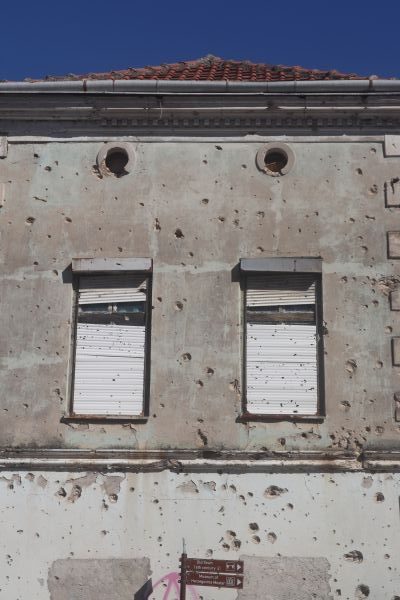
bullet holes are a reminder of the Bosnian war

and they are everywhere in town

in other places the walls are the only part remaining of buildings
On the other side of the bridge the tourist craze continues for a little while, but then dies out into a modern European city – the Croat side of Mostar. Sure enough, with the occasional mosque, but here Catholic churches dominate, new ones, like we already observed on our way into town. And away from the bridge there is actually little of interest anymore, in Croat Mostar. Except for the skeleton buildings that are reminders of the war, especially the former Ljubljanska Banka, now turned into a triangular concrete skeleton, abandoned and, as every abandoned building seems to require, plastered with graffiti. Apparently, at the time – war time -, this being the tallest building in town and on the border between Muslim-dominated and Croat controlled territory, it was also an infamous base for snipers who took aim at anybody trying to cross Spanski Trg – Spanish Square – in front of the building.
‘War time’ needs some more detailing. Initially Mostar was besieged by Serbs who wanted to incorporate the town into the Republika Srpska, the Bosnian Serb entity, but by joining forces the Bosnian Croats and the Bosniaks – the Bosnian Muslims – managed to push out the Serbs. Only to turn onto each other afterwards, and savagely continue the fighting. Including positioning snipers – you already know how I think about that.
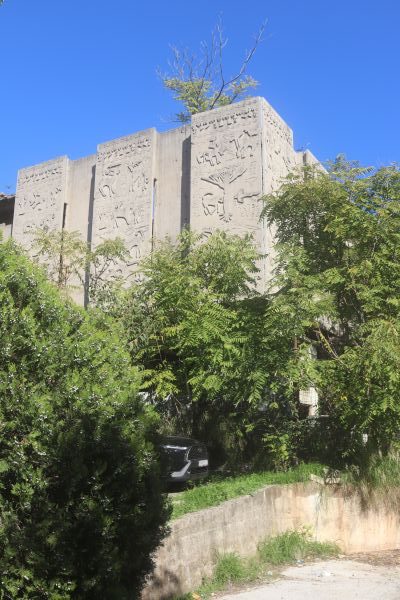
the Rasvjtak shopping mall, now closed

a truly brutalist piece of architecture, built in the 1970s

is another victim of the war, not more than a shell
Anyhow, Ljubljanska Banka (also dubbed Sniper Tower) is not the only visible memento of the war, there are lots of other houses and buildings that have been destroyed, and left purposely to remind everybody of the horrors of that time. There is a large, block-size building of which only the outer walls are standing, just about. And the Rasvjtak shopping mall, a 1970s Brutalist moloch, decorated all around with bas reliefs, is also not much more than an empty shell. Many of the houses still standing are riddled with bullet holes, others have been burnt out. Whether this is the best strategy towards healing past friction, I wonder, but the few people we talk to about this, are all adamant that we mustn’t forget. And they won’t; it is just waiting for the next spark to ignite a successor war, no doubt about it.

and this is another building that is no more than a shell of its former self

only the outer walls remain standing

but barely so, only with the support of wooden beams

Mostar by night, another vies from the Old Bridge

the entrance to Blagaj Tekke

and the Blagaj Tekke itself, the house sheltered under rocks

inside a nice roof decoration

as do the beehives in the fields

outside, pommegranates provide some colour
Outside Mostar we visit the Blagay Tekke, which consists of a set of traditional stone-roofed buildings which once was the centre of whirling dervishes, following a mystical form of Islam, but now is just a pretty place next to the even prettier Buna River, fully focussed on tourism.

the well-organised stecci along the road, part of the Radimlja Necropolis

nicely decorated stecak tombstone, also found back in the shopping centre panels, see earlier

another stecak, decorated

and here it looks like the stecci have been arranged neatly in rows

one of the stecci in the site near the village of Boljuni

where the tomb stones are located in a more atmospheric environment

some have a clear Christian link, too, like we saw earlier in Montenegro
A little further we come across two more stecci sites. The Radimlja Necropolis is along the main road, and contains 110 white tomb stones, which, unlike the other stecci sites we have seen, does actually look like a cemetery. More importantly, many of these tombs are nicely carved, far more convincingly than at the earlier sites. The second site, near the village of Boljuni, actually has two cemeteries, close to each other. Less carvings, perhaps, but the setting here is impressive, on a field under ancient trees.
next: a brief retrospective intermezzo, or move on directly to Split
