
a window in the tower of the Grad Potsreda, a castle in East Slovenia
It keeps pouring down, and all the various weather forecasts we consult are unanimous in that it will be pouring down for a while. The plan was to go to Maribor, where there is nothing special, but just a pleasant town with a lot of atmosphere. But not in the rain, so we skip Maribor, and focus on a couple of museum castles in the east of Slovenia. Museums are indoors.
We could have taken the motorway, of course, but decided on a smaller road, the one largely following the Sava River east. Which turned out to be the right decision, allowing us to observe some of the Slovenian countryside: small villages surrounding a sharp-spired church and a range of older and newer wooden barns, obviously still very much in use. We come across a wooden bridge on concrete pillars, dating from the 1930s. Stretches of road are so narrow that movement is being controlled by traffic lights, allowing alternating one-way traffic.

wooden bridge aacross the Sava River

and the bridge from inside, basely wide enough for a car, let alone a tractor

typical wooden barn in the Slovenian countryside

and another one, old but obviously still in full use

the Grad Potsreda, one of a series of castles in Eastern Slovenia

the courtyard of the castle
The Castle
Grad Potsreda is a heavily restored castle near the Croatian border. Apparently, the first castle was built here in the 13th C, but it doesn’t look that way. The present day structure is from the 19th C, and has since been smoothly refurbished. An attractive court yard is ringed by columned floors, with flower pots and the lot. Inside are several exhibitions, some permanent, some temporary, and not all of them are that interesting. One of the better ones is that of Slovenian painter France Slana, who, amongst his oeuvre, also counts a few paintings of the wooden barns we have seen earlier today.

the castle also displays a collection of paintings by Slovenian artist , France Slana, this one called ‘Street’, from 2005

and another accomplished painting by Slana, ‘Ruins by Water’, also from 2005

Slana also painted the wooden barns that we saw today, and this one is from 1983; not much has changed!

the countryside in between the various castles

the courtyard of Brezice Castle – also to illustrate why we opted for an indoors program today
The Frescoes
The one I was most curious about was the Brezice Castle, which is unique in Slovenia for its Baroque Knight’s Hall. This is the largest room in the castle, and is painted from top to bottom with frescos depicting scenes from Greek and Roman mythology. One needs to slug through the museum, which is also housed in the castle, with ethnographic and archaeological displays, a weapons collection, a mushroom collection and whatever, but finally one reaches this indeed superbly decorated hall – which in itself is a great achievement, although my travel companion did question the skills of the painter, who, shall we say, was not very good with faces.

the Knight’s Hall, decorated with frescoes from top to bottom

and this is the same hall, from the other side

along the sides, extensive fresco panels

one of the many individual frescoes

and another one, from Greek mythology

not only the Knight’s Hall, also the chapel is decorated with frescoes

including some recognisable characters

the island village of Kostanjevica na Krki
The village
We stayed in the nearby village of Kostanjevica na Krki, located on a tiny island in the Krka River, connected to both sides by two wooden bridges. It is a lovely little town, but the still continuing rain made us postpone sightseeing to the next day. An idea we abandoned all together when it still rained. In fact, I think we were lucky to have kept dry feet during the night, given the rather high water levels of the river!
Except that we failed to keep dry feet in the garden of the Bozidar Jakac Art Museum, outside town, and the real reason to come this far.
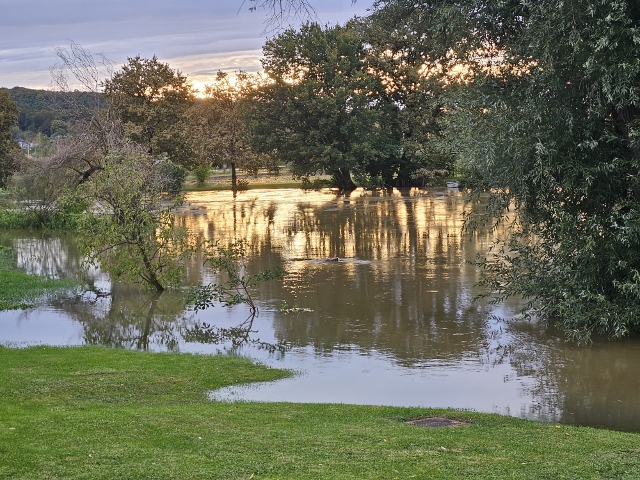
island just about, the water shouldn’t rise much more!
