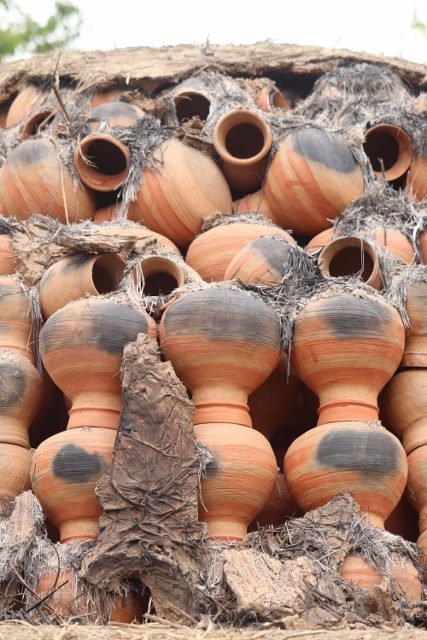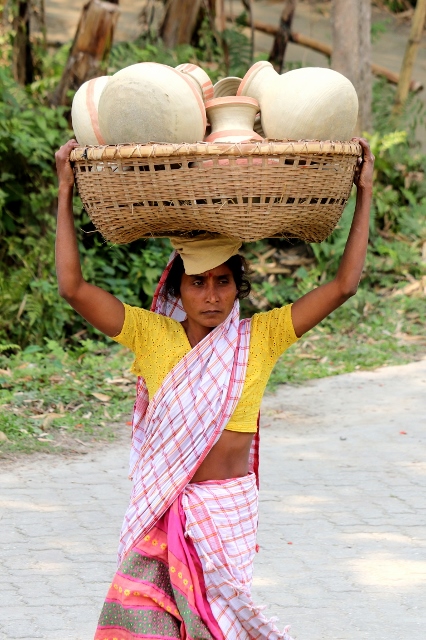
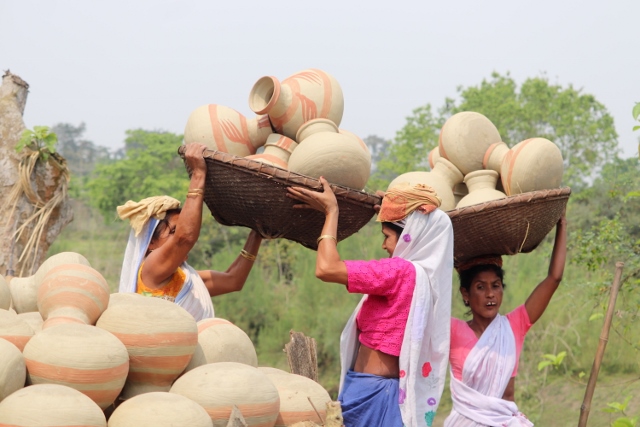
I have seen village pottery making before, on my travels. But never was I so fascinated by the process as here in Falmora, a specialist pottery village on Majuli Island. Especially the bakery of the pots is great. On a small hill, a mountain of pots is created by stacking larger and smaller pots densely together, the pile occasionally supported by wooden sticks. Women are carrying the various sizes of pots, simply decorated and so far sun-dried only, to the hill in large bamboo baskets. Others use a cart, to get from where the pots are made to the pile.




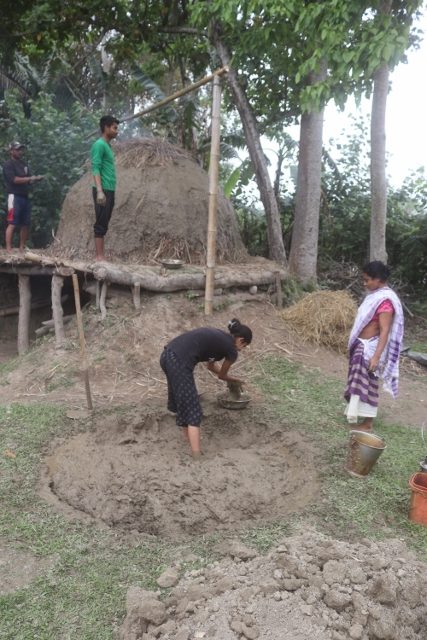
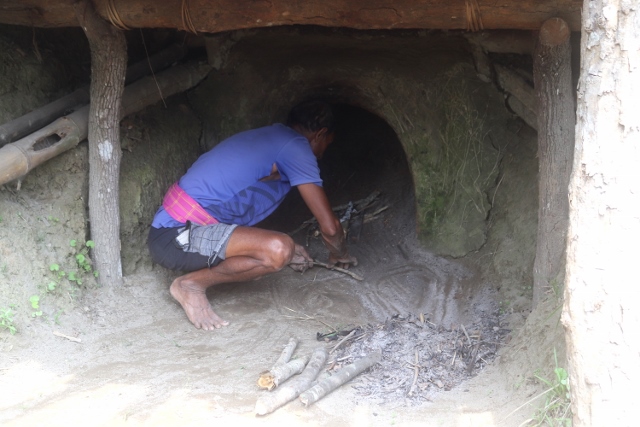
When the stack is big enough, containing up to 600 pots, the outside is covered with straw, after which a layer is mud is applied. Instead of putting the pots in the oven, they built an oven around the pots! Under the hill is a rather small fireplace, from which a chimney leads up to the centre of the stack. Brilliant! It takes eight to nine hours of heating, and then the pots are ready.


the pottery making
The process that precedes the baking is equally impressive. We get a demonstration in pot making, without turning wheels as we know them. One of the women takes a seat on a low stool, grabs a handful of clay and starts to mould in in shape. Although technically without wheel, the tray she is using does turn, driven by her toe! In a little less than ten minutes she has produced a midsize pot, which then needs to dry in the sun for an hour, or so, before she can finish it, and apply some simple hand painting.
And once every so many days, they collect the pots and bake them, as described already. And then they sell them all over Assam, it seems, because we encounter them in markets days later, in Numaligarh, Kaziranga and Sibsagar.
but first: the mask makers