
colour unity in a window in Gangtok, capital of Sikkim
To get from Darjeeling to Gangtok, in Sikkim, the only form of public transport is the dreaded Sumo, the jeep that fit ten passengers, kind of. Two rows of four, and two in the passenger seat next to the driver. We buy four seats next to each other, a whole row, and so travel unexpectedly comfortable.
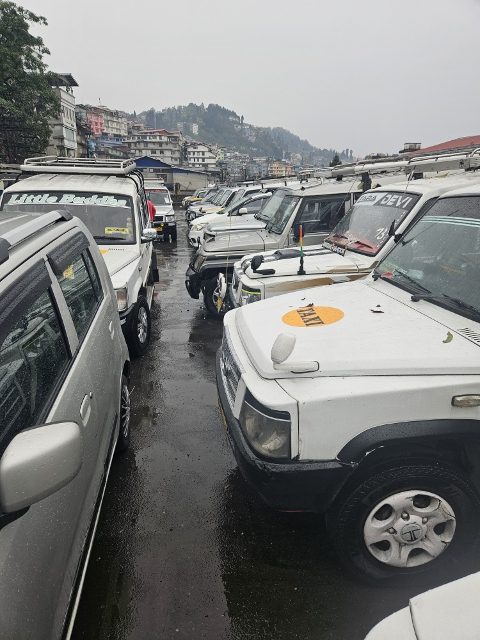
the Suma station in Darjeeling, from where all the shared taxis depart
At the Sikkim border we need to get our Inner Line Permit, especially for foreigners (because we don’t go much further than Gangtok, we don’t need a another special permit, the Protected Area Permit that we needed in Arunachal). Getting the ILP is a piece of cake: copy of passport and visa, and one passport photo, and we receive the document, which we subsequently need to show at the border control post, twenty meters further. Where the data that have just provided to the people at the permit desk are meticulously checked again, and subsequently copied in another great big book of Santa Claus. After which our passports are stamped! Really!
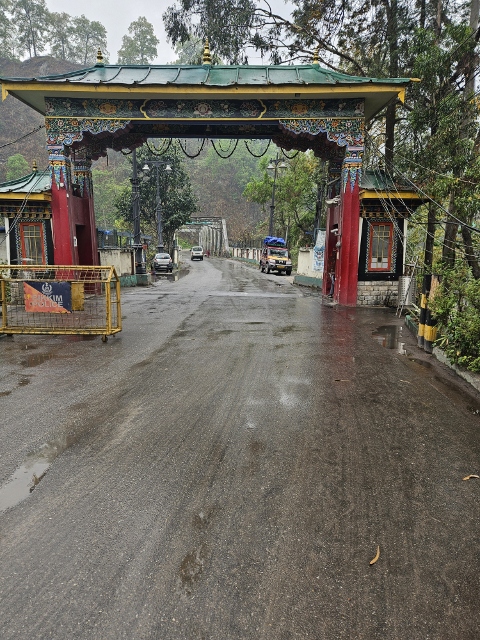
the border with Sikkim, where our passports are being stamped
Sikkim
Sikkim is all about the views. In the north of India, wedged in between Bhutan, Tibet and Nepal, it is famous for its mountain scape on the south flank of the Himalayas, including that of the world’s third highest mountain, the 8586 m high Kangchenjunga. It was pouring down when we left Darjeeling, and it still is. No views to speak of.
And that doesn’t get a lot better in the next few days. Although occasionally the sun breaks through, the distant peaks remain elusive, and the hills around Gangtok mostly hazy. The thing to do in Sikkim, is to explore the high mountains to the north, the views, the high altitude lakes, and the many Buddhist monasteries. But with this type of weather, any exploration is bound to result in disappointment. We decide to limit our visit to Gangtok, and some of the monasteries around.

one of the many footbridges connecting various levels in Gangtok
Gangtok
Gangtok is a bit of a quaint city. It is not very big, but a challenge to negotiate on foot, as its streets, even more than in Darjeeling, wind up and down the steep mountain slope. In order to accommodate pedestrians, there are several foot bridges that cross from one street to another, or connect shopping areas. And the stairs we know from Darjeeling are here even more profoundly present, even higher and even steeper.

the start of MG street, fittingly with a statue of Mahatma Ghandi

further down MG street, lively and busy
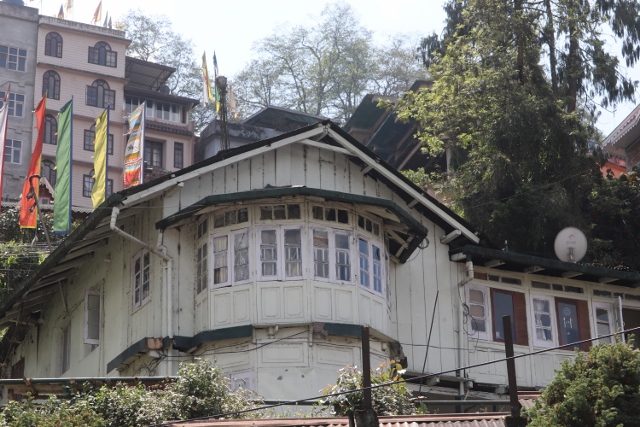
and with the occasional old wooden house, although most of Gangtok is more modern
But Gangtok is also touristic, far more so than Darjeeling. Every other building in the centre seems to be a hotel, or a restaurant, and the streets are teeming with tour operators and souvenir shops. Not that it is very full with tourists, they apparently were better informed about the weather, and the views, than we were.
There is actually not a lot to do in town, there are no old buildings left and the newer ones, three-to-four stories, aren’t particularly attractive. The centre of town is MG Road – MG for Mahatma Ghandi -, a pedestrian zone with a lot of atmosphere, people walking up and down, but very little in terms of touristic attractions. And all the other streets have not much to offer, either. Except that they are generally narrow, which means that if two cars need to pass each other, the people walking are being squeezed. Good thing there are no tuktuks and rickshaws to add to the traffic, the roads are just too steep for those.

we encounter a group of Nepali tourists

proudly wearing their distinctive jewelry
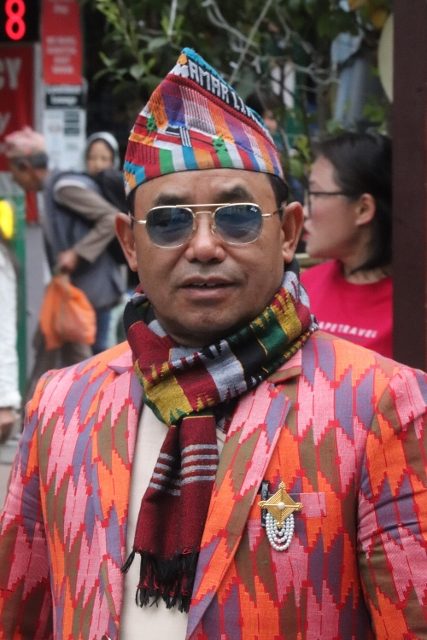
or otherwise colourful outfits

she, too, is all dressed for the occasion

somewhat modern apartments

view from the top level of the market

and the semi-circular supermarket area
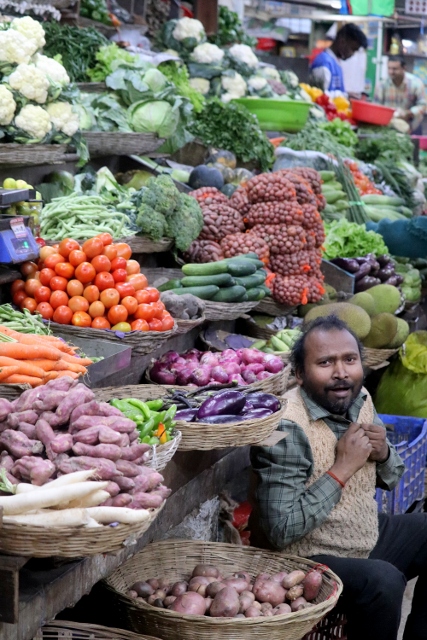
the Gangtok market, and one of its sellers

all kinds and colours of pulses, in the market

and predominantly white, flower and rice

woman in the market

and another one, less sure of the photographer

and two men, also active in the market

the Shri Thakurbari Temple, an active center of worship in the middle of town

MG street in the evening

and the same, through a curtain of Chinese lanterns

the cable car station in the distance, from the cable car
The main attraction in town is a ride with the cable car, the Gangtok Ropeway, which goes from Deorali Bazar, fairly far down from the centre, to Namnang, well above it. The 935 meters take about ten minutes, during which you have a nice view over the city and its surroundings, including the vegetable terraces and the settlements a little further away – still mostly modern housing, no charming villages in sight. And then you travel back down again, you don’t even get off at Namnang, because obviously, there is nothing to do there, either.
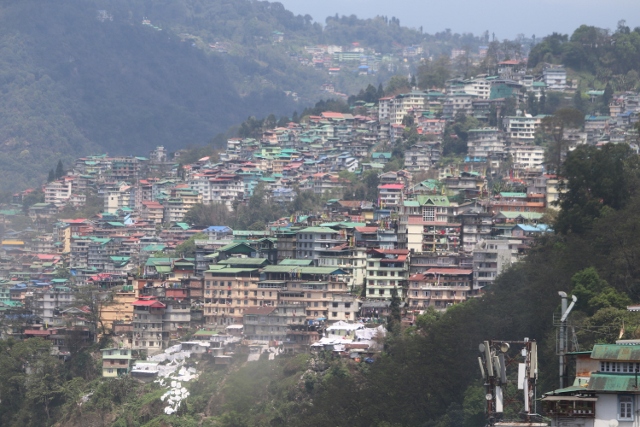
and the view from the cable car, across large parts of Gangtok

the entrance of Rumtek monastery, complete with police shouting not to take photos

the main building in the monastery

and several monks congregating in front of it

the door, with handle, strickly forbidden to photograph
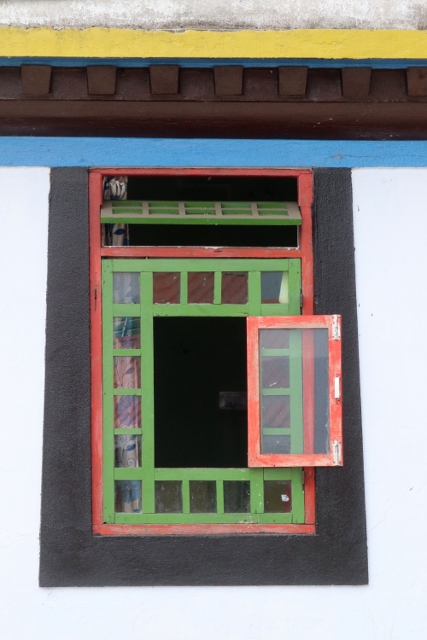
a well-maintained, colourful window
Rumtek Monastery
The Rumtek monastery, a good hour’s drive from Gangtok, was originally built in the 18th Century. But when the Karmapa Lama, leading the Karma Kagyu sect of Buddhism, was exiled from Tibet and arrived here in 1959, the monastery was in ruins. It was rebuilt in the 1960s in its present form, and is thus not very old at all, although some relics, like the Golden Stupa, have been rescued from the Chinese Cultural Revolution and are now exhibited here. some more photos here

inside the temple building, once again photography strickly prohibited
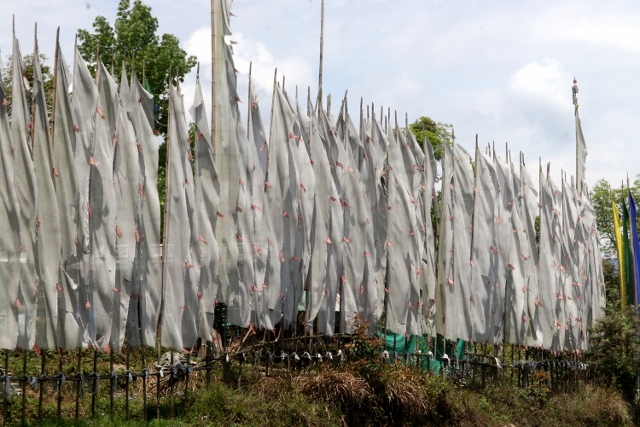
Buddhist prayer flags outside the monastery
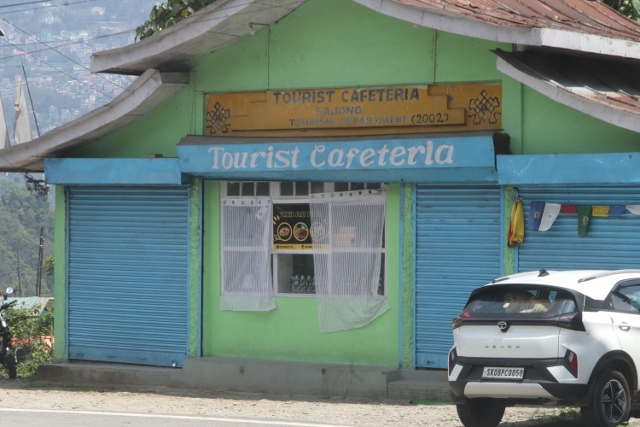
and there is even a tourist cafeteria nearby, unfortunately closed
Although this is the most important monastery in Sikkim, with some 400 monks residing, the whole complex creates a pretty sterile impression. Not helped by the presence of armed military personnel, who already at the entrance begin to scream that photography of the gate is not allowed. Asked about their presence a soldier claims it is to protect the Golden Stupa, but from internet resources I understand that it has more to do with the controversy about the reincarnation of the next Karmapa Lama, which is being contested by two different Buddhist groups. Who, apparently, violently clashed in 1993, hence the tight security. You know, we have been to nicer Buddhist monasteries, with more character, a more of a spiritual feeling. Recently, Tawang being one of them.
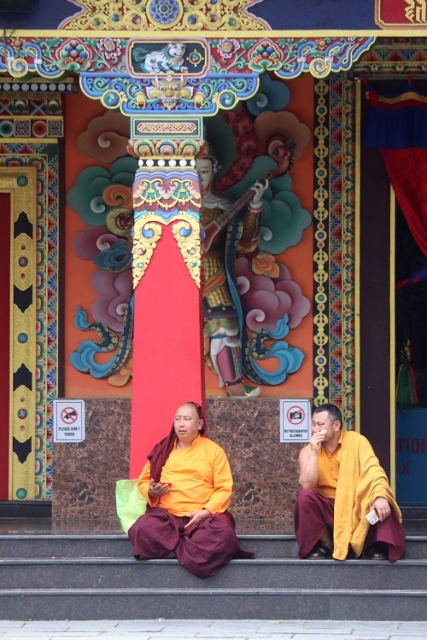
two monks in front of the Enchey Monastery
Enchey Monastery
The Enchey Monastery is in Gangtok itself, on a hill just above our hotel. And the contrast with Rumtek is startling, here we do experience a great atmosphere, a serene peace; somehow, because it is smaller, perhaps, and less important, there are fewer tourists. Once again, the buildings are mostly not very old. The monastery was first built in the 1840s, and the current layout was established in 1909. But it was rebuilt in 1948 after a fire, and earthquake damage over the years has resulted in further refurbishments. Nevertheless, the complex looks attractive, with several well-maintained buildings, a large stupa, and lots of prayer wheels. Never mind the same obsession with photography, especially inside the halls. some more photos here
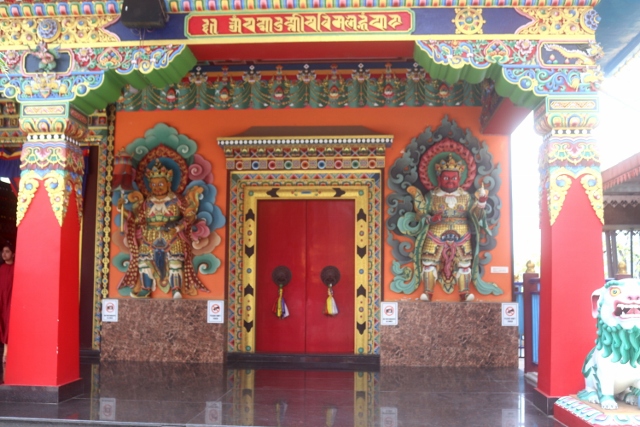
side entrance of the main temple of the Enchey Monastery

and here, too, colourful windows

and this is yet another temple at the same monastery
And afterwards a pleasant half-an-hour walk down, back to our hotel. Where we enjoy the terrace, even though the views remain obscured. Reflecting on Sikkim, or at least on the Gangtok area, we do note some differences with the NE India states we have been to earlier this trip. Sikkim is clean, it has been successful in managing trash, and in convincing people to do the same. Amazingly, no small plastic bottles are allowed in the state, we can only get two litre bottles or bigger. That said, the area around Gangtok lacks the charm of NE India. There are no villages with farm houses, the buildings are mostly three-to-four stories, or higher, and new. And where in the NE almost everybody was friendly, welcoming and curious, here we find the people indifferent, businesslike, but not very forthcoming, not the chatty type. This could be a function of the further developed levels of tourism, of course – although the people in Darjeeling, also touristic, didn’t maintain the same distance. Or maybe the friendliness and welcoming attitude is just not in the people here. Maybe they lack the characteristics that come from a tribal background.
The NE India states are called the Seven Sisters. Sikkim is sometimes called the eighth Sister. The stepsister.
next: Kolkata

one morning the high peaks are trying to get through the clouds

and there they are, finally, the snowy mountain range

culminating in the 8586 m high Kangchenjunga, third-highest mountain in the world
