
corrugated iron is king, in the villages around Mokokchung, like this chimney in Longkhum
The centre of Mokokchung is rather underwhelming, a few streets with shops, the occasional restaurants, and a church or two – this is Baptist territory, no competition. There is the meat market, the football stadium, and even a real piece of modern art, a sculpture made of used car parts. And it has the Whispering Winds hotel, by far the best accommodation we have experienced so far on this trip. Incredibly nice, friendly, professional staff, on the ball. We have had friendly staff before, but mostly to tell us that one or another service was, unfortunately, temporarily unavailable. In Kohima they ran out of coffee, bread for toast, and fruit after the first day breakfast. Sorry. Luckily, we have learned to carry our own powder coffee.

the centre of Mokokchung

with all kind of characters hanging around there
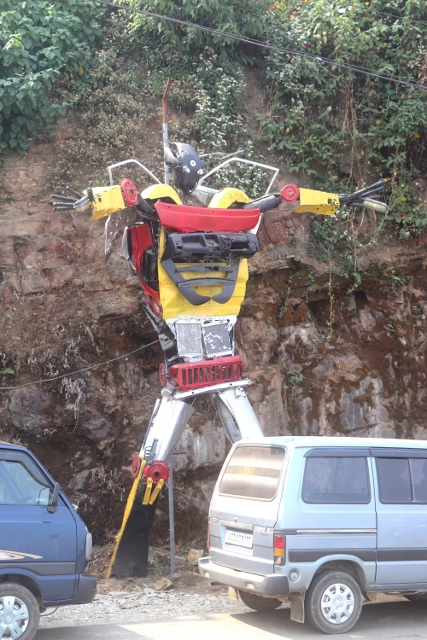
a real work of art, from used car parts, at the outskirts of Mokokchung

and the meat market, unmissable

where meat and flies are available in almost equal quantities

walking the town is an effort, with only slopes and stairs
Mokokchung is much larger than its centre, of course, and much of the town is, like Kohima, spread out over the surrounding hill-sides. Walking from one neighbourhood to the next is an exercise, something I found out when I decided to walk from the centre to our hotel. But the reason to come here is not the town, but – as so often in Nagaland – the villages around it.

watch tower in one of the villages, obviously post-dating the headhunting risks

several storage huts at the edge of Longkhum

and this is the morung, a rather recent structure, once again corrugated iron

although the roof has some characteristic elements
The villages
There is a certain order to the villages, which in the Mokokchung area are all from the Ao tribe. Firstly, they are always built on a hill, understandable, if you consider the head hunting past of the Naga tribes. From a hill it is easier defending yourself, and you can see your enemy approaching. Perhaps this is also the reason that every village has at least one watch tower – although most of the towers we see now are from the post-head hunting era; head hunting gradually decreased with the influence of Christianity in the region during the 20th C, and was officially banned by the Indian government in 1962. Often, next to the watch tower is an enormous, hollowed tree, that serves as a drum, to sound the alarm, or announce other issues. Although that role has perhaps nowadays been taken over by the church, also prominently present in every village.

the monument to P.Shilo Ao, the first chief minister of Nagaland, in Longkhum

one of the locals of Longkhum, going around his business
Longkhum
The first of the villages in Longkhum, the highest of the Ao villages at almost 1850 m, some 500 m higher than nearby Mokokchung. It is an important village in Ao beliefs, known as the vanguard village as well as the resting place of the spirits of the dead on their way to paradise. More recently, the village honoured P.Shilo Ao, the first chief minister of Nagaland, when the state was established as formal part of India in the 1960s. Next to the monument is the watch tower, and a little further the morung, once the meeting place for young men, now a general place for all villagers, including women.
This is as much traditional architecture as we get; the houses in the village are of the bamboo and corrugated iron type, and some are made of wood or concrete. When I suggest that this may be an indication of wealth, our guide is adamant that it is just the preference of the owner, some like the bamboo walls more, others the concrete structures. Especially the wooden and concrete houses are often brightly coloured. What all houses have in common, is that they are neatly kept, and invariably with flowers on the porch or in front of the house.

view of the village Longkhum

and another one: nice place all together

not every street is flat

colourful houses
Most working-age people are out, working in the fields, but some of the older people remain in the village. We are invited in for tea by Atula, 82, who as soon as we sit down puts her husband, Alemwati, 86, to work. She has born five children, he has retired from the Indian army, and proudly tells us that he has fought four wars – he was there when India fought China in 1962, for example. He insists that we accept a present, in the form of a basket he has woven himself; in fact, we must take three baskets, each of them beautifully crafted. He then shows us his collection of headdresses, his spear and machete, and his bamboo shield, all essential Naga attributes, of which he is clearly very proud. Incredibly hospitable people, and incredibly generous; saying no is not an option.

and inside a fascinating collection of kitchen utensils

as well as baskets, all self-made by now 86 year old Alemwati

82 year old Atula invited us in for tea

this is a now defunct tourist lodge in the village, originally built in 2006

and one of its windows

not everybody is old, in Longkhum

one of the wooden houses, and the customary flowers, in Ungma, the biggest of the villages around Mokokchung

and more colourfully painted houses

with a little space in between

and one of which is the local taxi service

and one of the residents of Ungma, happy to be photographed

the image of hornbills, sacred birds, on the local morung

which also has a brightly painted door
Ungma
On the way back we pass by Ungma, one of the largest Ao villages with over 7000 people, and actually so close to Mokokchung that it is now part of the Mokokchung agglomeration. This is obviously a more advance village, larger houses, and less corrugated iron. Yet, here too, it is remarkably clean, and remarkably flowery.
The standard highlights are another morung, with traditional patterns, and the alarm drum, once again a huge tree trunk, with its head beautifully decorated. Another highlight is, once again, a cup of tea, this time in the house of one of our guide’s relatives. Thankfully, we avoid any presents, this time.
next: more of the Ao villages

and a fabulous drum, inside
