
Kohima, the capital of Nagaland, is built across several hills
As soon as we leave the plains of Assam and enter the mountains to the south, we know we are in Nagaland. We are supposed to show our permits again – for Nagaland we need an Inner Line Permit, an ILP, much easier to obtain that the PAP for Arunachal Pradesh. But there is no police or border post, no great big book to write our data in, and we enter, undetected!

the museum of Mr Banarjee, full of artefacts

of which this headdress is the most eye-catching
Even before entering, we had already been confronted with Naga culture. In a small place called Golagarh my ever-alert travel companion had found a small museum, dedicated to the memory of Mr Banarjee, which contained about everything Mr Banarjee had ever collected. And that was a lot, our house is child’s play compared to his. The centre piece is a large Naga headdress, complete with several head-hunted skulls. Nagas were head-hunters, until not so long ago.
Kohima
Kohima, Nagaland’s capital, is a sprawling city as we haven’t seen in a while, its half-a-million inhabitants spread out over several hill sides. Despite the many winding, up- and downhill streets, fairly narrow in many places, traffic runs surprisingly smoothly. Helped by a ban on trucks during daytime hours, and by an army of mostly fierce, female police women who create some order in the chaos. From our hotel we have a good view of town; almost every neighbourhood is dominated by an enormous church, and there are not a few. Whether this should be the priority in Nagaland, which is not one of the richest states in India, is debatable, of course.

a long line of trucks outside Kohima, waiting for the night, to enter the city

one of the many police women managing the traffic

another view of Kohima, sprawling
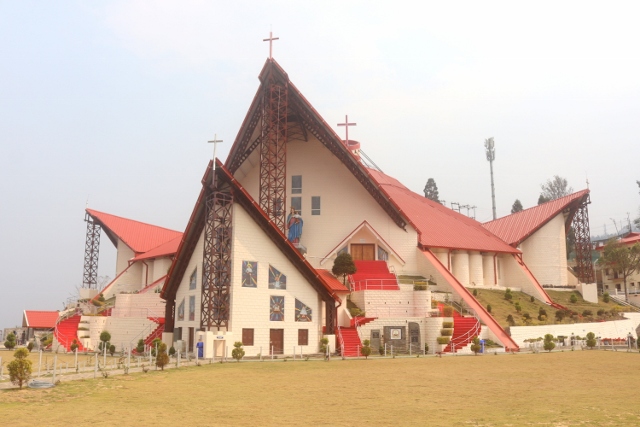
the cathedral, a not unattractive modern construction financed by Japan
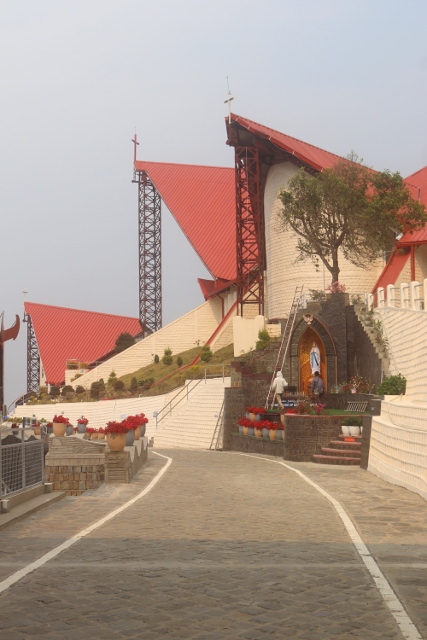
this is the entrance

and this the bell tower
The Cathedral
For the next few days we have been assigned a guide, again, part of the package. And he takes us to the most extravagant of all churches in Kohima, the Catholic cathedral consecrated in 1991. It is a monstrous building, yet, there is a certain quality and originality in the design. The façade, for instance, resembles that of traditional Naga houses. Interestingly, it was funded by Japan as a monument to the Japanese soldiers who died in the Battle of Kohima during the Second World War.
The battle, by some authors named the Stalingrad of the east, was a turning point in the war, when Japanese troops invading India were beaten back by British forces between April and June 1944; one of those battles we know little about, but had a major impact on the outcome of the war.
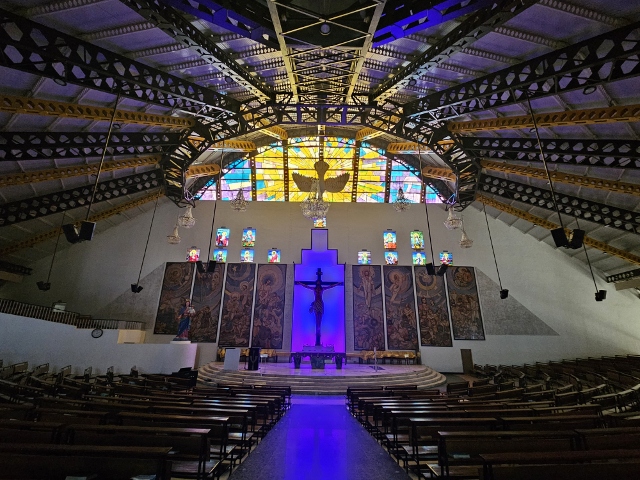
and an impessive inside
The Cemetery

graves at the Kohima war cemetery

and the main monument at the end
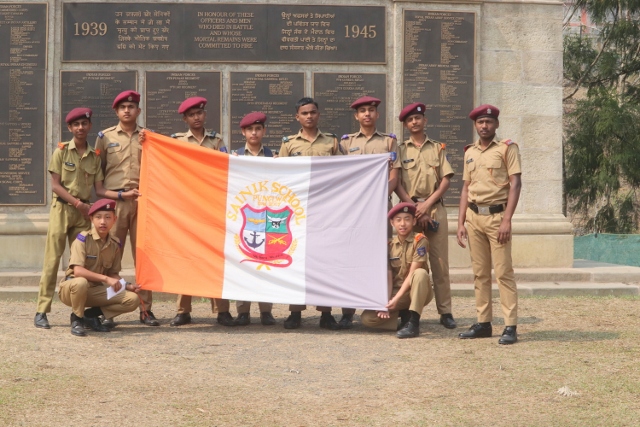
in this instance with proud military cadets and their flag
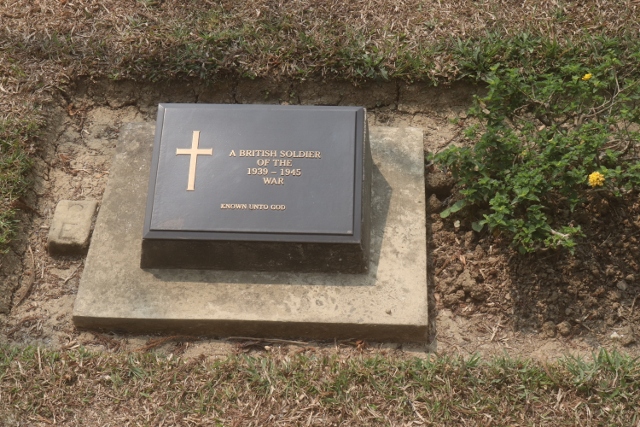
there are far too many of those….

gardeners of the Commonwealth War Graves Commission are meticulously maintaining the grounds
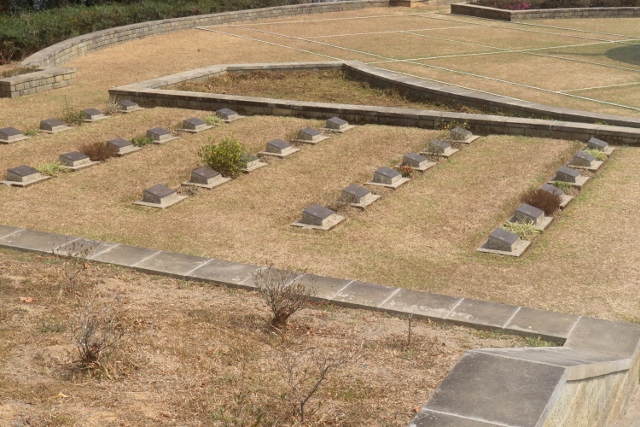
another view of the cemetery, and part of the original tennis court that belonged to the villa of the Deputy Commissioner, where one of the main battles was fought
The main tourist attraction is the cemetery of the same war, same battle, but with victims of the allied forces: British troops, including many Indian soldiers and Gurkhas, and a few Australians and Canadians. There are 1420 troops buried here, plus an additional 917 Hindu and Sikh soldiers, who were cremated in accordance with their faith. The cemetery, located on what was called Garrison Hill with the residence of the then Deputy Commissioner, is meticulously maintained by the Commonwealth War Graves Commission.

metal sculptures at the national museum in Kohima

one of the smoking pipes in the collection

and fairly crudely carved amulet masks

a wooden sculpture wearing one of those amulets

and a more elaborate decoration, once again with heads
The Museum
After the cemetery there is the museum, not entirely uninteresting, with lots of Naga artefacts, the type of things we like. There are traditional dresses, head gear, weapons – mostly spears and bows and arrows, wooden sculptures, masks. The wood carvings, as in masks and sculptures are a bit basic, but especially the dresses and headgear are elaborate, and beautiful.
Every guide takes you to the main souvenir shop, and so does ours. Where none of the type of artefacts we saw in the museum are for sale, but lots of other, rather uninteresting things are. And that is it, for Kohima. There is really nothing else of interest in this city.

the neatly organised vegetable market

with one of the curious sellers

goods in small packages, wrapped in plastic

and more plastic bags, rather unusual in most markets
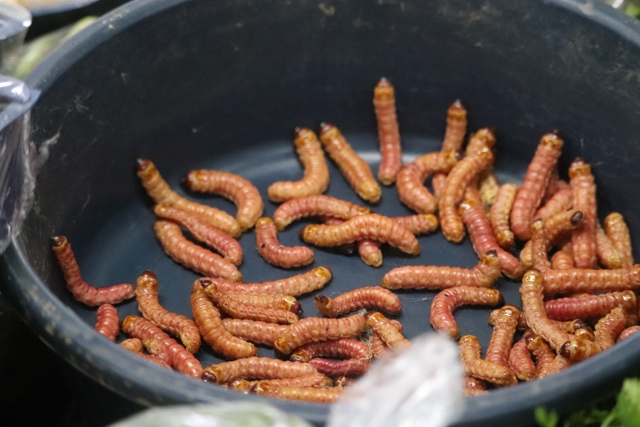
local delicacy

and another one

mice, too, are happily sold to the customers
The Market
Of course there is the market, always good for an half-an-hour’s stroll. I have shown you many markets already, during this trip, but the one in Kohima is a little different. Firstly, the market sellers don’t present their produce in large heaps, as so often, but in neatly prepared packages, presumably of more or less equal weight, fixed price. And that really looks different from the usual markets, more organised. Still, lots of things I have no clue what they are, but the women – mostly women – take their time to try to explain.
The other difference is that these people sell everything imaginable alive. Sure, chicken and meat, and fish we recognise. The silk worms we have seen before. But here we have other types of worms, too, and snails, and frogs. Alive. And in small cages, there are ‘jungle rats’, and there are mice. A delicacy, they ensure me. We don’t see the dogs, but they, too, are common fare (which I find on a menu, the next day). But again, the most striking thing is the friendliness of the people, the relaxed atmosphere. Hard to beat. A few more photo’s here.

street food outside the market

all looking very appetising

in between the various choices, dog meat and rice

taxi stand at the city centre, with typical traditional village gate
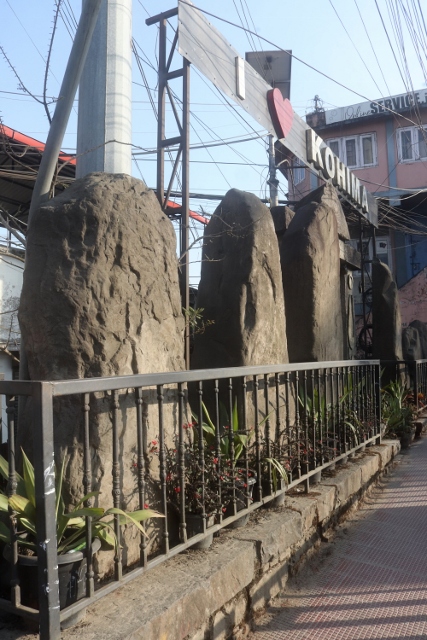
in the centre, three monoliths, similar to the ones we would encounter later in many of the surrounding Angami villages – note the ‘I love Kohima’, too

the main commercial district

with mostly four-story buildings

vegetables being sold on the street on a Saturday afternoon

this time not in prepacked plastic bags

the chillies, too, can be bought in various quantities

this lady specializes in long beans

and this one in smiling
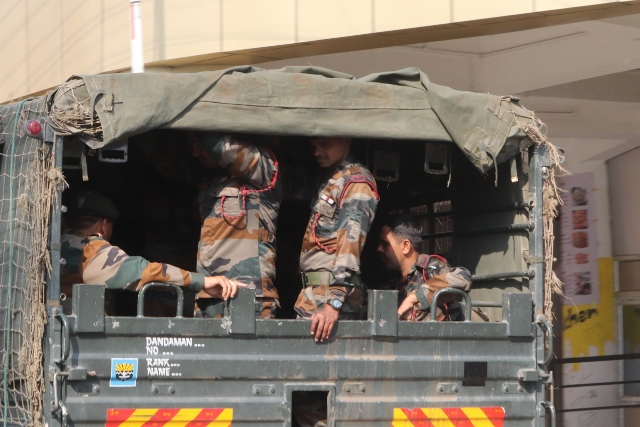
truck full of army personnel driving through town

and some army vehicles are even more threatening
The City Centre
On the last afternoon, when we get early to our hotel, I check out the city centre, the main commercial area – we finally have a hotel walking distance from the centre. No high-rise here, four or five stories is enough, but mostly less. It is Saturday afternoon, the pavement is full of sellers. Predominantly food, and I recognise lots of things they also sold in the market. I walk around, take my photos, nobody minds. Here I feel more of a language barrier than in the market, but still, we manage to have a good laugh, over nothing, really, but it is just nice to wander around, feeling welcome. And so far, not a tourist in sight.
That relaxed atmosphere somehow completely contrasts with the heavy military presence in town. Men in military fatigue, heavily armed, are guarding I don’t know what. Military pick-ups, full of heavily armed soldiers, are cruising the centre. And lots of military trucks, also full of soldiers, drive from one end of town to the other, and back, it seems. And that while I thought that Nagaland independence – 20 years ago the reason it was so difficult to get a permit for tourist visits here – was not seriously on the cards anymore.
next: several villages around Kohima
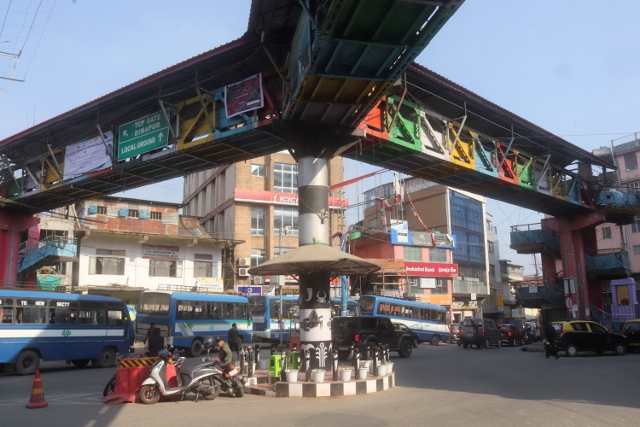
pedestrial overpasses in the centre of town – which are not being used a lot, to be honest
