
a little corrugated iron hut, with traditional symbols on the roof, in the centre of Pfutsero
Pfutsero
We reach as far as Pfutsero, a town some 80 km from Kohima, and allegedly the highest and the coldest town in Nagaland, at some 2100 m (I presume there are villages higher than that). Which is a bit of a disappointment, because you come to Pfutsero because of the expansive views over the valley and the mountains, which were virtually invisible because of the haze. Our guide insists that we must go to Peak of Hope, after having been to Peak of Glory, but after the glory we give up, no hope for better visibility. As there is little else to do in Pfutsero, we head back.
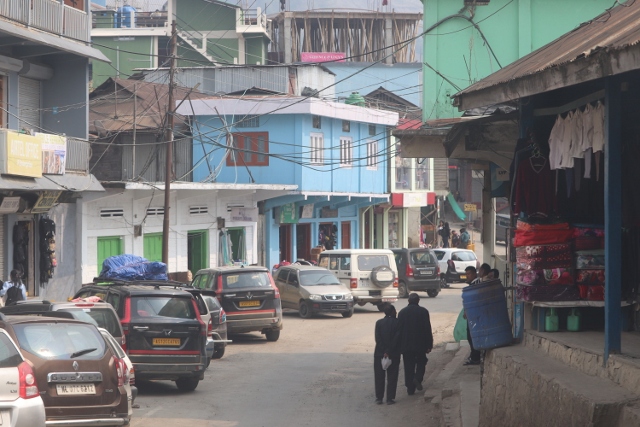
Pfutsero main street

view of Pfutsero, from the nearby Peak of Glory
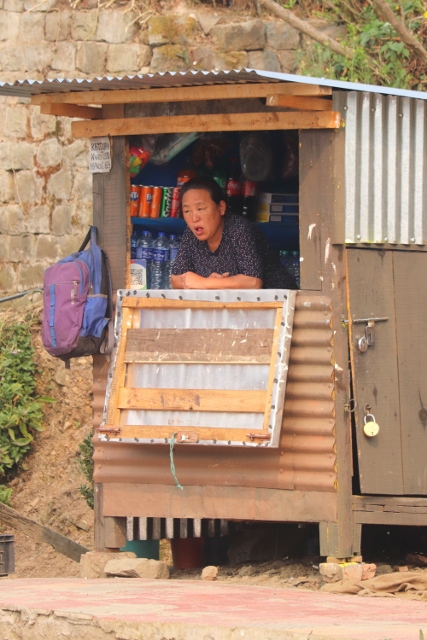
everywhere in the NE you find these small shops

a shop in Pfutsero

also selling long beans

one of the local inhabitants

and another one, woolen hat against the cold
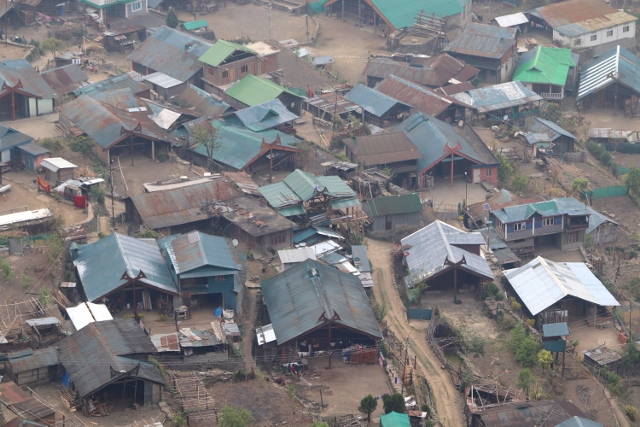
looking out over Zabami village, not too far from Pfutsero

outside the village, the same rice paddies and terraces as elsewhere in Nagaland

with quite a few basic-decorated traditional houses
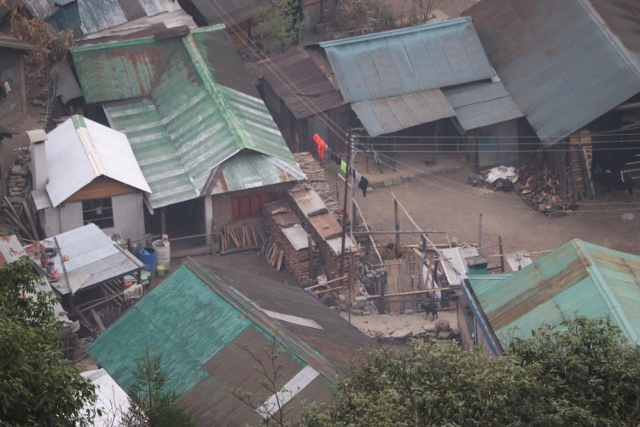
and a tiny bit of colour thanks to the laundry
Zabami and Leshemi
We stop at a few more villages. We don’t get in, but we look from above at Zabami village, dominated by green corrugated iron roofs, and almost no modern houses. It looks pretty poor, here, even though they seem to cultivate the same rice on terraces as elsewhere.
Seeing the poverty, or at least the humbleness of the villages we come across, the ostentatious presence of Christian churches starts to irritate me more and more. The Peak of Glory was already adorned with psalm quotes, but in Pfutsero, as in many of the villages, we come across huge churches. Not different from Kohima, mostly Catholic, Baptist, or Pentecost – some 98% of the population is Christian in Nagaland, any trace of indigenous religious belief has been professionally wiped out.

a random church in the area, huge, and totally out of proportion compared to the villages
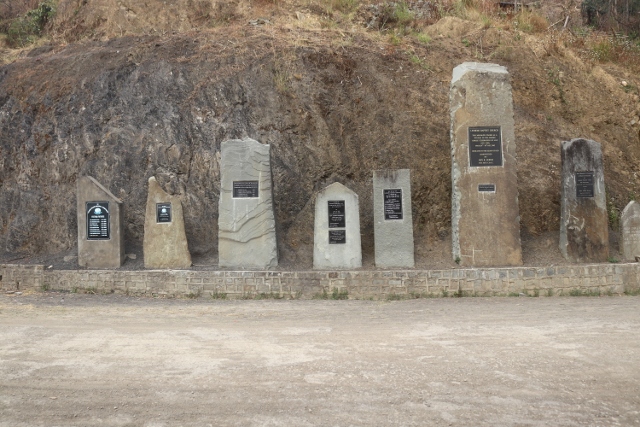
traditional monoliths transformed for the benefit of the church

Leshemi village, not different from other villages here, corrugated iron dominating
A good example is Leshemi village, another village dominated by corrugated iron. Except for the large blue and white church, that towers over the village. Opposite the church are a series of traditional monoliths, originally erected to honour the deaths in a tribal context, but now incorporated in the Chistian burial concept, in a convenient merge of traditional and church customs. (Remember we saw some in downtown Kohima, as well.)

outside the village, a herd of buffalo using the main road

and it is the season of the fabulous banana flowers

as well as lots of blossoming trees

and the occasional bright red leave standing out

the people of Viswema, ready to leave after a day’s hard work

but then, also very enthusiastic about the photo opportunity
The Working Women
The highlight of the day comes near Viswema village, where we pass, at the end of the day, a large group of mostly women at the side of the road. We stop, and ask if they would object to some photos. They enthusiastically jump up, yet saying ‘no, no. no’. I am a bit put off, until I understand that they want me to wait. They get their traditional wraps, with which they work, out of their bags to put on, before I am supposed to take the photos! And they put their baskets on their backs again, to make it look real! Then they put a wrap around my travel companion’s waist, as well, and a basket on her back, the string around her head. And they are having lots of fun over it, and so do we. In the end they all pose as a group, even sing a traditional song for us, and exchange telephone numbers, so we can send them the pictures later. It turns out they had just finished work – collecting wood for the church, never mind – and were waiting to be picked up by the bus. But were perfectly happy to pull out all the attire again, for us.

all of them dressed up again, with wrapping cloth and basket

and posing for the camera after having sung a traditional song

it is all about fun

and so thinks my dressed up travel companion

and another one of the women
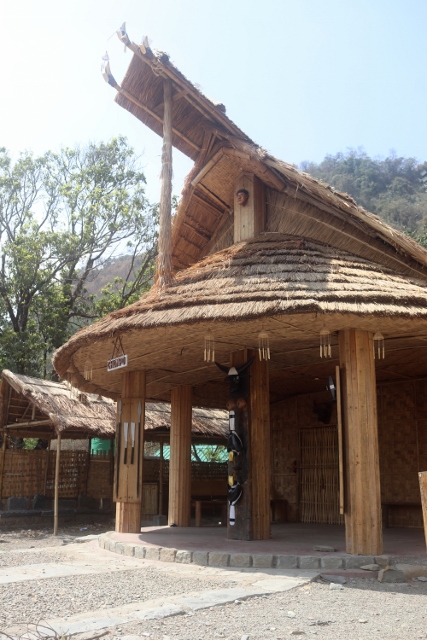
one of the pavilions in Kisama heritage village

the front carved with traditional motifs, like hornbills, mithuns and the ever-present heads

another of the buildings, more straightforward
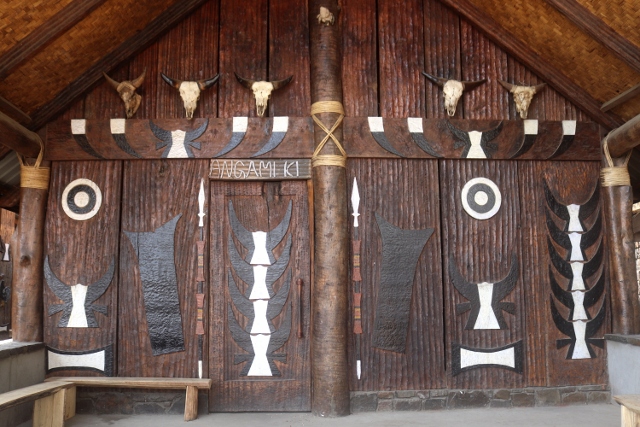
and another pavilion front

and look, the Kuki tribe’s pavilion – even though we haven’t seen any Kukis yet
Kisama village
As spontaneous and unplanned our encounter with the Viswema women was, so predictable and utterly touristic is the visit to Kisama heritage village – back on the official program again. The Naga culture is celebrated each year, in December, with the Hornbill festival, when the 16 or 17 tribes of the state send a delegation to Kisama, with handicrafts for sale, traditional dancing and singing, and lots of spectators. How authentic this all is, I don’t know, they have just had the 25th festival, so it is not that old, but of course, it is a great way to keep the Naga culture alive. Yet, outside the Hornbill festival, there is little to do in the village. There are no people living here, there are just a number of pavilions – called morungs -, newly constructed in traditional style, with traditional decoration, for each of the participating tribes. And guess what? The first we identify is the Kuki In, the morung for the Kuki tribe! But for the rest this is not a very interesting place; workers are busy upgrading the stadium, but the toilets are closed, and so is the foreign exchange bureau – in indication of what to expect in December.

the stadium is being upgraded for the forthcoming Hornbill festival, in December
The last village, Khonoma, we actually never entered. Here, tourism has developed somewhat further, and you need to register, and pay for your entry village tickets, as well as for your compulsory guide. The fact that we already have a guide is irrelevant. And when I suggest that this is robbery, it is interpreted as so offensive, that it meant the premature end of our visit. We leave again, and we will never know whether we missed something precious, apart from the souvenir shops with which the fixed walking route through the village starts. I know, I know, I should learn to keep my big mouth shut, so once in a while. I am just not made for overly touristic places.
next: to Mokokchung

and another surprise, a sculpture bt Sushank Kumar, financed by my former employer in this country, Plan India (or should I say, my creation)
