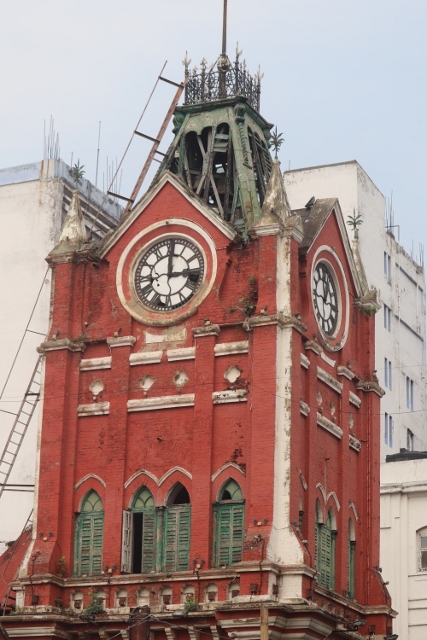
clock tower in the centre of Calcutta, or Kolkata, as it is called nowadays
Somehow I always had the impression that Kolkata – or Calcutta, as it used to be called – is the most chaotic Indian city of all. The old centre of Delhi was busy, when we lived there 20 years ago, and Mumbai, I recall, was a nightmare negotiating. And on this trip we experienced Guwahati, a traffic mess because of its many construction projects. But I was convinced that all of this would pale into insignificance by what we would encounter in Calcutta.

outside the railway station, the ubiquitous yellow Ambassador taxis lined up

one of the central junctions in the city, not the whole day packed with traffic – as I had expected
It didn’t. When we arrived in the morning at Sealdah, one of the main railway stations of the city, we were not sucked into a never-ending stream of passengers from different trains coalescing into a massive rush of people. Outside the station we picked up a taxi, which managed to reach our hotel quite comfortably, without having gotten stuck in traffic. On the contrary, it was actually remarkably quiet on the streets, also the ones near our hotel, which is located in the centre of town.
When we lived in India 20 years ago, we had been almost everywhere, but never to Calcutta, the capital of the Indian state of West Bengal. So it seemed a fitting end of our current trip, which otherwise also wrapped up some loose ends. And which, you remember, began two months ago in Bangladesh, once called East Bengal, and part of the same – colonial – administration in the past.

the general post office, a monumental colonial relict

entrance to the post boxes section
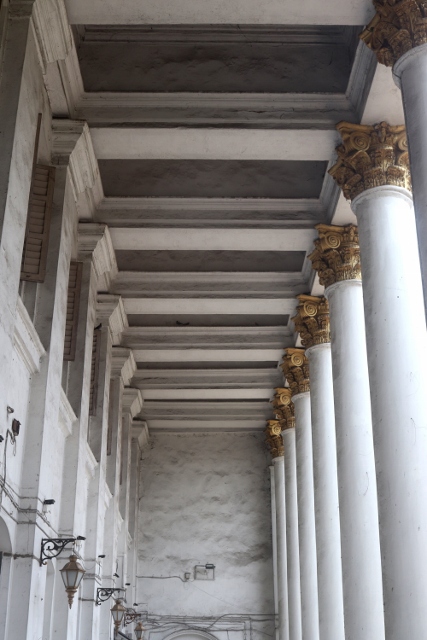
and imposing the gallery outside

the post office also has its clock

Saint Andrew’s church, if you wouldn’t know better just another Wren church in the centre of London
And Calcutta was the centre of that colonial past, that is obvious from wherever you look. On our first day we wander around the business district, where the former offices of the main British banks were. But the Britishers left much more behind, of course. The Town Hall, the High Court, the General Post Office, one by one extravagant buildings to impose the idea of power, I suspect. It is those buildings that are still being used, by the Indian authorities, and they seem to have been maintained relatively well. One fabulous example is the Writer’s Building, originally designed in 1777 to house the ‘writers’, or junior clerks, of the East India Company, but later turned into the headquarters thereof, and then into the centre of the entire British Raj in the subcontinent. At the moment the building, now used by the state government of West Bengal, is being renovated.

the iconic Writer’s Building, initially for the colonial clercks, later the headoffice of the East India Company, and now used by the state government of West Bengal
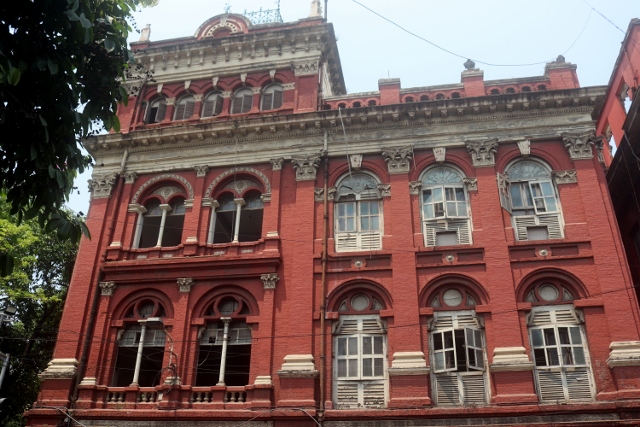
close up of the huge, brick-built Writer’s Building

and a few of the corner offices of the same
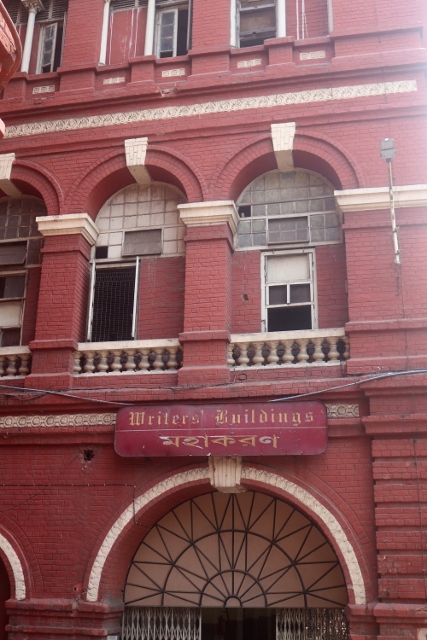
the name still being used, despite its evolvement

many of the buildings, used by government departments, are being protected by lots of police

some of the old buildings are literally overgrown

yet, others have beautiful architectural details

Nani Chambers, another one of those monumental remnants
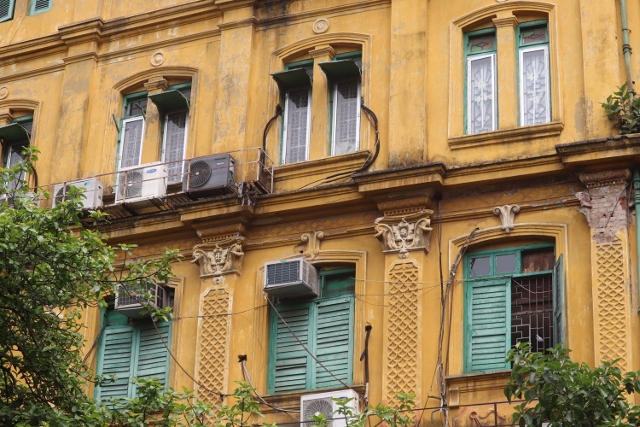
series of windows on another building, with detailed decorated columns

not every building, not every window is in top condition
Many of the buildings have been designated a Heritage Monument, although they do not all necessarily seem that protected. So many of the lesser buildings, also from the colonial era, are almost falling apart, and it is such a pity. They have beautiful details, in their decorations, the columns, the balconies and the windows. Yet, more often than not trees are growing out of the walls, or from the roofs, roots draping the structure. Which is slowly being undermined, of course, to the extent that many of these buildings are already mostly empty. Come back in ten, twenty years, and they will all have collapsed, or, hopefully, taken down before they cause casualties. Photogenic they are, though, for the time being. more photos

but they are impressive, these huge windows

even though some of the construction needs maintenance
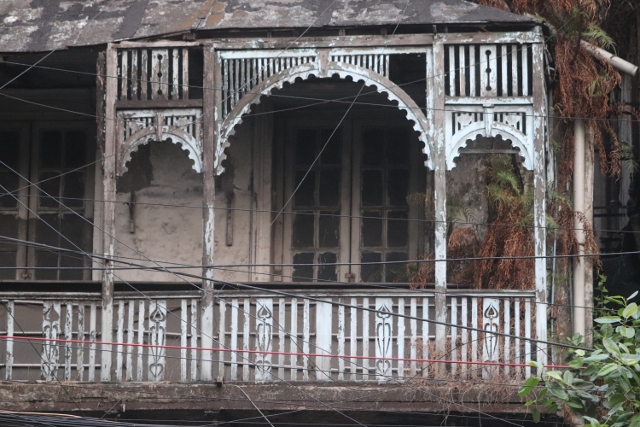
another fabulous, almost collapsing colonial balcony
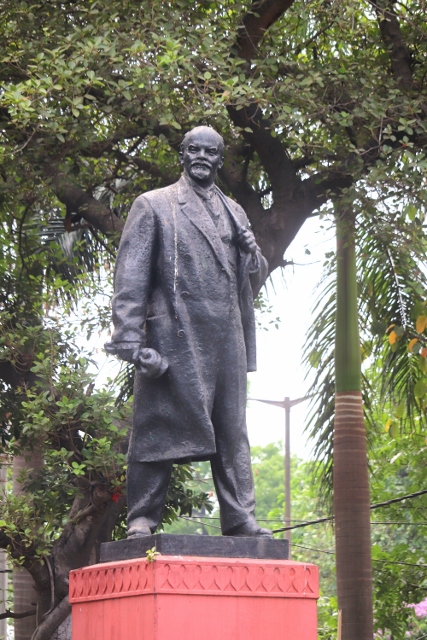
West Bengal has been governed by the communist party for a long time

which is probably why we find Lenin and Ho Chi Min still honoured here
In the centre of town is this large, green open space, called the Maidan. It has been compared to Central Park in New York, or Hyde Park in London, but the reality is that is has not been maintained that well. Perhaps during the weekend it is busy, with people picnicking, and playing sports. There is a football field, and there is space for cricket, including score boards. But on a Friday morning there are only a few die-hard cricketers training, hoping to reach the privileged few who reach stardom in India, and the world. Several clubs, having been established a hundred years ago or more, have their private, members-only enclosures, but these, too, are empty now.

Shaheed Minar, a monument at the beginning of the Maidan

the Maidan itself, or part thereof, the large open space in the city centre

cricket is the most popular pasttime for which the Maidan is used

where individual organisations have their private areas, for the staff, or perhaps for entertaining

the press club, too, has its private tent along the Maidan

somebody decided to provide some colourful paint to the trees in the Maidan

the approach to the Victoria Memorial

the building at the memorial, another impressive, power-oozing structure

with lots of pillars and arches, and flowering plants

and last but not least, the enormous statue of Victoria herself
At the far end of the Maidan is the Victoria Memorial, perhaps the most defining of colonial heritage buildings. It was built between 1906 and 1921, so five to twenty years after Victoria, Empress of India amongst other titles, died. It is a huge marble building, housing a museum – which we skipped -, located inside extensive gardens, and apparently the largest monument to a monarch anywhere in the world. What can I say? Opulence, extravagance, outdoing all the excessive other colonial structures in town. But in its pompousness not very attractive, I think.
Saint Paul’s cathedral, nearby, is then a comparatively humble building, fairly large, but not as imposing as so many other churches. It was built in 1847, the first Anglican cathedral in Asia, to replace Saint John’s church, which had become too small for the large, and growing, British community in Calcutta. The present structure has twice been rebuilt, after the 1897 and 1934 earth quakes.
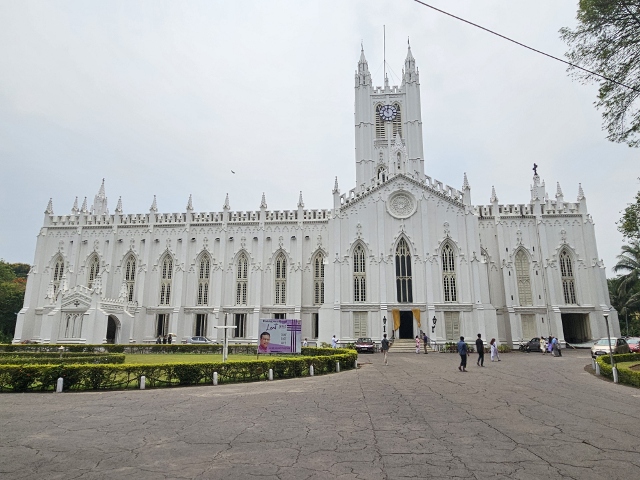
Saint Paul’s cathedral, relatively humble compared to some of the other colonial architecture

inside, too, it is not such an extravagant affair as some other churches

the entrance to South Park Street Cemetery

and just to make sure, the things you are not supposed to do here!

wide alleys, lined with tombs
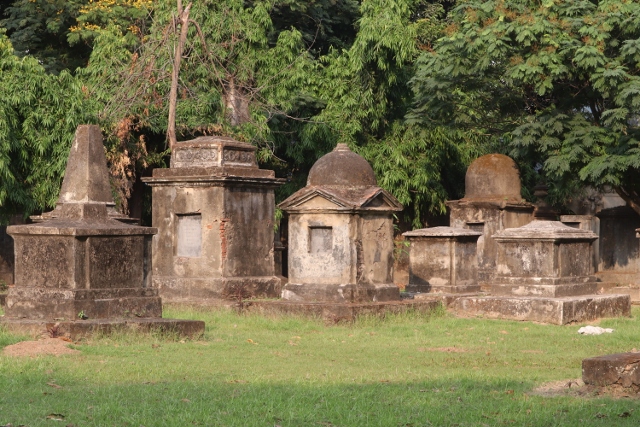
many of them quite large, not necessarily beautiful

and the occasional pillar, with an urn on the top
Perhaps the most poignant remnant of colonial Britain is its cemetery, the South Park Street cemetery. It was built in 1767 as one of the first non-church-linked cemeteries, meant to cater for British soldiers, administrators and their families. Burials continued here into the 1830s, after which the cemetery was extended to North Park Street – which was later demolished. Two things are evident in South Park Street. In those days the tombs and mausoleums were in line with the extravagance of the buildings of the colonial British – many of them are enormous, and richly decorated. Secondly, people didn’t get very old back then, not many passed the fifty; and lots of plaques are for children, some of them not even one year old, who didn’t survive the no doubt harsh conditions – no matter their privileged status.
next: more Kolkata (2)

some tombs are more expressive, in the open

and sadly, many are for children
