
one of the smaller carvings at Unakoti, a Hindu rock carving site outside Kumargath
You have these days that everything works out just fine, very smoothly. We had been looking for hotels in Kumarghat earlier, but nothing came up on the regular booking sites. Via Google and Facebook – how could we ever have travelled without these, before? – we managed to get a phone number of a reasonably rated hotel, which we called to reserve a room. The response didn’t inspire a lot of confidence, but we booked anyhow. Perhaps the gentleman would want to know my name? Ahh, ok, tell me. My first name was enough. And transport to Unakoti, the site we wanted to visit? Ahh, we sort out when you get here. And how much is all this going to cost? Ah very little, Sir, very little.

a fishing net in the river that flows through Kumargath
When we arrived at the railway station of Kumarghat, we were immediately approached by a young man, who offered to bring us to Unakoti, the main tourist attraction in this area. Why not, his price seemed reasonable, and he would drop us at the hotel on the way back. But we passed the hotel, anyhow, so we briefly stopped, met our host, who remembered us – not my name -, and suddenly sounded very competent, expecting us in the evening. All set, then!

the first rock carving in Unakoti
Unakoti

and there are more, like this large head

and another head, with big ears
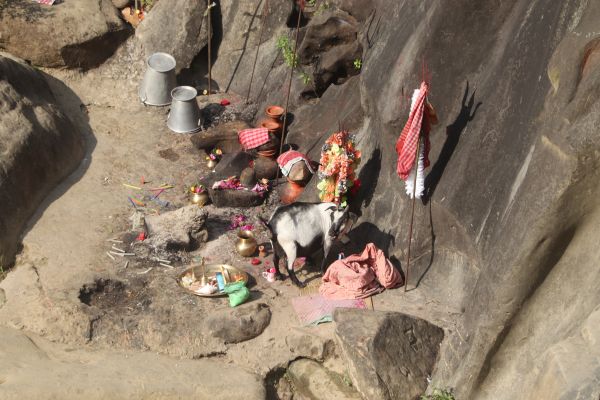
the goats are consuming the offerings

and the elephant God, Ganesha

and more Hindu figurines – I don’t know enough about it

animals are also represented
We have seen rock carvings before, even very recently – along the Gomati river in Amarpur -, but nothing has prepared us for the ones in Unakoti. I had seen a few pictures of some of them, but in fact there are many more, a whole sandstone wall full of giant faces, strange animals and geometric decorations. Apparently, they stem from the 7th to 9th C AD. Some blocks, also carved, have fallen off, others have been damaged, scratched over, by vandals. Some loose pieces have been collected and are being kept in a shed, closed, but visible through grills – some have suffered badly from erosion.
But the main thing is the rock wall, in which the large faces and animals have been carved. The main image is Lord Shiva, who, according to legend, spent the night here. But there are so many more, and every time you look again, you discover another. They are aesthetically pleasing to the eye, and at the same time, obviously, an important symbol for Hindus, who come to pray, and make offerings – which are subsequently eaten by the free roaming goats, but never mind.
The drawback? It is quite a descend to the main offering site, from which you have the best and most detailed views. And it is even further down to another, separate section, dedicated to Ganesh, the elephant deity. Which means that you have to steeply climb up again later. But it was definitely worth the effort. An absolutely unique site.

another of the carvings, several in one, actually

this head is almost a caricature

the non-descript centre of Kumarghat
When we got back to our hotel, all turned out less perfect than earlier anticipated. The hotel was the pits, dirty, no hot water, no nothing really. A cup of milk-tea, and stale bread and boiled eggs for breakfast. Anyhow, we managed the night, and we enjoyed the town of Kumarghat, where, other than a market, was very little to do. Except taking the train again, on to Silchar, in Assam.

colourful fish market
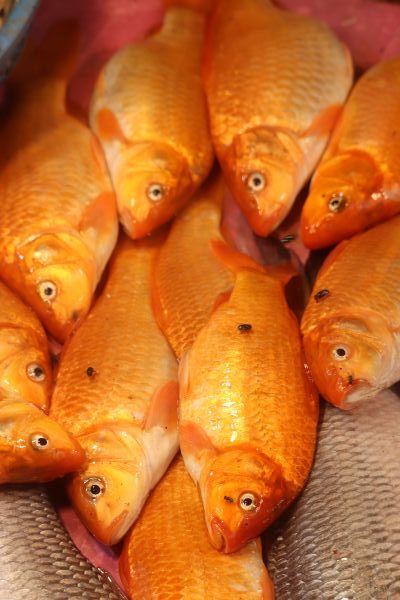
and again, colourful fish market

pumpkins in the street

and a mountain of cauliflower

and they also make something, here, baskets
