
Ayacucho is not only a lovely colonial town, with some ancient ruins and spectacular cacti nearby, but also a renown carnival site, at the right time of the year.
The ‘enchanting’ part of Ayacucho, to be sure, is limited to the Plaza de Armas and the three or four blocks around it. The rest of town is the usual chaotic urban sprawl, with potholed roads, unfinished buildings and dirt everywhere. Not unlike Ica, Nasca, Camana, other towns we have been to so far in Peru.

But the old colonial part is very nice indeed, most of the old houses have been well maintained, many have attractive courtyards, which have been turned into restaurants, or shopping areas. Around the Plaza is the cathedral, and many of the 33 churches of the city – one for each year of the life of Jesus Christ. You can only visit so many churches, of course, all do look somewhat the same after a while, also inside, where the altar pieces are incredibly baroque, incredibly detailed carved frames with a range of saints inside. In some of the streets large mansions embody the colonial architecture, but nowhere more so than around the Plaza, where the houses have a covered arcade, and balconies. They, too, have been turned into restaurants. The streets are narrow, pavements even narrower, and with the way the Peruvians drive, pretty dangerous – but we are lucky once again, it is carnival, and many of the streets around the Plaza have been closed for traffic.


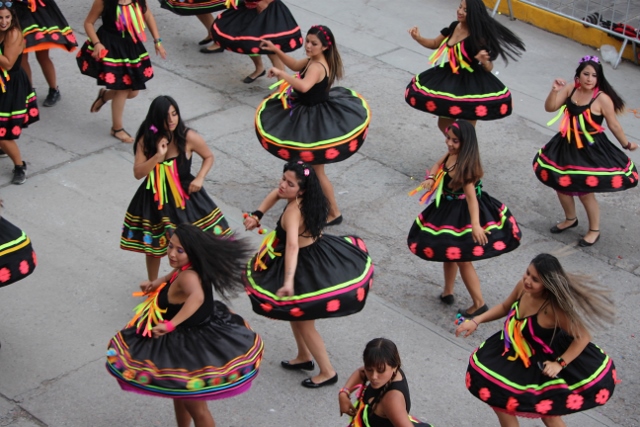
More than in other Peruvian towns we have been, we see women – mostly women – in traditional Andean dress, often complete with colourful scarves, and hat; some are bowler hats, some are top hats, dark, and sometimes white. This is, of course, multiplied many times over in the carnival groups that parade through town, around the Plaza. Where in the Arica carnival we observed quite some variety amongst the participants, the carnival in Ayacucho is more traditional: very few skimpily dressed girls, predominantly whirling ballroom dresses, and the music scarily monotonous, with drums and flutes. Rather than mingling among the spectators, which in any case is on a much smaller scale than Arica, we decide to make use of those restaurants and their fabulous balconies, and watch from above, either enjoying Pisco Sours in the process, or a sumptuous lunch.


Outside Ayacucho are ruins – excuse me, an archaeological site – of the Wari culture, the ones preceding the Inca empire in this area. Although we were not going to, after our last experience, we signed up for a tour anyhow, which wasn’t too bad after all. The archaeological site turned out to be much more impressive than I had expected, with chambers – burial chambers? – at several different levels underground, a couple of circular temples, and lots of surviving walls, composed of well-fitted stones and no mortar. How they – and the Incas after them – managed to cut these stones so perfectly, without metal tools, is still unclear.
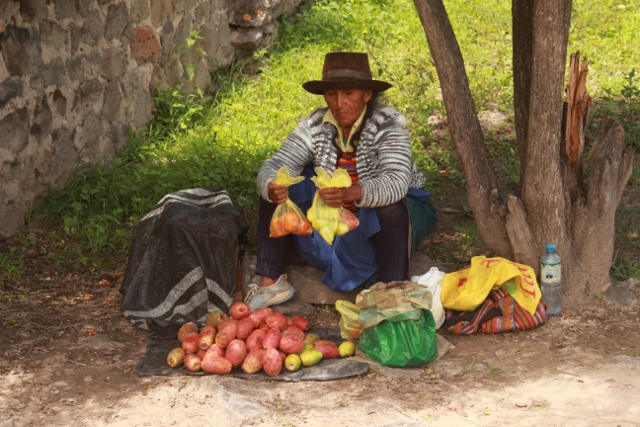
The site is attractively located, with wide sweeping views over the surrounding mountains. An additional bonus are the cacti growing all around, yielding what is locally known as ‘tuna’, yellow to red fruits that can be eaten. The fruits grow from the flowers, which are, at this time of the year, less numerous.


Of course, after the ruins we could have turned around, but the tour wasn’t finished yet. The next stop was – you guessed it – a commercial stop. Many of the houses here have a talisman on the roof, for good fortune, or for religious purposes. Many talismans are in the form of a church, or just for decoration, and they are being made of clay. So we had to visit a clay workshop. Where, incidentally, they make a lot more than just the roof talismans, but luckily, we have another several weeks of travel ahead of us, so we cannot possibly begin to acquire any of this. Better even, we manage to escape from the tour for about twenty minutes, to wander around the cobblestone village of Quinua, which turns out to be entirely dedicated to clay workshops. After a further visit, to a 19th Century battlefield where the Latin American forces decisively beat the Spaniards, we got back to Ayacucho. Where we settled on one of the balconies around the Plaza once more, with another Pisco Sour.
scroll all the way down for a short video of the carnaval, too.
next: the road to Cusco




Nice carnival after a Nice tour!!
Ah Thea, you have been catching up. Peru is indeed an adventure, more than Chile, and also a bit more varied. More to come!!